Last updated: 4 August 2026
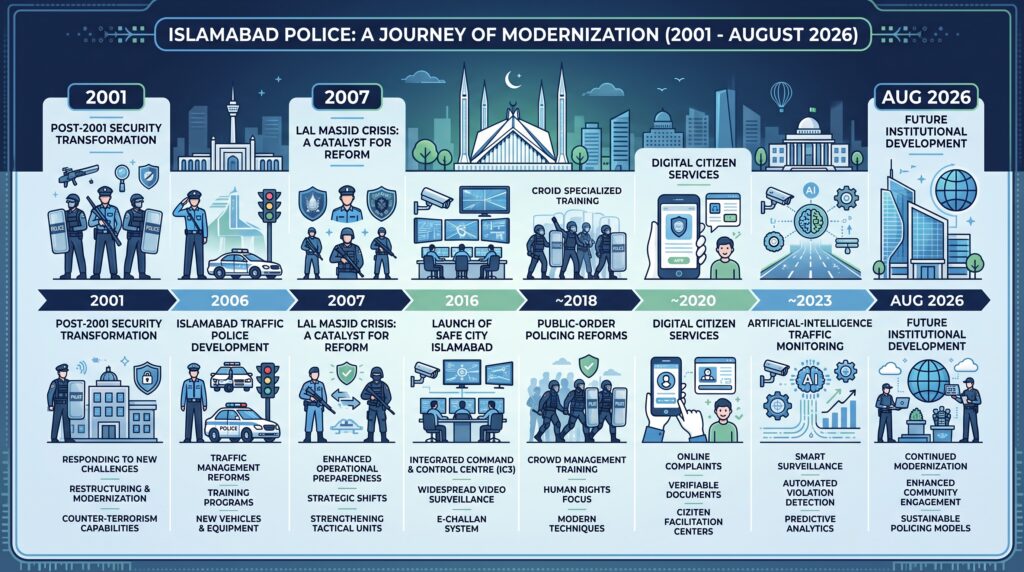
Islamabad Police has changed substantially since 2001. What was once primarily a conventional urban police force now operates as a complex capital-security organisation responsible for ordinary crime control, counterterrorism, diplomatic protection, traffic management, public-order operations, intelligence coordination and technology-based surveillance.
The official name of the organisation is Islamabad Capital Territory Police, commonly shortened to Islamabad Police or ICT Police. It was established on 1 January 1981 through Presidential Orders No. 17 and 18 of 1980. By August 2026, it reported a strength of approximately 12,625 personnel and operated through five principal divisions: Operations, Security, Law and Order, Safe City, and Headquarters and Logistics.
Its specialised formations include Islamabad Traffic Police, the Counter Terrorism Department, Special Branch, the Crime Investigation Agency, Dolphin Squad and the Anti-Riot Force. The Operations Division administers 27 police stations across five policing zones: City, Saddar, Rural, Industrial Area and Soan.
The institutional development of Islamabad Police between 2001 and August 2026 can be understood through four broad changes:
- The expansion of counterterrorism and diplomatic security after 2001
- The growing importance of political protest and public-order policing
- The transition toward Safe City surveillance and digital policing
- The expansion of online services, specialised units and centralised recruitment
Islamabad Police at a glance in August 2026
As of 4 August 2026, the official Islamabad Police leadership page identified Syed Ali Nasir Rizvi as Inspector General of Police, Islamabad.
The force’s central responsibilities include:
- Preventing and investigating crime
- Protecting federal institutions and constitutional offices
- Securing diplomatic missions and foreign delegations
- Managing traffic and road safety
- Responding to terrorist threats
- Policing demonstrations and public gatherings
- Operating Safe City surveillance and emergency systems
- Providing verification, licensing and complaint services
The official police contact system lists 15 for emergencies, 1715 for the IGP complaint service, 1815 for the Online Women Police Station and 1915 for Islamabad Traffic Police assistance.
Islamabad Police development after 2001
The attacks of 11 September 2001 and Pakistan’s subsequent involvement in international counterterrorism efforts transformed Islamabad’s security environment.
Islamabad contains Parliament, the Supreme Court, the Presidency, the Prime Minister’s Office, foreign embassies, international organisations and residences of senior officials. Its police force therefore had to assume a larger role in intelligence coordination, checkpoint management, diplomatic protection and the security of sensitive installations.
The Security Division was formally established in 2003. Its responsibilities include protecting national leaders, foreign dignitaries, diplomatic missions, judicial institutions, important government buildings and high-security events.
2002: Protestant International Church attack
On 17 March 2002, an attacker threw grenades into the Protestant International Church in Islamabad’s Diplomatic Enclave. Five people were killed and approximately 41 were injured.
The attack demonstrated that religious institutions and diplomatic-area facilities remained vulnerable despite their location within a heavily protected part of the capital. It also reinforced the need for closer coordination between Islamabad Police, diplomatic security personnel and federal intelligence organisations.
2003 to 2004: Expansion of diplomatic and protective security
During 2003 and 2004, Islamabad Police increasingly concentrated on the protection of embassies, international organisations, religious sites and federal institutions.
This period established a policing model in which routine law enforcement operated alongside intelligence-led security duties. Coordination with the Federal Investigation Agency, provincial police organisations, paramilitary forces and intelligence agencies became increasingly important.
The formal development of the Security Division in 2003 reflected this shift toward specialised protective policing.
2005: Bari Imam shrine bombing
On 27 May 2005, a suicide bomber attacked a gathering at the Bari Imam shrine. Around 20 people, including the attacker, were killed and nearly 100 were injured.
The bombing made sectarian terrorism a central concern for Islamabad Police. Security planning for mosques, imambargahs, shrines and religious gatherings subsequently placed greater emphasis on controlled entry, searching arrangements, perimeter protection and coordination with organisers.
Islamabad Traffic Police and specialised traffic reform
The creation and expansion of Islamabad Traffic Police during the mid-2000s represented an important institutional reform.
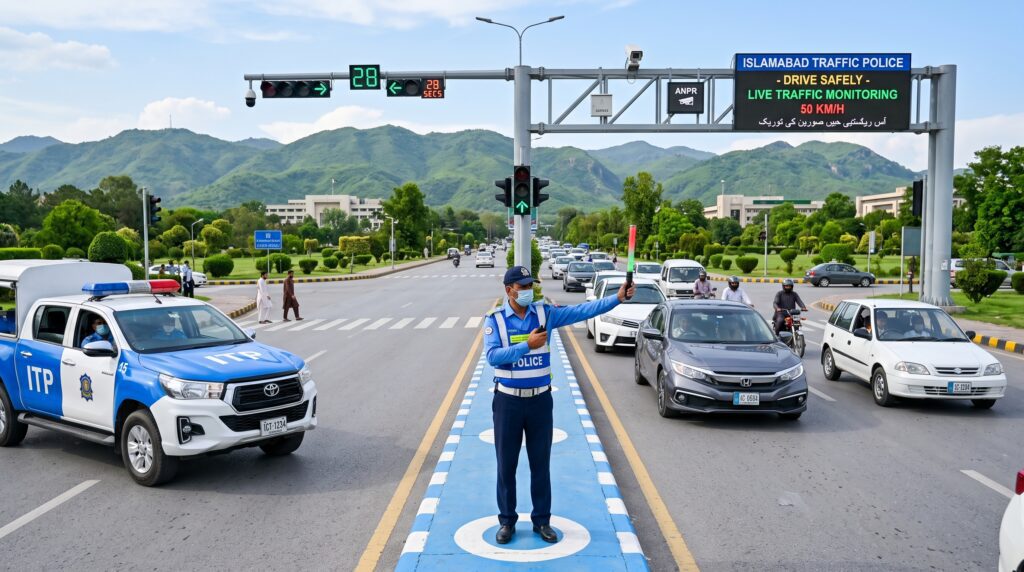
Rather than treating traffic regulation as a secondary responsibility of ordinary police stations, the capital developed a specialised organisation responsible for road safety, traffic enforcement, driving licences, public education and traffic management during national or diplomatic events.
The official Islamabad Traffic Police profile describes it as a model traffic organisation. It became the first police organisation in Pakistan to operate its own FM radio station and obtained ISO 9001 certification for aspects of its policing and licensing services.
Specialisation allowed traffic officers to concentrate on urban road management while reducing some of the traffic-related workload carried by territorial police stations.
2007: Lal Masjid crisis
The Lal Masjid confrontation of July 2007 was one of the most serious security crises in Islamabad’s history.
The conflict developed after students and administrators associated with Lal Masjid and Jamia Hafsa confronted state authorities, occupied property and became involved in increasingly serious disputes with law-enforcement agencies. The resulting siege and security operation caused substantial loss of life and exposed weaknesses in intelligence coordination, crisis negotiation, deployment planning and command responsibility.
On 27 July 2007, shortly after the operation, a suicide bomber attacked police and constabulary personnel near Aabpara. At least 14 people were killed, including seven police officers, and more than 65 were injured.
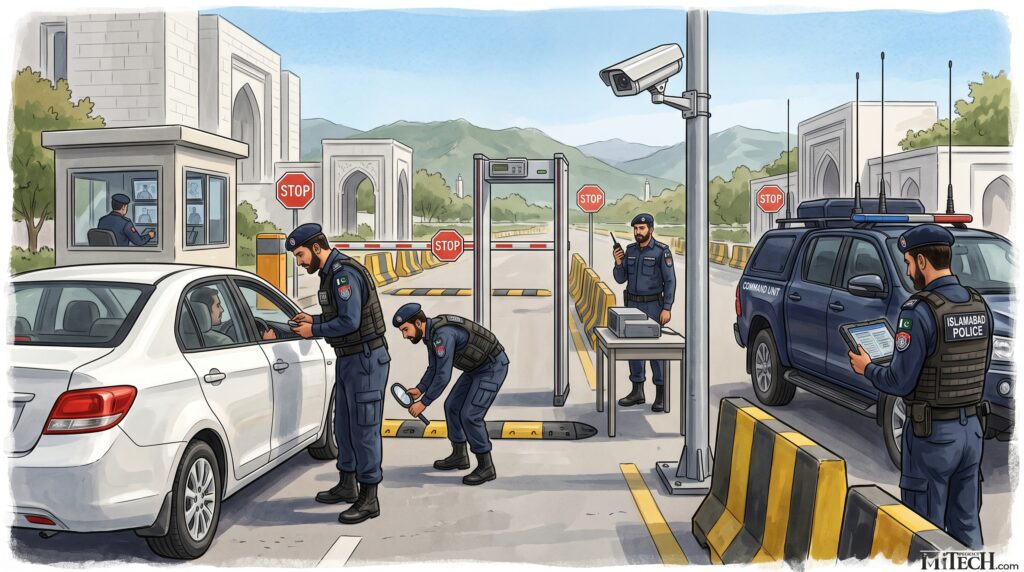
The Lal Masjid crisis had lasting consequences for capital policing. It led to more checkpoints, larger counterterrorism deployments, stronger intelligence coordination and greater protection for federal and diplomatic sites.
2008: Danish Embassy and Marriott Hotel attacks
Islamabad faced several major terrorist attacks in 2008.
On 2 June, a vehicle bomb exploded outside the Danish Embassy. Several people were killed and more than 25 were injured. The attack raised questions about vehicle screening and the protection of diplomatic premises.
On 20 September, a suicide truck bomber attacked the Islamabad Marriott Hotel. The reported death toll later reached approximately 60, while more than 250 people were injured. The bombing became one of the most destructive terrorist incidents in the capital’s history.
The Marriott attack exposed vulnerabilities in perimeter protection, vehicle inspection, emergency evacuation, firefighting and coordination between police, rescue organisations and private security personnel.
On 9 October, another suicide attacker targeted the headquarters of the police Anti-Terrorist Squad. Eight police personnel were reportedly injured and the building was badly damaged.
These attacks confirmed that police installations, hotels, embassies and international facilities had all become potential militant targets.
2009: Continued attacks on public and international institutions
The terrorist threat continued throughout 2009.
In April, an attacker targeted Frontier Constabulary personnel near a police facility, further demonstrating the danger faced by officers and paramilitary personnel deployed in the capital.
On 5 October, a suicide bomber entered the World Food Programme office and detonated explosives, killing five United Nations employees.
On 20 October, two suicide bombers attacked the International Islamic University Islamabad. The university’s official account states that eight students and a security guard were killed, while more than 30 people were injured.
In December, an attempted attack near the Naval Complex killed two naval personnel and injured others.
The attacks of 2008 and 2009 encouraged stronger security audits, tighter entry controls and closer operational coordination between Islamabad Police and private or institutional security teams.
2010: Consolidation of counterterrorism measures
By 2010, Islamabad’s counterterrorism arrangements had become more structured. Checkpoints, intelligence alerts, security audits and joint operations had become routine parts of policing in the capital.
Although the frequency of mass-casualty incidents declined compared with 2008 and 2009, Islamabad Police continued to operate under a persistent terrorist threat. The capital’s policing model remained heavily influenced by the need to protect federal institutions and prevent attackers from entering sensitive areas.
2011: Assassination of Salman Taseer
On 4 January 2011, Punjab Governor Salman Taseer was assassinated at Kohsar Market in Islamabad by Mumtaz Qadri, a police commando assigned to his security detail.
The attacker surrendered at the scene, and other members of the security squad were detained as part of the investigation.
The assassination exposed the risk of ideological radicalisation within security organisations. It raised serious questions about background checks, psychological assessment and continuing vetting of personnel assigned to protect political leaders and other high-risk individuals.
2012: Diplomatic security and protest management
Demonstrations associated with international and religious controversies placed pressure on Islamabad’s diplomatic-security arrangements during 2012.
Police were frequently required to prevent protesters from entering the Diplomatic Enclave while attempting to preserve the right of peaceful assembly. This tension between public order, diplomatic protection and constitutional freedoms became a recurring feature of Islamabad policing.
2013: Blue Area armed standoff
In August 2013, an armed man entered central Islamabad with automatic weapons and remained involved in a televised standoff on Jinnah Avenue for approximately five hours.
The incident attracted criticism because police did not resolve it quickly, television crews remained close to the active scene and command responsibility appeared uncertain. A civilian political figure eventually approached the gunman before police shot and arrested him.
The standoff became an important case study in tactical command, crisis negotiation, media control and the management of armed incidents in crowded urban areas.
2014: District court attack and market bombing
On 3 March 2014, gunmen and suicide attackers targeted the District and Sessions Court complex in Islamabad. Eleven people were killed and 29 were injured.
On 9 April, an explosion at the fruit and vegetable market killed 24 people and injured 122.
These attacks renewed attention to security at courts, markets and other crowded public spaces. Controlled entrances, CCTV surveillance, emergency planning and improved coordination with private guards became increasingly important.
2014: PTI and PAT protests in the Red Zone
The Pakistan Tehreek-i-Insaf and Pakistan Awami Tehreek protests of 2014 created a prolonged public-order crisis in the capital.
Demonstrators occupied parts of the Red Zone and attempted to approach important state buildings. Clashes between police and protesters resulted in at least three reported deaths and more than 400 injuries. Police used tear gas and rubber ammunition during confrontations around protected areas.
The protests raised lasting questions about political influence over police operations, proportionality in the use of force, protection of government buildings and the constitutional right to peaceful assembly.
2015: Planning for technology-based policing
During 2015, preparations advanced for the Islamabad Safe City Project.
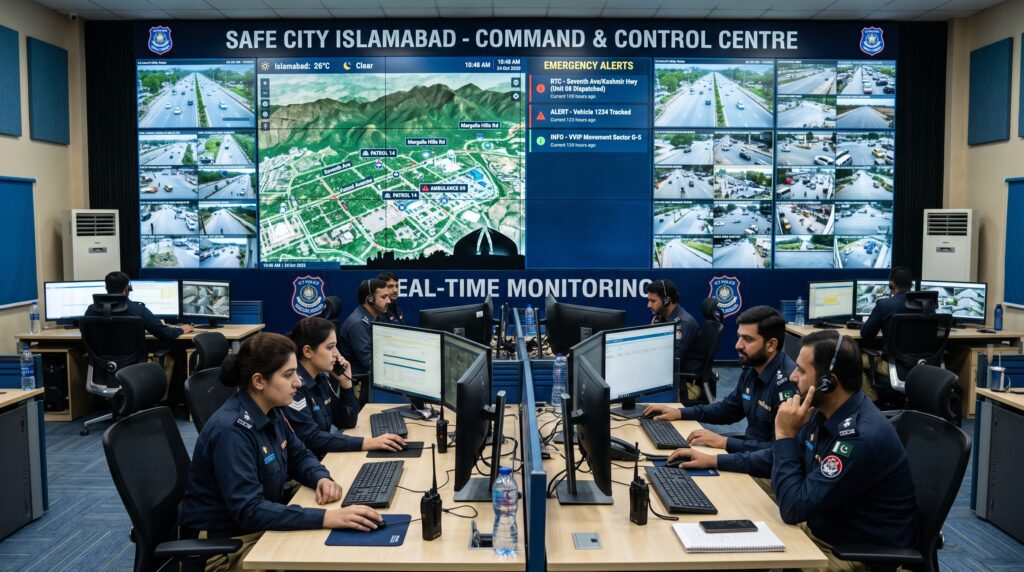
The objective was to reduce dependence on physical checkpoints by establishing a camera-based command-and-control system capable of monitoring roads, identifying vehicles, supporting investigations and coordinating emergency responses.
The project represented a major change in policing philosophy. Surveillance technology and centralised communications were expected to supplement conventional patrolling and territorial police-station work.
2016: Safe City Islamabad
The Islamabad Safe City Project was formally inaugurated on 6 June 2016.
The initial system included nearly 1,950 surveillance cameras and a command-and-control centre in H-11. Cameras monitored major roads, entry and exit points, important buildings, commercial centres and selected residential areas.
Safe City Islamabad supported:
- CCTV surveillance
- Vehicle identification and tracking
- Traffic management
- Emergency communications
- Crime-scene reconstruction
- Protection of sensitive installations
- Coordination between field units and command centres
The official Safe City structure now incorporates video analytics, integrated emergency services, data analysis and artificial-intelligence-supported monitoring.
Technology improved the ability of police to trace vehicles and reconstruct incidents. It also created questions about privacy, data security, camera accuracy, retention periods and unauthorised access.
2017: Faizabad sit-in and police operation
In November 2017, supporters of Tehreek-i-Labbaik occupied the Faizabad Interchange and disrupted movement between Islamabad and Rawalpindi.
A large operation involving Islamabad Police and supporting forces was launched on 25 November. According to a police report submitted to the Supreme Court, approximately 5,508 personnel were deployed and 173 law-enforcement personnel were injured.
The report identified problems including personnel fatigue, mixed deployments, inadequate coordination and uncontrolled live media coverage.
The experience strengthened the case for a permanently trained riot-management organisation. Islamabad Police now maintains an Anti-Riot Force within the Law and Order and Training Division. Its official operational principles include negotiation, de-escalation and proportionate crowd control.
2018 to 2019: Digital services and institutional consolidation
During 2018 and 2019, Islamabad Police continued integrating Safe City surveillance with traffic management, vehicle identification and investigative work.
Citizen-facing services also became increasingly digital. Police verification, character certificates, licensing, tenant registration and electronic traffic enforcement gradually reduced dependence on conventional police-station visits.
The expansion of digital services improved access but also made the accuracy and security of police databases more important.
2020: COVID-19 enforcement
The COVID-19 pandemic substantially expanded the responsibilities of Islamabad Police.
Police enforced Section 144 orders, restrictions on movement, closures, mask requirements and local lockdowns. In one early enforcement period, 424 people were arrested and 121 cases were registered for alleged violations of restrictions.
The pandemic demonstrated the police force’s role in public-health emergencies. It also raised questions about whether arrests and criminal proceedings were proportionate responses to minor violations.
2021: Osama Satti killing and police accountability
On 2 January 2021, 21-year-old Osama Nadeem Satti was killed when members of an Islamabad Police armed-response unit fired at his vehicle.
A joint investigation team concluded that the shooting was intentional. Investigators found that 19 bullets had struck the vehicle and that parts of the officers’ account were contradicted by available evidence.
In February 2023, a trial court sentenced two police officials to death and three others to life imprisonment.
The case became one of the most important police-accountability cases in Islamabad. It reinforced demands for:
- Body-worn cameras
- Clear firearms policies
- Independent investigation of police shootings
- Better supervision of armed units
- Preservation of CCTV and digital evidence
- Criminal accountability for unlawful force
The case also showed that surveillance systems can support accountability as well as enforcement.
2022: I-10 suicide bombing
On 23 December 2022, police stopped a suspicious vehicle in Islamabad’s I-10 sector. The vehicle exploded, killing one police officer and injuring several other officers and civilians.
The Tehreek-i-Taliban Pakistan claimed responsibility, and a joint investigation team was formed.
The incident demonstrated the continuing importance of roadside checks and alert frontline officers. Police intervention may have prevented the attacker from reaching a more crowded or strategically important target.
2023: F-9 Park rape case and women’s security
In February 2023, a woman was raped at gunpoint inside F-9 Park. The crime caused national concern about security, lighting, patrolling and emergency response in large public spaces.
Police used Safe City systems, geofencing and other investigative methods to trace suspects. Police later stated that two suspected offenders had died after firing at a checkpoint. The victim’s lawyer and others questioned the account and alleged that the men had previously been in police custody.
The disputed circumstances highlighted two separate concerns: the failure to prevent violence against women and the need for transparent investigation of deaths involving police.
Islamabad Police has since expanded women-focused services, including the Online Women Police Station and the 1815 helpline. These initiatives are intended to give women, children and vulnerable complainants round-the-clock access to police assistance.
2024: Peaceful Assembly and Public Order Act
The Peaceful Assembly and Public Order Act 2024 became law on 6 September 2024 and applies specifically to Islamabad Capital Territory.
The law established a formal system for regulating public assemblies. It requires organisers to apply for permission, sets time requirements for applications and allows authorities to designate or restrict locations for demonstrations.
Supporters argued that clearer rules were necessary because repeated protests had blocked roads and disrupted access to hospitals, schools, courts and government institutions.
Human-rights organisations argued that the law gave the authorities excessive power to restrict peaceful protest. Amnesty International described the legislation as a threat to the right of peaceful assembly.
For Islamabad Police, the law provided a clearer statutory framework for public-order operations. It did not remove the obligation to respect constitutional rights and use force only when lawful, necessary and proportionate.
2024: PTI protests and contested public-order operations
Large PTI demonstrations again placed Islamabad under extensive security restrictions in late 2024.
Police blocked roads, deployed containers, detained protesters and registered cases under criminal, antiterrorism and public-order laws. During the November confrontations, government authorities reported that a police officer was killed and 119 officers were injured in Islamabad and related clashes. Authorities also reported damage to police vehicles.
Islamabad’s police chief later announced that 954 protesters had been arrested and stated that weapons had been recovered. PTI and other critics disputed parts of the official account and alleged excessive force and unlawful detention.
The conflicting accounts demonstrated the importance of body cameras, independent documentation, clear arrest records and transparent reporting during politically sensitive operations.
2025: Police Station on Wheels and citizen services
In July 2025, Islamabad Police introduced an artificial-intelligence-integrated Police Station on Wheels.
The mobile unit was designed to take police-station services into communities, register complaints and provide access to police assistance without requiring every complainant to travel to a conventional station. Police reported that the Safe City network had expanded to 3,257 cameras and that thousands of complaints had been processed during the mobile unit’s pilot phase.
The initiative represented a shift toward mobile and service-oriented policing. Its success depends on whether complaints received through mobile or electronic systems result in timely legal action and proper investigation.
2025: G-11 district court suicide bombing
On 11 November 2025, a suicide bomber attacked near the District and Sessions Court complex in Islamabad’s G-11 sector.
Twelve people were killed and 36 were injured. Investigators used CCTV footage, Safe City systems and artificial-intelligence-assisted analysis to reconstruct the attacker’s movements.
Authorities later announced the arrest of four alleged facilitators linked to the attack.
The bombing again demonstrated the vulnerability of courts and crowded public institutions, even after years of security and surveillance investment.
2026: Tarlai imambargah suicide bombing
On 6 February 2026, a suicide bomber attacked the Khadija Tul Kubra Imambargah in Islamabad’s Tarlai area during Friday prayers.
At least 31 people were killed and approximately 169 people were injured. Islamic State claimed responsibility. The attack was described as the deadliest terrorist incident in the capital in more than a decade.
The bombing forced Islamabad Police to reassess security at mosques, imambargahs and other religious locations. It renewed attention to controlled entry, searches, parking restrictions, armed guards, intelligence gathering and emergency medical response.
The attack confirmed that the terrorist threat had not disappeared despite the expansion of surveillance and counterterrorism capabilities.
2026: Safe City expansion and artificial intelligence
In July 2026, Islamabad Police reviewed further expansion of the Safe City network and the introduction of artificial-intelligence-based traffic monitoring.
The planned system includes automated detection of traffic violations, intelligent signal management and real-time monitoring of major intersections.
A related telecommunications-modernisation plan seeks to connect Safe City cameras, traffic police and operational field units through a high-speed command-and-control network.
These developments may improve deployment and response times. They also increase the need for clear rules governing facial recognition, number-plate data, system accuracy, access controls and retention of personal information.
2026: Special Initiative Police Stations
Islamabad Police continued upgrading police stations under the Special Initiative Police Station programme during 2026.
The programme focuses on improved front desks, waiting areas, citizen facilities, investigation rooms and technology-supported policing. Police leadership also directed investigators to make greater use of forensic evidence, surveillance records and modern investigative methods.
Improved buildings and reception areas can make police stations less intimidating. Their practical value, however, depends on whether officers register legitimate cases, communicate with complainants and complete investigations without unnecessary delay.
2026: Crime reduction claims and registration concerns
Islamabad Police officially reported a 61 percent reduction in crime during the first six months of 2026.
That claim should be considered alongside concerns about complaint registration. A separate report stated that 21,222 electronically tagged complaints were recorded from January to April 2026, while 6,253 criminal cases were registered.
Police responded that not every electronically tagged complaint involved a cognisable offence requiring an FIR. Some officers and critics nevertheless argued that the figures raised questions about under-registration or classification practices.
A decline in registered FIRs does not automatically establish that fewer crimes occurred. Reliable assessment requires comparison of complaints, FIRs, emergency calls, hospital data, victim surveys, arrests, recoveries and court outcomes.
2026: Investigation backlog
An internal police document reported in May 2026 showed that investigations in 3,074 cases from 2024 and 2025 were still pending across Islamabad’s five policing zones.
Investigation delays weaken the criminal-justice process. Evidence may deteriorate, witnesses may become unavailable and victims may lose confidence in the system.
For this reason, police performance should not be judged only through arrests or registered cases. The quality and speed of investigation, submission of challans and successful prosecution are equally important.
Institutional development of Islamabad Police
Counterterrorism and intelligence coordination
Counterterrorism has remained a defining responsibility of Islamabad Police since 2001.
The attacks of 2002, 2005, 2007, 2008, 2009, 2014, 2022, 2025 and 2026 show that terrorist organisations have targeted religious sites, courts, hotels, universities, diplomatic facilities, international organisations and police personnel.
Effective counterterrorism requires more than checkpoints. It depends on intelligence sharing, community cooperation, surveillance, trained first responders, forensic investigation and coordination across provincial boundaries.
Public-order policing and constitutional rights
Islamabad is Pakistan’s main centre for national demonstrations. Political, religious, professional and civil-society groups frequently seek access to Parliament, the Supreme Court, government offices and the Diplomatic Enclave.
The 2014 Red Zone protests, 2017 Faizabad sit-in and demonstrations of 2024 showed that public-order operations can rapidly become politically contested.
Professional crowd control requires:
- Early negotiation with organisers
- Clearly communicated routes and restrictions
- Trained and rested police personnel
- Graduated use of force
- Reliable arrest and injury records
- Body-worn cameras
- Independent review of disputed incidents
The central challenge is to protect residents and state institutions without treating peaceful political activity as a criminal threat.
Safe City and digital policing
Safe City Islamabad is one of the most significant institutional developments in the history of the force.
The system supports surveillance, vehicle tracking, traffic regulation, emergency response and criminal investigation. It can also provide evidence when official police accounts are disputed.
Technology does not eliminate the need for competent investigators or accountable decision-making. Cameras may record an incident, but officers must still preserve evidence, identify suspects, interview witnesses and present a legally reliable case.
Digital policing also requires safeguards against mass surveillance, inaccurate identification, data breaches and politically motivated access.
Police accountability
Public confidence depends on whether Islamabad Police applies the law to its own personnel.
The Osama Satti case, disputed encounters and allegations of non-registration demonstrate the need for independent investigation of misconduct.
Effective accountability requires:
- Prompt registration of complaints against police officers
- Independent investigation of deaths involving police
- Preservation of CCTV, body-camera and communication records
- Public reporting of disciplinary outcomes
- Criminal proceedings where evidence supports prosecution
- Protection of complainants and witnesses
Accountability should be treated as part of professional policing rather than as an obstacle to police authority.
Investigation and prosecution
Arrest statistics receive considerable attention, but arrests alone do not produce justice.
A case can fail because evidence was contaminated, CCTV footage was not preserved, forensic material was collected late or the wrong legal provisions were applied.
Islamabad Police therefore needs close coordination with prosecutors, forensic laboratories, medical personnel and digital-evidence specialists. Investigation officers also require manageable workloads and continuing legal training.
Women’s access to policing
Violence against women has increased pressure on Islamabad Police to provide accessible and victim-sensitive services.
The Online Women Police Station and 1815 helpline are intended to improve access for women, children and vulnerable complainants. Policewomen have also been deployed at public-facing service points.
These services will be effective only when complaints remain confidential, victims receive respectful treatment and trained investigators take timely action.
Citizen facilitation and service delivery
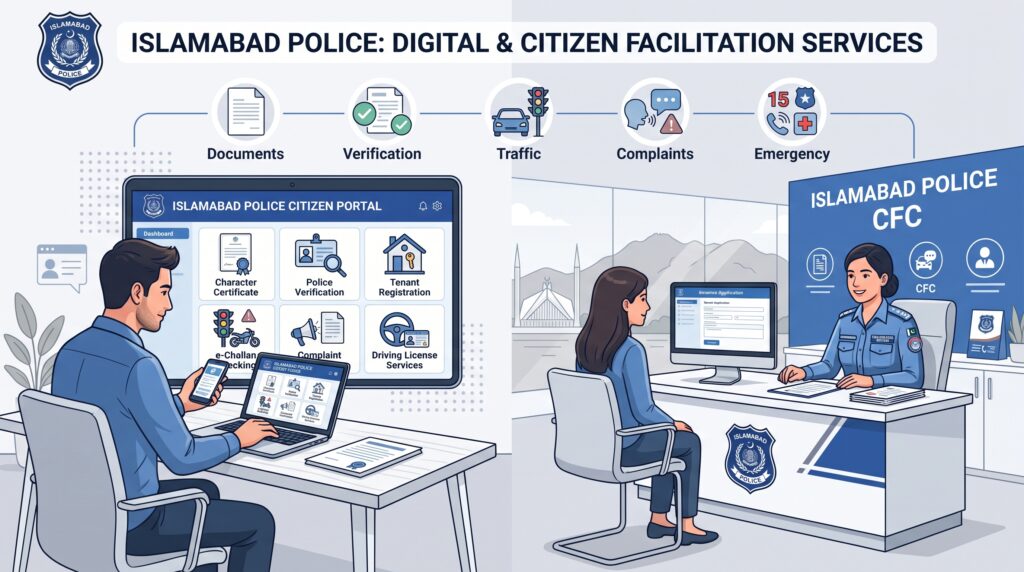
Islamabad Police now provides several citizen services through online systems, facilitation centres and mobile units.
These include character certificates, police verification, tenant and servant registration, traffic services, FIR-related assistance, complaint submission and lost-property reporting.
Digital access can reduce unnecessary visits and opportunities for informal payments. It must still be supported by reliable systems, clear processing times and effective complaint escalation.
Islamabad Police Jobs 2026: Recruitment overview
Islamabad Police Jobs 2026 included a large recruitment campaign advertised as offering more than 1,700 vacancies.
The official recruitment advertisement stated that applications had been invited for multiple positions through a merit-based process. The related recruitment portal included listings for executive staff, including Constable BS-05 and Constable Driver BS-05.
The online application period has closed, but the recruitment process was still active in early August 2026. Official Islamabad Police media updates showed physical and endurance tests continuing through 4 August.
Applicants should distinguish between the closing of applications and the completion of recruitment. A closed application portal does not mean that testing, verification and selection have ended.
Islamabad Police online apply 2026: Current application status
Islamabad Police online apply 2026 applications for the advertised recruitment campaign are no longer open.
The official advertisement extended the application deadline to 15 July 2026. As of 4 August 2026, the department had moved into physical and endurance testing.
Candidates who submitted applications should monitor only the official recruitment portal and Islamabad Police channels for:
- Physical-test schedules
- Roll-number or test slips
- Document-verification instructions
- Written-test dates
- Result announcements
- Official corrections or schedule changes
A website displaying an old application button or copied advertisement should not be treated as proof that applications remain open.
Islamabad Police official website: Verifying genuine notices
The Islamabad Police official website is the primary source for recruitment advertisements, public notices, departmental news and citizen services.
The official domain is islamabadpolice.gov.pk.
The jobs page published the 2026 recruitment notice on 11 July and displayed a deadline of 15 July 2026.
Before submitting an application, candidates should verify:
- The advertisement’s publication date
- The official closing date
- The name of the authorised testing organisation
- The exact post title and pay scale
- Eligibility, domicile and quota requirements
- Any official extension or corrigendum
Private jobs websites may reproduce useful information, but an official departmental advertisement should always take priority when dates or eligibility conditions conflict.
Islamabad Police Jobs 2026 last date: Confirmed closing date
The confirmed Islamabad Police Jobs 2026 last date for the recruitment campaign displayed on the official website was 15 July 2026.
The official advertisement described this as an extended deadline. This means that earlier dates appearing in copied advertisements or search results were superseded by the official extension.
As of 4 August 2026:
- The application deadline had passed
- New applications were not being accepted under that advertisement
- Physical and endurance tests were continuing
- Candidates needed to follow official testing updates
A future Islamabad Police vacancy will carry its own advertisement and closing date.
Islamabad Police Jobs Apply online: Safe application process
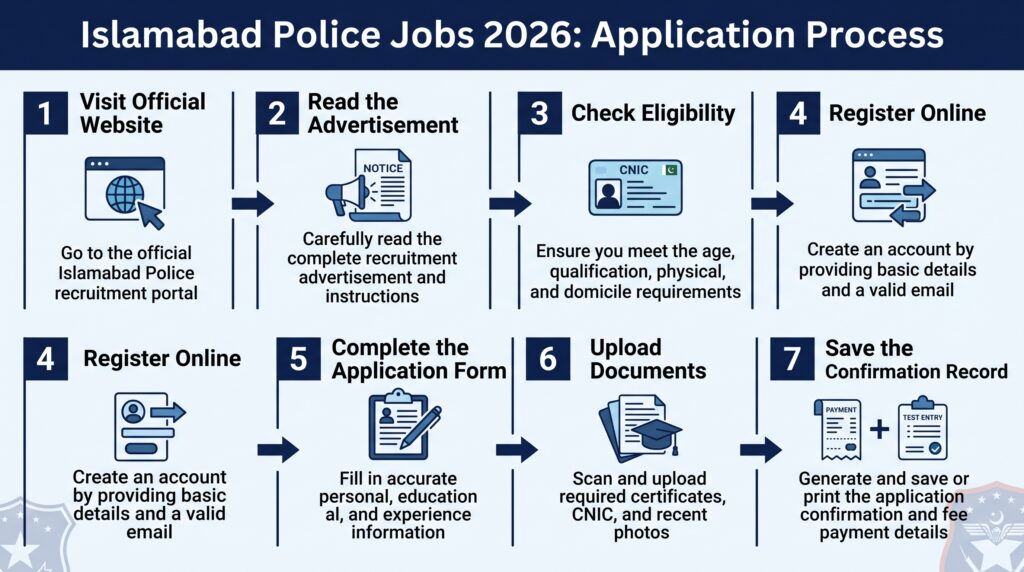
Islamabad Police Jobs Apply online procedures should begin with the official police jobs page rather than a third-party employment website.
A safe application process is:
- Open the official Islamabad Police jobs page.
- Locate the active recruitment advertisement.
- Read the complete eligibility and quota conditions.
- Follow only the authorised recruitment-portal link named in the notice.
- Register using accurate identity and contact information.
- Select the correct post, domicile and quota.
- Enter educational and personal details carefully.
- Upload the documents requested in the advertisement.
- Pay an application or testing fee only through the approved method, when required.
- Review the application before final submission.
- Save the application number, confirmation page and payment evidence.
- Monitor the official portal for test schedules and results.
Applicants should never provide passwords, verification codes or original identity documents to an unofficial agent.
Islamabad Police Jobs application form: Documents and completion
The Islamabad Police Jobs application form is normally completed electronically during an active recruitment campaign.
Documents commonly requested for police recruitment may include:
- CNIC or B-Form
- Recent photograph
- Domicile certificate
- Educational certificates
- Valid driving licence for driver posts
- Quota-related documents
- Government-employment information, where applicable
- Disability or minority documentation, where relevant
The precise requirements in the live advertisement always control. Conditions from an earlier recruitment campaign should not be assumed to apply to a new vacancy.
After submitting the form, candidates should retain:
- A saved or printed application
- The registration or tracking number
- The payment receipt, where applicable
- A screenshot of the confirmation page
- Copies of all uploaded documents
An application should be treated as complete only when the authorised portal confirms successful submission.
Islamabad Police Jobs last date: Avoiding expired advertisements
Islamabad Police Jobs last date searches often display copied notices long after recruitment has closed.
Candidates can avoid expired or misleading advertisements by checking:
- Whether the advertisement year is current
- Whether the official deadline has already passed
- Whether an extension was issued
- Whether the official portal still accepts applications
- Whether the vacancy appears on the Islamabad Police website
- Whether the post title matches the official notice
- Whether the testing organisation is authorised
Search-engine ranking does not establish that a vacancy is genuine or currently open.
For the recruitment campaign discussed in this article, the final official deadline was 15 July 2026. Testing continued afterward, but applications did not remain open.
Islamabad Police constable jobs: Posts and selection process
Islamabad Police constable jobs are among the most frequently searched uniformed vacancies.
The authorised 2026 recruitment portal included listings for:
- Constable BS-05
- Constable Driver BS-05
The precise age, education, domicile and physical standards depend on the official advertisement. Candidates should not rely on requirements copied from an earlier year.
The selection process may include:
- Online registration
- Initial document verification
- Physical measurement
- Running or endurance test
- Written examination
- Driving or skill test for specialised posts
- Interview
- Medical examination
- Character and background verification
- Final merit and quota-based selection
Official Islamabad Police updates in early August 2026 showed that the physical and endurance-testing stage was in progress.
Candidates should prepare original identity, domicile and educational documents for verification and follow the instructions printed on their official test slips.
Major challenges facing Islamabad Police
Terrorism
The capital remains an attractive target because of its political, diplomatic and symbolic importance.
The 2025 court bombing and February 2026 imambargah bombing demonstrated that militant organisations can still penetrate the capital despite expanded surveillance.
Political pressure
Islamabad Police operates under the federal government and is regularly deployed during disputes involving national opposition parties, religious movements and the administration.
This creates a continuing risk that operational decisions will be viewed as politically motivated.
Public confidence
Allegations of unlawful force, non-registration of FIRs and questionable encounters weaken cooperation between citizens and police.
Without public trust, witnesses may avoid reporting crime and communities may be less willing to share intelligence.
Conventional crime
Street robbery, mobile-phone snatching, vehicle theft, burglary, fraud and organised criminal activity remain important public concerns.
Official crime-reduction claims should be evaluated through transparent and independently reviewable statistics.
Rapid urban expansion
Islamabad’s population and peripheral settlements have expanded faster than police infrastructure in some areas.
Rural and developing zones require adequate stations, patrol vehicles, investigation officers and emergency resources.
Investigation delays
The large backlog of pending investigations reduces the likelihood of timely prosecution and increases frustration among complainants.
Police reform must therefore address investigation workloads as well as visible patrolling.
Digital rights
Artificial-intelligence surveillance and centralised data systems create new risks involving privacy, inaccurate identification, unauthorised access and political misuse.
Clear laws and independent oversight are necessary to ensure that security technology remains proportionate and accountable.
Future priorities for Islamabad Police
The long-term effectiveness of Islamabad Police will depend on several priorities:
- Intelligence-led counterterrorism
- Professional and proportionate crowd control
- Transparent crime-registration systems
- Faster, evidence-based investigations
- Independent review of police misconduct
- Better protection for women and vulnerable groups
- Responsible use of surveillance technology
- Merit-based recruitment and professional training
- Stronger community relationships
- Public reporting of measurable performance outcomes
Technology, recruitment and infrastructure can support these objectives. They cannot replace lawful decision-making, competent investigation and public confidence.
Conclusion
Islamabad Police: Current Affairs and Institutional Development, 2001 to August 2026 reflects the transformation of a conventional urban police force into a specialised capital-security organisation.
Since 2001, Islamabad Police has faced terrorism, sectarian violence, attacks on courts and diplomatic facilities, large political demonstrations, public-health enforcement and growing conventional crime. It has responded by expanding its Security Division, developing Islamabad Traffic Police, establishing Safe City surveillance, creating specialised riot and counterterrorism units and introducing digital citizen services.
The Safe City system, Police Station on Wheels, Special Initiative Police Stations, Online Women Police Station and artificial-intelligence-based traffic management represent significant institutional developments.
Serious weaknesses remain. Crime-registration concerns, investigation backlogs, disputed police encounters and politically sensitive public-order operations continue to affect public trust.
The future credibility of Islamabad Police will not be determined only by the number of cameras, officers, checkpoints or arrests. It will depend on whether the force registers complaints transparently, investigates crime professionally, protects constitutional rights and holds its own personnel accountable.
Read More : Pak Army Latest Civilian Vacancies 2026
Frequently asked questions
When was Islamabad Police established?
Islamabad Police was established on 1 January 1981 through Presidential Orders No. 17 and 18 of 1980.
Who is the current IGP of Islamabad Police?
As of 4 August 2026, the official Islamabad Police website identifies Syed Ali Nasir Rizvi as Inspector General of Police.
How many police stations operate in Islamabad?
Islamabad Police reports 27 police stations across five operational zones.
What is the Islamabad Police official website?
The official domain is islamabadpolice.gov.pk.
What was the Islamabad Police Jobs 2026 last date?
The confirmed extended closing date for the recruitment campaign discussed in this article was 15 July 2026.
Can candidates still apply for Islamabad Police Jobs 2026?
No. The cited application window closed on 15 July 2026. Physical and endurance tests were continuing in early August.
Which Islamabad Police constable jobs were advertised in 2026?
The authorised recruitment portal included Constable BS-05 and Constable Driver BS-05 listings.
What are the Islamabad Police helpline numbers?
The official contact system lists 15 for emergencies, 1715 for IGP complaints, 1815 for the Online Women Police Station and 1915 for traffic assistance.
What was the most serious Islamabad security incident in 2026?
The 6 February 2026 suicide bombing at the Khadija Tul Kubra Imambargah in Tarlai killed at least 31 people and injured approximately 169.
Is Safe City Islamabad using artificial intelligence?
Yes. The official Safe City structure includes video analytics and AI-supported monitoring, while further AI-based traffic enforcement and signal-management systems were reviewed in July 2026.
Who is the IG of Islamabad Police?
Syed Ali Nasir Rizvi is the Inspector General of Islamabad Police as of 4 August 2026.
Who is the new IG Police of Islamabad?
Syed Ali Nasir Rizvi is the serving IGP of Islamabad, and he has held the position since April 2024.
Who is the CTO of Islamabad?
Kainat Azhar is the Chief Traffic Officer of Islamabad Traffic Police as of August 2026.
Who is the CTO of Traffic Police in Islamabad?
Kainat Azhar currently supervises traffic enforcement, road safety and driving-licence services as Chief Traffic Officer.
Who is the SSP Islamabad Police?
Captain Retired Qazi Ali Raza serves as SSP Operations, while other SSP-level officers manage specialised Islamabad Police branches.
Who is the DSP of Islamabad Police?
Islamabad Police has several DSPs assigned to different subdivisions and branches, so there is no single DSP for the entire capital.
When was Islamabad Police established?
Islamabad Capital Territory Police was established on 1 January 1981 through Presidential Orders No. 17 and 18 of 1980.
How many police stations are in Islamabad?
Islamabad Police operates 27 police stations across five operational policing zones.
How many police officers are there in Islamabad?
Islamabad Police has an organisational strength of approximately 12,625 personnel.
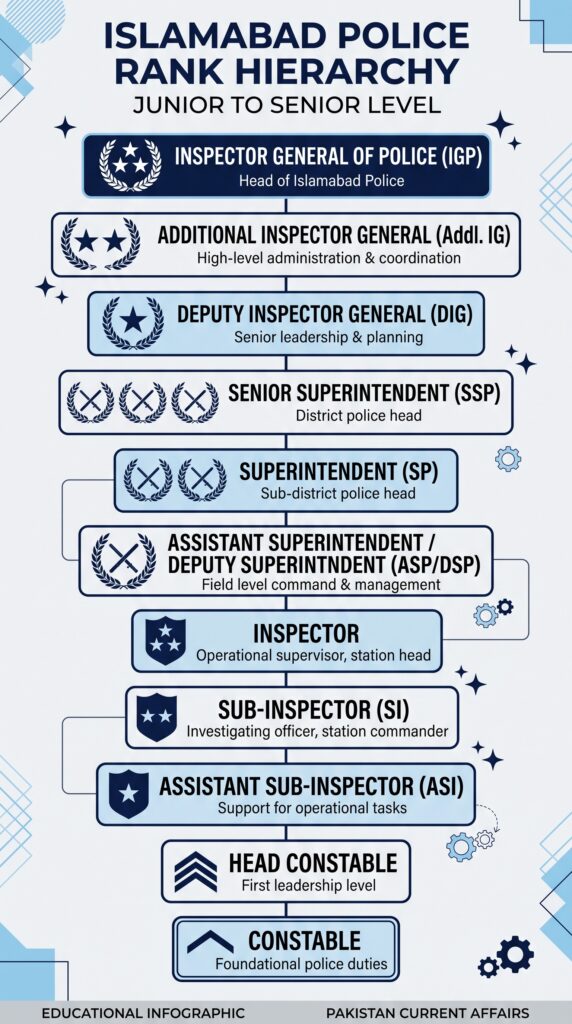
What is the ranking structure in Islamabad Police?
The hierarchy generally runs from Constable, Head Constable, ASI, Sub-Inspector and Inspector to ASP or DSP, SP, SSP, DIG, Additional IGP and IGP.
Islamabad Police Salaries and Pay Grades
What is the salary of a police constable in Islamabad in 2026?
An Islamabad Police constable in BPS-7 receives basic pay of approximately Rs19,590 to Rs52,590 per month, excluding allowances.
What is a Police Constable salary?
A Police Constable’s total salary includes basic BPS-7 pay along with house-rent, conveyance, risk and other admissible allowances.
What is the salary of an ASI in Islamabad Police?
An Islamabad Police ASI in BPS-11 receives basic pay of approximately Rs22,410 to Rs69,810 per month before allowances and deductions.
What is the highest salary of an ASI Police officer?
The maximum basic salary of a BPS-11 ASI is approximately Rs69,810 per month, while the total salary may be higher after allowances.
What is the salary of an LDC in Islamabad Police?
An Islamabad Police Lower Division Clerk in BPS-11 receives basic pay of approximately Rs22,410 to Rs69,810 per month plus applicable allowances.
What is the highest salary of a DSP?
A DSP in BPS-17 may receive maximum basic pay of approximately Rs136,340 per month, excluding official allowances and benefits.
What is Grade 17 in police?
BPS-17 is a gazetted officer grade generally held by ASPs and DSPs in Pakistan’s police system.
Which constable receives the highest salary?
A senior constable at the maximum pay stage with risk, special-duty and other authorised allowances generally receives the highest constable salary.
What is a good salary in Islamabad?
A monthly income of about Rs150,000 to Rs250,000 may be reasonable for one person, although housing, family size and lifestyle greatly affect expenses.
Islamabad Police Ranks and Positions
Which rank is best in police?
IGP is the highest organisational rank, while ASP is generally considered one of the best direct officer-entry positions through the CSS examination.
What is the highest rank in police?
The Inspector General of Police is the highest rank in Islamabad and provincial police organisations.
What does DSP stand for in police?
DSP stands for Deputy Superintendent of Police, normally a BPS-17 supervisory officer.
What is the full form of ASP in police?
ASP stands for Assistant Superintendent of Police, usually a BPS-17 officer from the Police Service of Pakistan.
What does SSP stand for in police?
SSP stands for Senior Superintendent of Police, a senior command rank above SP and below DIG.
What is the full form of DIG in police?
DIG stands for Deputy Inspector General of Police, a senior rank above SSP and below Additional IGP.
What is the full form of ASI in police?
ASI stands for Assistant Sub-Inspector.
What is an ASI in Pakistan Police?
An ASI is a junior investigating and supervisory officer who ranks above Head Constable and below Sub-Inspector.
Is an SHO higher than an ASI?
Yes, an SHO is normally an Inspector or Sub-Inspector and is therefore usually senior to an ASI.
What is a DPO in police?
DPO stands for District Police Officer, the senior officer responsible for managing police operations within a district.
Does Islamabad Police have a DPO?
Islamabad Police does not follow the standard provincial DPO structure because the capital force is headed by an Inspector General of Police.
What is the full form of PSP in police?
PSP stands for Police Service of Pakistan.
What is a PSP officer?
A PSP officer is a member of the Police Service of Pakistan who normally begins service as an ASP and may later hold senior command positions.
What is the full form of PSI in police?
PSI generally means Police Sub-Inspector, although Pakistan commonly uses the abbreviation SI.
What is the full form of ACP?
ACP stands for Assistant Commissioner of Police, a title used mainly in police commissionerate systems.
What does PS mean in police?
PS normally stands for Police Station in Pakistan.
Police Abbreviations and Full Forms
What is the full form of OCPD in police?
OCPD commonly means Officer in Charge of Police District, although its meaning can vary by country.
What is the full form of PID in police?
PID may mean Police Intelligence Department, Personal Identification Division or Public Information Division depending on the organisation.
What is the full form of CPU in police?
CPU may stand for Crime Prevention Unit, Community Policing Unit or Child Protection Unit.
What does PSB stand for in police?
PSB commonly stands for Professional Standards Branch, although some countries use it for Public Security Bureau.
What is the full form of CI in police?
CI commonly means Circle Inspector in South Asian policing or Chief Inspector in British-style police services.
What is the full form of CCD Police in Pakistan?
CCD stands for Crime Control Department, a specialised formation dealing with organised and serious crime.
What is the full form of CPG in police?
CPG may stand for Community Policing Group, although the abbreviation is not used uniformly by all police organisations.
What is the full form of PRP in police?
PRP may mean Police Reform Programme, Police Response Patrol or Police Reserve Platoon depending on the organisation.
What is the full form of ICP in police?
ICP commonly means Incident Command Post during emergency and disaster operations.
What is the full form of CCPS in police?
CCPS often means Certified Crime Prevention Specialist, which is a professional qualification rather than a police rank.
What does PSA stand for in policing?
PSA may mean Police Service Area, Police Service Assistant, Police Service Aide or Public Safety Assistant.
Police Mission, Principles and Community Policing
What is the basic mission of police?
The basic mission of police is to prevent crime, maintain public order, protect life and property and enforce the law fairly.
What are the nine policing principles?
The nine Peelian principles focus on crime prevention, public approval, voluntary cooperation, impartial enforcement, minimum necessary force and close police-community partnership.
What is community policing in Pakistan?
Community policing is a partnership in which police and residents work together to identify local problems, prevent crime and improve public trust.
What is the motto of Islamabad Police?
Islamabad Police uses “Pride in Service” in its crest and recruitment material, while “Service With Passion” also appears on its official website.
Islamabad Police Uniform and Vehicles
What is the uniform of Islamabad Police?
The standard Islamabad Police uniform generally includes a light-blue shirt, dark navy trousers, navy headgear, black footwear and official duty equipment.
What is the uniform of police in Pakistan?
Pakistan does not have one nationwide police uniform because federal and provincial police organisations use different colours, badges and headgear.
What kind of vehicles does Islamabad Police use?
Islamabad Police uses patrol cars, SUVs, pickup trucks, motorcycles, vans, traffic vehicles, riot-control vehicles and mobile service units.
What is the best police car?
The best police vehicle depends on its purpose, but a good police car should be reliable, safe, fast, visible and easy to maintain.
Other Relevant Questions
What is the old name of Islamabad?
Islamabad did not have an official former city name because it was developed as a planned federal capital near Rawalpindi.
What is the largest police station?
There is no universally recognised largest police station because size may be measured by land area, staff strength, workload or population served.
Can a British citizen join the LAPD?
A British citizen may apply to the LAPD only if legally authorised to work in the United States and able to meet all recruitment requirements.
How many Deputy Inspectors-General of Police are there in Kenya?
Kenya’s National Police Service has two Deputy Inspectors-General, one for the Kenya Police Service and one for the Administration Police Service.
Pingback: PMA Long Course 158 Verbal Intelligence PDF & Practice Test