ISSB: The Complete Journey of Officer Selection in the Pakistan Armed Forces begins long before a candidate enters an assessment centre. It starts with the decision to serve Pakistan, continues through registration and initial screening, and eventually leads to four demanding days of psychological assessment, group activities, interviews, and close observation.
For many young Pakistanis, becoming a commissioned officer is not simply a career goal. It represents discipline, leadership, responsibility, personal growth, and service to the country. However, earning the opportunity to train as an officer requires more than good academic marks or physical strength.
The Inter Services Selection Board, commonly called ISSB, assesses candidates seeking commissions in the Pakistan Army, Pakistan Navy, and Pakistan Air Force.
ISSB is not one conventional examination. Instead, it is a complete personality and leadership assessment. Candidates are observed by psychologists, Group Testing Officers, and Deputy Presidents through a three-dimensional selection system. The official process lasts four days and uses individual tasks, group activities, psychological assessments, and interviews to determine whether a candidate has the potential to complete military training and serve as an officer.
This guide covers the complete journey, including ISSB Registration, the ISSB call letter, intelligence tests, psychological tests, GTO activities, interviews, female eligibility, the official 2026 schedule, result checking, and a practical preparation plan.
Important: Recruitment dates, course requirements, age limits, physical standards, and eligibility conditions may change. Candidates should always verify current information through official Armed Forces and ISSB resources.
What Is ISSB?
The Inter Services Selection Board is Pakistan’s official institution for assessing potential officers for the Armed Forces.
Its purpose is not to find perfect candidates. Instead, it identifies people who have the qualities and potential required to complete demanding military training and accept the responsibilities of commissioned service.
The board looks for qualities such as:
- Clear thinking
- Emotional stability
- Practical intelligence
- Confidence
- Communication skills
- Teamwork
- Initiative
- Sense of responsibility
- Social adjustment
- Decision-making ability
- Leadership potential
- Honesty and self-awareness
ISSB centres are located in Kohat, Gujranwala, Malir, and Quetta. Candidates from across Pakistan may be assigned to one of these centres according to service requirements and administrative arrangements.
Why ISSB Is Different From an Ordinary Test
A conventional examination often rewards the candidate who remembers the correct answer. ISSB works differently.
Selectors want to see how you behave when:
- Your idea is rejected
- Another candidate disagrees with you
- The group is running out of time
- You do not know an interview answer
- A practical plan fails
- You must lead people you have just met
- You must follow someone else’s instructions
- You feel tired, nervous, or uncertain
This is why memorized sentences and rehearsed interview answers are unreliable. A candidate may write impressive statements about teamwork but behave selfishly during a group task. Another may claim to be calm yet become argumentative when challenged.
ISSB compares what candidates write, say, and do. The final picture emerges from all three areas.
A Simple Story About Genuine Leadership
Consider two fictional candidates, Hamza and Saad.
Hamza has memorized several statements about leadership. In his psychological test, he writes that a good leader always respects the team. However, during the group discussion, he interrupts everyone. During the outdoor task, he rejects every suggestion and insists that only his plan can work.
Later, in the interview, Hamza describes himself as patient and cooperative.
Each statement sounds positive when viewed alone. However, when the selectors compare his written answers, group behaviour, and interview responses, they may notice that his claimed personality does not match his actions.
Saad is quieter. He does not try to speak first in every discussion. Nevertheless, he listens, presents relevant ideas, helps another candidate understand the task, and remains active after the group rejects one of his suggestions.
Saad never repeatedly announces that he is a leader. His behaviour shows it.
The lesson is simple:
ISSB is more likely to recognize genuine, consistent behaviour than a rehearsed performance.
ISSB official website: Your Main Source of Reliable Information
The ISSB official website should be the first place candidates visit for authoritative information.
The website provides access to:
- The current ISSB schedule
- Candidate registration
- Candidate login
- Call and result information
- Joining instructions
- Selection-system details
- Candidate guidelines
- Ineligibility conditions
- Official downloads
- Contact information
The official website also directs applicants to the recruitment portals of the Pakistan Army, Pakistan Navy, and Pakistan Air Force.
Important Official Links
- ISSB official website
- ISSB candidate registration
- ISSB candidate login
- ISSB schedule
- ISSB selection system
- ISSB joining instructions
- ISSB candidate guidelines
- ISSB ineligibility conditions
- ISSB contact information
Social media groups and preparation websites may be useful for practice, but they should not replace official information about schedules, documents, eligibility, or reporting instructions.
ISSB Test: What the Board Actually Assesses
The ISSB Test is a four-day selection process based on three specialist dimensions.
1. Psychological Assessment
Psychologists examine the candidate’s attitudes, thought patterns, emotional responses, imagination, motivation, and self-awareness through carefully designed assessments.
2. Group Testing Officer Assessment
The Group Testing Officer, usually called the GTO, observes candidates during group discussions, planning exercises, practical obstacles, command situations, and other activities.
This dimension reveals how candidates communicate, cooperate, lead, follow, and respond to difficulties.
3. Deputy President Interview
The interviewing officer evaluates the candidate’s intellectual ability, personal background, emotional pattern, social behaviour, general awareness, and motivation for military service.
The board then combines the observations from these three dimensions. A candidate may be recommended for further consideration or may be found unsuitable for military training. Final merit decisions are made by the relevant service headquarters.
ISSB Registration: How to Apply Correctly
ISSB Registration is often misunderstood because candidates may deal with two different registration stages.
Stage One: Apply Through the Relevant Service
A candidate normally begins by applying for an advertised commissioning course through one of the official service recruitment portals:
- Join Pakistan Army
- Join Pakistan Navy
- Join Pakistan Air Force
The relevant service determines:
- Available officer courses
- Age limits
- Educational qualifications
- Gender eligibility
- Registration dates
- Physical standards
- Medical standards
- Initial-test requirements
- Preliminary interview procedures
ISSB does not replace this first application stage.
Stage Two: Register on the ISSB Candidate Portal
Candidates whose information has entered the ISSB system can use the official candidate registration page.
The current registration process includes:
- CNIC verification
- Email verification
- Mobile-number verification
- Password setup
Candidates must enter a 13-digit CNIC number without dashes to begin the verification process.
Step-by-Step Registration Process
- Find a suitable officer course on the relevant service website.
- Confirm that you meet the eligibility conditions.
- Apply through the official Army, Navy, or Air Force portal.
- Complete the initial tests, medical assessment, physical test, and preliminary interview.
- Wait for your information to be forwarded for ISSB consideration.
- Visit the official ISSB candidate portal.
- Verify your CNIC, email, and mobile number.
- Create a secure password.
- Sign in regularly to review call or result information.
- Never share passwords or verification codes with unofficial websites.
Creating an ISSB portal account does not independently make a person eligible for an Armed Forces course. The candidate must first pass through the relevant service’s application and shortlisting system.
Join pak army ISSB: From Army Application to Officer Selection
The phrase Join pak army ISSB is frequently searched by candidates hoping to become commissioned officers in the Pakistan Army.
However, ISSB is not the first stage of Army recruitment.
The journey generally involves:
- Applying for an advertised Pakistan Army course
- Completing initial intelligence or academic tests
- Passing the preliminary medical examination
- Meeting the required physical standards
- Attending the initial interview
- Being shortlisted for ISSB
- Receiving reporting instructions
- Completing the ISSB assessment
- Completing final medical requirements
- Competing on final merit
- Joining the relevant academy if selected
Pakistan Army officer-entry routes may include:
- PMA Long Course
- Technical Cadet Course
- Lady Cadet Course
- Medical Cadet Course
- Direct Short Service Commission
- Other specialist entries advertised by the Army
Each course has separate requirements. The eligibility conditions for a graduate applying through the Lady Cadet Course may differ considerably from those for an intermediate-level candidate applying through the PMA Long Course.
Candidates should therefore use the official Join Pakistan Army website to review the current advertisement rather than relying on old eligibility tables.
ISSB call letter: How to Check and Prepare for Reporting
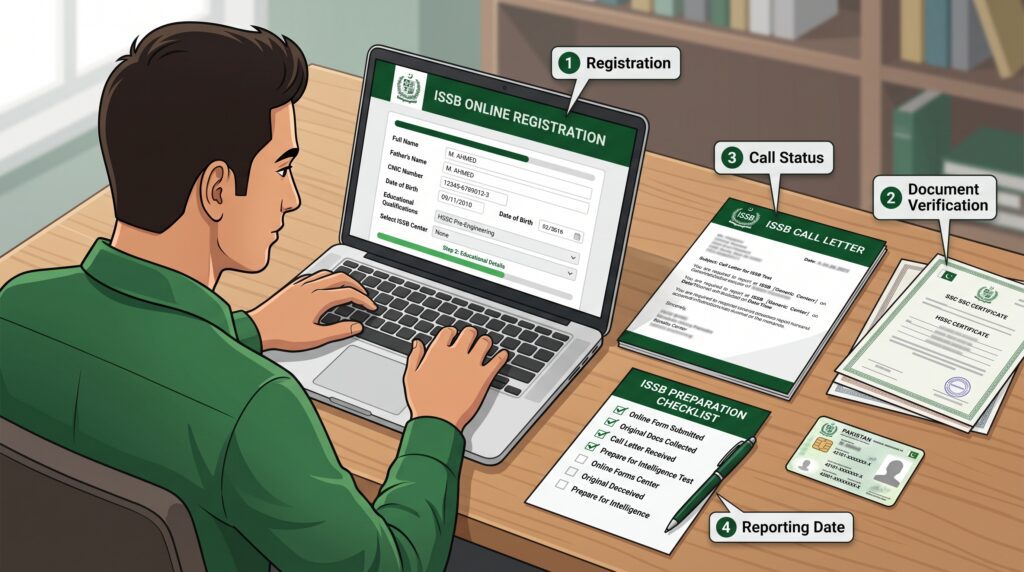
The ISSB call letter or call status provides the information a candidate needs to report to the assigned centre.
It may include:
- Assigned ISSB centre
- Reporting date
- Reporting time
- Candidate information
- Course details
- Joining instructions
- Required documents
Official joining guidance states that candidates must report on the date and time shown in their call status. Candidates who fail to report as instructed may not be permitted to join the assessment, and the board is not required to offer another date.
How to Check Your ISSB Call Status
- Visit the ISSB candidate login page.
- Enter your CNIC number.
- Enter your password.
- Open the call-status section.
- Confirm the assigned centre.
- Note the reporting date and time.
- Read the joining instructions carefully.
- Save or print the available information.
- Recheck the portal before travelling.
Documents to Prepare
Candidates should follow the instructions issued for their specific course. Commonly required original documents include:
- Matric certificate
- Matric detailed marks sheet
- Intermediate certificate
- Intermediate marks sheet
- Higher qualification documents where required
- O-Level or A-Level equivalence certificate where applicable
- Birth certificate where required
- Hope certificate for eligible appearing candidates
- Domicile certificate where applicable
- CNIC or Form B
- ISSB call letter
The official instructions state that photocopies are not accepted as replacements where original certificates are required. Candidates who do not possess the necessary documents may be prevented from appearing in the assessment.
Clothing and Personal Items
Candidates should bring:
- Formal or respectable clothing
- Tracksuit
- Sports shirt
- White socks
- Joggers or canvas shoes
- Seasonal clothing
- Blue pens
- Towel
- Toiletries
- Any additional item mentioned in the call instructions
Official instructions also explain that lodging and meals are provided during the candidate’s stay.
ISSB test date 2026: Current Official Schedule
The ISSB test date 2026 depends on the candidate’s Armed Force and commissioning course. There is no single test date for every candidate.
As of July 16, 2026, the official ISSB website displays the following tentative schedule for June to November 2026:
| Service | Course | Tentative duration |
|---|---|---|
| Army | 158 PMA Long Course | June 5 to September 18, 2026 |
| Army | TCC-38 | June 5 to July 5, 2026 |
| Army | 15th Conversion | July 20 to July 24, 2026 |
| Army | EME Aviation Officers | September 14 to September 18, 2026 |
| Army | LCC-29 | September 14 to September 18, 2026 |
| Navy | PNCT and SSC Pakistan Navy Courses | September 4 to October 12, 2026 |
| Air Force | PAF Courses, 138 CSC, PAF Female and Officers of PC | October 8 to November 11, 2026 |
The official website labels this schedule as tentative, which means dates may change. Candidates should regularly review the website, follow their individual call instructions, and report to the assigned centre with all required documents.
Update note for publishers: This section should be reviewed whenever ISSB publishes a new schedule.
ISSB requirements for females: What Women Candidates Should Check
ISSB requirements for females cannot be reduced to one universal age limit, qualification, or height requirement.
Female eligibility depends on:
- The relevant Armed Force
- The advertised commissioning course
- Academic qualification
- Required subject or professional degree
- Age on the specified date
- Marital-status conditions
- Medical standards
- Physical standards
- Current service policy
The current 2026 ISSB schedule includes LCC-29 for the Army and designated female entries for the Pakistan Air Force. However, inclusion in the schedule does not mean every woman is eligible. Candidates must meet the requirements stated in the relevant course advertisement.
Female Candidates Should Verify
Before applying, confirm:
- Whether the course is open to women
- Required degree or academic subject
- Minimum marks or CGPA
- Age limit
- Marital-status requirements
- Minimum height
- Weight and medical standards
- Physical-test requirements
- Professional registration where applicable
- Whether ISSB is included in the selection process
Clothing Guidance for Female Candidates
Official ISSB joining instructions state that female candidates may wear respectable clothing consistent with social norms.
For outdoor activities, they may be required to bring:
- Tracksuit
- Joggers or canvas shoes
- White socks
- Sports shirt
- Pullover or jersey in winter
Hair should be tied neatly, nails should be trimmed, and jewellery should not be worn during obstacles and outdoor tasks.
For accurate course requirements, use the official recruitment portals:
- Pakistan Army recruitment
- Pakistan Navy recruitment
- Pakistan Air Force recruitment
The Complete Four-Day ISSB Journey
The exact order of activities may be adjusted according to service requirements. The official selection system states that the structure is flexible, although the overall assessment lasts four days.
Arrival Day: Reporting and Registration
The arrival day normally comes before the four formal assessment days.
After reaching the centre, candidates may complete:
- Document verification
- Administrative registration
- Chest-number allocation
- Accommodation arrangements
- Initial briefing
- Photography or identity procedures
This is not the time to panic or compare your preparation with everyone around you.
Imagine a candidate named Adeel arriving at the centre. Within an hour, he hears other candidates claiming that they know every psychological question and have attended several academies. Adeel begins to doubt himself.
However, those conversations provide no reliable measure of future performance. A candidate who sounds highly confident on arrival may struggle during the real assessment. Another who appears quiet may perform naturally and consistently.
The best response is to organize your belongings, listen to official instructions, eat sensibly, and rest.
Day One: Verbal and Non-Verbal Intelligence Tests
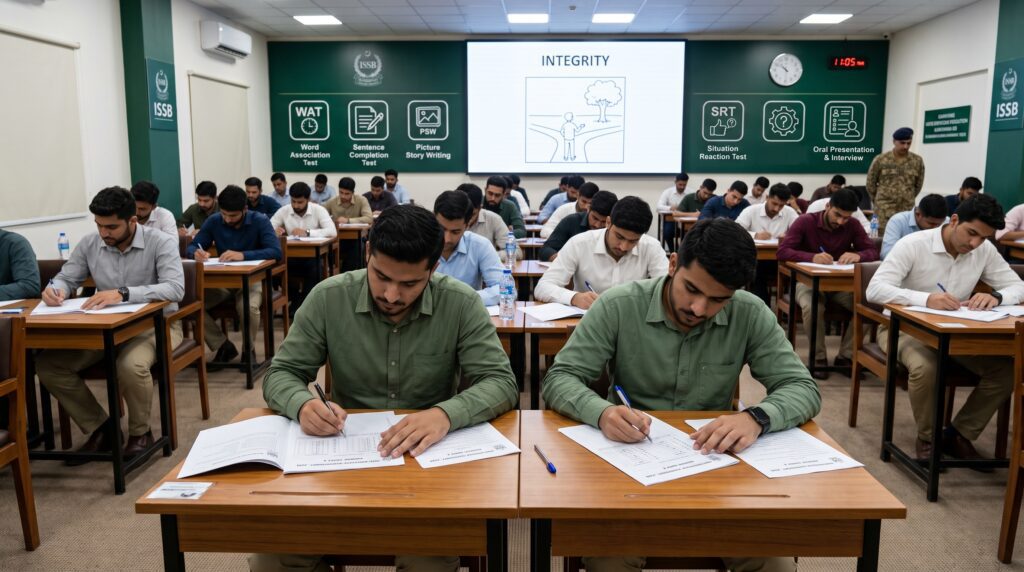
The first stage commonly includes verbal intelligence and non-verbal intelligence questions.
Verbal Intelligence Test
Common question types may include:
- Analogies
- Number sequences
- Letter series
- Coding and decoding
- Synonyms and antonyms
- Sentence completion
- Family relationships
- Direction problems
- Classification
- Odd-one-out questions
- Basic arithmetic reasoning
- Time, speed, and distance
The difficulty often comes from limited time rather than complex knowledge.
Non-Verbal Intelligence Test
Non-verbal questions use shapes, figures, symbols, and visual patterns.
Candidates may need to:
- Complete a figure series
- Find the missing shape
- Identify the odd figure
- Recognize rotation
- Understand a mirror image
- Follow changes in direction
- Count added or removed objects
- Identify alternating patterns
How to Prepare
- Learn one question type at a time.
- Practise without a strict timer.
- Review every incorrect answer.
- Identify why the mistake occurred.
- Repeat similar questions.
- Introduce time limits gradually.
- Attempt mixed mock tests.
A good preparation resource should explain the method behind an answer rather than simply showing the correct option.
Day Two: Psychological Assessment
Commonly prepared psychological activities include:
- Word Association Test
- Sentence Completion Test
- Picture Story Writing
- Situation Reaction Test
- Self-Description
These activities are designed to reveal patterns in the candidate’s attitudes, thought process, emotional responses, and self-awareness. ExamChamber’s preparation guide also presents these as central psychological-test areas.
Word Association Test
A word appears briefly, and the candidate writes a sentence or complete thought connected with it.
For example, consider the word failure.
A weak response might be:
Failure is always bad.
A more constructive response could be:
Failure helps a person identify mistakes and improve.
The purpose is not to force every word into an unrealistically positive statement. Write naturally, clearly, and responsibly.
Sentence Completion Test
Candidates may receive incomplete statements such as:
- My greatest strength is…
- When I make a mistake…
- My friends believe that…
- I feel worried when…
- My family expects me to…
- A responsible person should…
These answers may reveal attitudes toward relationships, responsibility, ambition, fear, failure, and self-improvement.
Do not attempt to present yourself as someone with no fears, weaknesses, disagreements, or mistakes.
Picture Story Writing
A clear picture story normally contains:
- A central character
- A realistic situation
- A problem or objective
- Practical action
- A believable result
A useful structure is:
Situation → Challenge → Action → Result
Avoid turning every image into a dramatic rescue operation or military mission.
Situation Reaction Test
Good responses generally show:
- Practical judgment
- Emotional control
- Responsibility
- Safety awareness
- Timely action
- Willingness to seek proper help
The most dramatic response is not always the best response.
Self-Description
Candidates may describe how they are viewed by:
- Parents
- Teachers
- Friends
- Classmates
- Colleagues
- Themselves
Prepare by reflecting honestly on your strengths, weaknesses, habits, achievements, failures, and responsibilities.
Day Three: GTO Tasks and Group Assessment
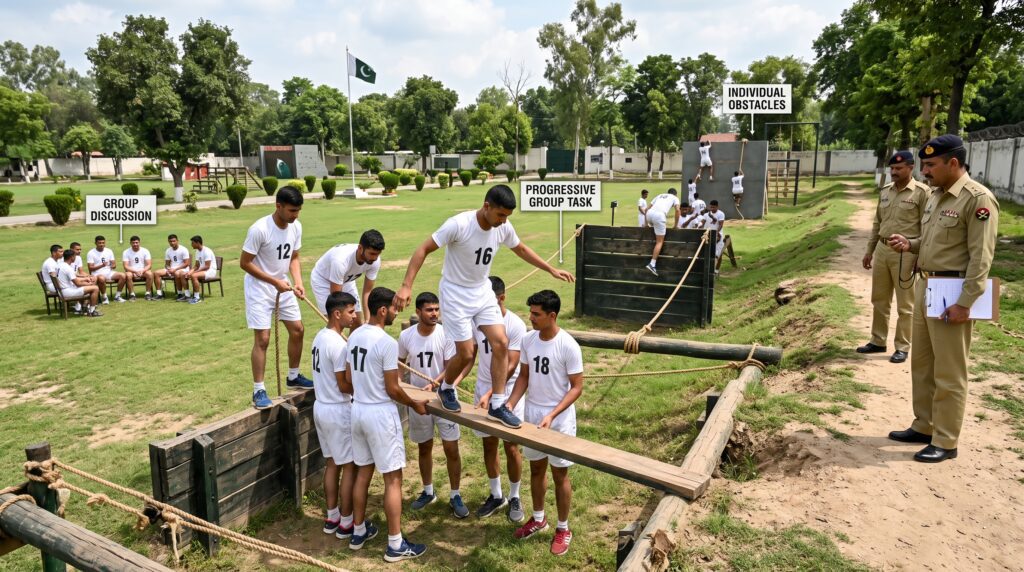
The Group Testing Officer assessment examines candidates in practical and social situations.
The GTO may observe:
- Participation
- Communication
- Cooperation
- Initiative
- Rule-following
- Problem-solving
- Leadership
- Ability to follow
- Response to failure
- Energy and determination
Group Discussion
A useful contribution should be:
- Relevant
- Clear
- Logical
- Respectful
- Brief
- Supported by an example where possible
Avoid shouting, interrupting repeatedly, or speaking without understanding the topic.
A candidate who makes three thoughtful points may perform better than someone who speaks continuously without adding value.
Group Planning Exercise
The group receives a situation containing several problems, available resources, distances, and time restrictions.
Use this method:
- Identify every problem.
- Decide which issue is most urgent.
- Calculate time and distance.
- Note the available resources.
- Divide responsibilities.
- Develop a realistic sequence.
- Present the final plan clearly.
The purpose is not to prove that your individual plan is superior. The purpose is to help the group reach a workable solution.
Progressive Group Task
Candidates cross a series of obstacles using limited supporting materials while following specific rules.
The GTO may observe whether you:
- Understand the restrictions
- Suggest practical solutions
- Help carry equipment
- Support group members
- Remain involved after failure
- Avoid prohibited actions
- Keep the group moving
Half Group Task
The group is divided into smaller teams, giving each candidate more opportunity to participate.
Do not suddenly become aggressive because fewer people are present. Continue listening, contributing, and supporting the team.
Command Task
One candidate is placed in command and asked to complete an obstacle with selected helpers.
A good commander should:
- Study the obstacle.
- Understand the rules.
- Explain a clear plan.
- Give respectful instructions.
- Use helpers effectively.
- Adjust the plan when needed.
- Accept responsibility for the result.
Leadership does not mean doing everything personally. It means organizing people and resources effectively.
Individual Obstacles
Individual obstacles may assess courage, determination, stamina, planning, and coordination.
Candidates should remain energetic but avoid reckless behaviour. Sensible effort creates a stronger impression than unnecessary risk.
Day Four: ISSB Interview and Final Conference
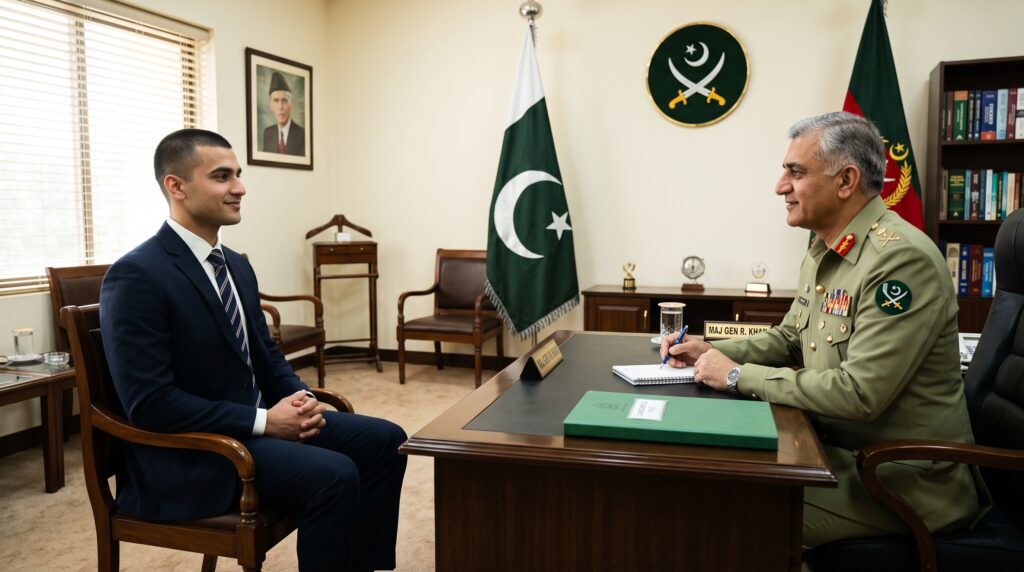
The ISSB interview explores the candidate’s personal background, education, relationships, general awareness, interests, motivation, and self-understanding.
Personal and Family Questions
Candidates may be asked about:
- Parents and their occupations
- Siblings
- Family responsibilities
- Home environment
- Financial circumstances
- Important family events
- Relationships with family members
Know the basic facts accurately. These questions may assess awareness, honesty, maturity, and responsibility.
Academic Questions
Prepare to discuss:
- Schools and colleges attended
- Marks and percentages
- Favourite subjects
- Weak subjects
- Academic failures
- Educational gaps
- Extracurricular activities
- Teachers who influenced you
If your performance declined, explain the reason honestly and describe what you did afterward.
Social Life and Hobbies
Questions may cover:
- Close friends
- Qualities of your best friend
- Social media use
- Sports
- Books
- Hobbies
- Disagreements
- Use of free time
Do not invent a hobby because it sounds impressive. The interviewer may ask detailed follow-up questions.
Mathematics and Academic Knowledge
Candidates may face questions involving:
- Mental arithmetic
- Percentages
- Ratios
- Speed, time, and distance
- Basic algebra
- Physics principles
- Subjects studied at school or college
When you do not know an answer, admit it calmly rather than guessing confidently.
Current Affairs
Candidates should understand:
- Pakistan’s geography
- National institutions
- Economic challenges
- Social issues
- Regional security
- Major international developments
- The basic structure of the Armed Forces
- Their chosen service and branch
For every major issue, ask:
- What happened?
- Why did it happen?
- Who is affected?
- What may happen next?
- What is my balanced opinion?
Why Do You Want to Join the Armed Forces?
Avoid giving a memorized slogan.
A sincere answer may refer to:
- Desire to serve Pakistan
- Interest in leadership
- Attraction to a disciplined profession
- Willingness to accept responsibility
- Family inspiration
- Interest in a specific branch
- Long-term professional goals
Your motivation should match your knowledge. A candidate who claims a lifelong interest in the Navy but knows nothing about naval duties may appear poorly prepared.
The Final Conference
After the assessments and interview, the selectors compare their observations.
The board may decide that the candidate is:
- Recommended
- Not recommended
A recommendation does not guarantee final admission to a military academy. The result is forwarded to the relevant service headquarters, which prepare the final merit list according to medical fitness, available vacancies, service requirements, and other conditions.
ISSB result check by Name: The Correct Official Method
ISSB result check by Name is a popular search phrase, but candidates should understand that the current official system does not provide an open public name-search facility.
The official ISSB candidate login asks for:
- CNIC number
- Password
Candidates should sign in through their own accounts to review the available information.
How to Check Your ISSB Result
- Visit the official ISSB website.
- Open the candidate portal.
- Enter your CNIC.
- Enter your password.
- Open the result-status section.
- Review the available information.
- Use official contact details if you cannot access your account.
Avoid websites that ask for payment, verification codes, passwords, or unnecessary personal information to perform a public name search.
How to Prepare for ISSB Step by Step
Step 1: Assess Your Current Position
Evaluate yourself in:
- Verbal intelligence
- Non-verbal reasoning
- English communication
- Mathematics
- General knowledge
- Current affairs
- Physical fitness
- Group discussion
- Interview confidence
- Self-awareness
Write down your three strongest and three weakest areas.
Step 2: Create a Daily Preparation Routine
A balanced routine may include:
- 30 minutes of verbal reasoning
- 30 minutes of non-verbal reasoning
- 20 minutes of current affairs
- 15 minutes of speaking practice
- 30 to 45 minutes of physical exercise
- Short psychological-test practice on selected days
Daily consistency is more valuable than one long session every weekend.
Step 3: Improve Communication Naturally
Choose a topic and speak about it for two minutes.
Record yourself and review:
- Clarity
- Logical order
- Repetition
- Speaking speed
- Confidence
- Unnecessary filler words
You do not need an artificial accent. Clear thinking and understandable speech are more important.
Step 4: Build Current-Affairs Knowledge
Read reliable national and international news.
Do not memorize headlines alone. Summarize each major issue using three points:
- What happened
- Why it matters
- Your balanced opinion
This improves performance in both interviews and group discussions.
Step 5: Practise Psychological Tests Responsibly
Practise writing quickly, but do not memorize model answers.
Your goal should be to improve:
- Speed of expression
- Sentence clarity
- Practical thinking
- Self-awareness
- Emotional balance
- Consistency
The official ISSB guidelines advise candidates to remain honest, straightforward, and natural. They warn against false projection and rigid coaching that teaches candidates to behave artificially.
Step 6: Join Group Discussions
Practise discussing meaningful topics with friends or classmates.
Focus on:
- Entering the discussion politely
- Presenting one clear argument
- Supporting it with an example
- Listening to others
- Disagreeing respectfully
- Summarizing important points
Step 7: Improve Physical Readiness
Follow a gradual routine involving:
- Running
- Push-ups
- Sit-ups
- Chin-ups where appropriate
- Stretching
- Mobility exercises
- Basic strength training
Do not begin an extreme routine immediately before ISSB. Confirm the current physical standards for your specific service and course.
Step 8: Know Yourself
Prepare accurate information about:
- Academic marks
- Family
- Friends
- Hobbies
- Achievements
- Failures
- Responsibilities
- Strengths
- Weaknesses
- Reasons for joining
- Preferred service and branch
The answers you provide in forms, psychological tests, and interviews should remain consistent.
Step 9: Attempt Timed Mock Tests
Timed practice develops:
- Speed
- Accuracy
- Concentration
- Mental stamina
- Time management
- Recovery after mistakes
Always review incorrect answers. Completing repeated tests without analysing mistakes produces limited improvement.
Step 10: Rest Before Reporting
During the final days:
- Organize all original documents.
- Review important current affairs.
- Continue light physical exercise.
- Avoid exhausting study sessions.
- Maintain a proper sleep routine.
- Confirm travel arrangements.
- Read the official joining instructions again.
A rested candidate is more likely to think clearly and manage pressure.
Common ISSB Mistakes to Avoid
Memorizing Model Answers
Memorized psychological and interview responses can create contradictions.
Dominating Group Tasks
Leadership means improving the group’s performance, not controlling every participant.
Remaining Completely Silent
Candidates need to participate enough for selectors to assess them.
Pretending to Know Everything
Admitting that you cannot recall an answer is better than confidently presenting incorrect information.
Creating a Fake Personality
Artificial behaviour becomes difficult to maintain across four days of assessment.
Ignoring Physical Fitness
Poor stamina can affect confidence, concentration, and participation.
Using Outdated Information
Schedules, age limits, course names, and physical requirements may change.
Trusting Unofficial Result Websites
Use the official candidate portal and protect your CNIC, password, and verification codes.
Believing in Guaranteed Selection
No website, book, instructor, or preparation academy can guarantee an ISSB recommendation.
Why a Structured ISSB Preparation Product Is Worth the Investment
Free information is available through websites, videos, social media groups, and forums. However, scattered preparation often creates confusion.
Common problems include:
- Repeated content
- Outdated requirements
- Incorrect answers
- Missing topics
- No progress tracking
- Unverified interview questions
- Psychological advice that encourages artificial responses
- Too much time spent searching instead of practising
A well-organized ISSB preparation product can solve these problems by placing important material in one structured system.
A useful product should include:
- Verbal intelligence practice
- Non-verbal intelligence practice
- Timed mock tests
- Answer explanations
- Psychological-test guidance
- Interview preparation
- General knowledge
- Current affairs
- English and mathematics revision
- GTO guidance
- Progress tracking
The value is not simply the number of questions. The real value is direction.
For example, suppose a candidate performs well in English and general knowledge but repeatedly struggles with visual patterns. A tracked preparation system makes that weakness visible. The candidate can then spend more time on non-verbal reasoning instead of repeating familiar subjects.
This makes preparation more focused and efficient.
Why Choose ExamChamber for ISSB Preparation?
The ExamChamber ISSB Test Preparation guide brings together intelligence practice, psychological-test guidance, GTO information, interview preparation, general knowledge, current affairs, mathematics, English, and related Armed Forces resources.
Its ISSB page currently describes the core guide as free and presents links to subject-based preparation material. It also states that its test resources include results and explanations.
This makes it useful for candidates who want to:
- Begin preparation without searching across many unrelated websites
- Understand the major ISSB stages
- Practise intelligence questions
- Review academic subjects
- Identify weak areas
- Build a consistent study routine
- Access related Army, Navy, and Air Force preparation
Buy With Confidence, Not Because of Empty Promises
A serious preparation product should not promise guaranteed selection.
Instead, it should help you:
- Save preparation time
- Organize your study
- Understand test formats
- Review mistakes
- Improve speed
- Build confidence through practice
- Measure progress
Before purchasing any premium package, confirm:
- What material is included
- Whether access is time-limited
- Whether explanations are provided
- Whether tests are mobile-friendly
- Whether the content is regularly updated
- Whether customer support is available
- Whether refund or access terms are clearly stated
A good product does not create a fake officer-like personality. It helps a genuine candidate prepare more effectively.
Start your ISSB preparation with ExamChamber and build your routine around intelligence practice, communication, current affairs, physical readiness, and honest self-assessment.
Frequently Asked Questions
What Is the ISSB Official Website?
The ISSB official website is the authoritative source for the schedule, candidate portal, joining instructions, selection information, downloads, and contact details.
How Long Does the ISSB Test Last?
The official selection process lasts four days after the arrival day. The exact structure of activities may be adjusted according to service requirements.
How Can I Complete ISSB Registration?
First apply through the relevant Armed Force. When your candidacy is available in the ISSB system, use the official candidate registration page to verify your CNIC, email, mobile number, and password.
How Can I Check My ISSB Call Letter?
Sign in through the ISSB candidate portal and review your call information.
What Is the ISSB Test Date 2026?
Dates depend on the service and course. Consult the official ISSB schedule and your individual call status.
Are ISSB Requirements for Females the Same for Every Service?
No. Female eligibility depends on the course, service, branch, qualification, age limit, and current advertisement.
Can I Complete an ISSB Result Check by Name?
The current official candidate portal requires CNIC and password credentials. Candidates should avoid unofficial name-search websites.
Is Coaching Necessary for ISSB?
No. Structured preparation may improve familiarity, speed, and confidence, but memorizing answers or copying another personality can be harmful.
Can a Quiet Candidate Be Recommended?
Yes. Candidates do not need to be loud. They need to participate meaningfully, communicate clearly, cooperate, and demonstrate sound judgment.
Does Physical Strength Decide the Result?
No. Physical readiness is helpful, but ISSB also evaluates practical intelligence, communication, emotional stability, teamwork, and leadership potential.
Does an ISSB Recommendation Guarantee Final Selection?
No. Final selection may also depend on medical fitness, available vacancies, course conditions, and service-level merit.
Frequently Asked Questions
How can I pass the ISSB test?
You can improve your chances by practising verbal and non-verbal intelligence questions, staying physically fit, following current affairs, communicating confidently, working well in groups, and presenting your natural personality honestly.
What is the ISSB selection process?
The ISSB selection process includes intelligence screening, psychological tests, group discussions, planning exercises, outdoor GTO tasks, a personal interview, and a final conference where the assessors review your overall performance.
Which book is best for ISSB?
A good ISSB preparation book should cover intelligence tests, psychological exercises, GTO tasks, interviews, general knowledge, and solved practice questions, with Dogar Brothers’ ISSB guides being a commonly used option.
What is the syllabus of ISSB?
The ISSB syllabus broadly covers verbal and non-verbal intelligence, psychological tests, group planning and leadership tasks, personal and academic interview questions, current affairs, general knowledge, and basic mathematics.
Is the ISSB interview difficult?
The ISSB interview can feel challenging because questions cover your personality, family, education, social life, current affairs, and motivation, but honest answers, self-awareness, and calm communication make it manageable.
Read More : Nadra 2026 Jobs announced
Final Thoughts
ISSB: The Complete Journey of Officer Selection in the Pakistan Armed Forces is not a search for a flawless person. It is an assessment of whether a candidate has the potential to be trained as an officer.
You do not need to speak first in every discussion.
You do not need to answer every interview question perfectly.
You do not need to complete every obstacle before everyone else.
However, you should demonstrate:
- Honesty
- Responsibility
- Courage
- Cooperation
- Practical judgment
- Emotional control
- Self-awareness
- Willingness to improve
Prepare your intelligence, but do not ignore your character.
Improve your communication, but do not become artificial.
Develop your fitness, but do not confuse recklessness with courage.
Study current affairs, but develop your own balanced opinions instead of repeating memorized statements.
Most importantly, remain consistent.
A candidate who writes responsibly, behaves cooperatively, and speaks honestly creates a believable impression. That consistency is difficult to imitate because it develops through genuine preparation and personal growth.
Use the ISSB official website for authoritative instructions and ExamChamber’s ISSB preparation resources for organized practice.
The journey is demanding, but preparation itself can teach discipline, leadership, patience, teamwork, and self-awareness. Even before you wear the uniform, those lessons can begin shaping you into someone ready to earn it.