Preparing for the FIA Constable written test requires more than memorising a few vocabulary lists. Candidates should understand commonly tested synonyms, antonyms, preposition combinations, sentence structures, tenses, narration rules, and active and passive voice.
This first set of FIA Constable English most important MCQs with answers 2026 contains 100 carefully edited practice questions. The questions have been arranged by topic so that candidates can identify weak areas and revise them systematically.
This is an independent educational resource. It is not an official FIA paper, answer key, or subject-wise syllabus.
FIA Constable Recruitment 2026: Official Test Context

The official 2026 FIA recruitment advertisement listed 941 Constable positions in BS-05. For the Constable post, it specified second-class matriculation from a recognised board, an age range of 18–25 years with five years of general age relaxation, and prescribed physical measurements.
The advertisement also stated that eligible Constable candidates would first undergo physical measurements and an endurance test. The endurance requirement was a one-mile or 1.6-kilometre run within seven minutes for men and ten minutes for women. Only successful candidates would proceed to the computer-based written examination.
Applications under that advertisement closed on 4 May 2026. Candidates should check the official FIA careers section for subsequent recruitment notices, test schedules, or corrections rather than relying on unofficial social-media posts.
Syllabus note: The cited recruitment advertisement confirms a written computer-based examination but does not provide a detailed subject-by-subject English syllabus. Therefore, these MCQs should be treated as general preparation material rather than an official prediction.
What This FIA English Practice Set Covers
| Section | Topic | Questions |
|---|---|---|
| 1 | Synonyms | 1–25 |
| 2 | Antonyms | 26–50 |
| 3 | Prepositions | 51–70 |
| 4 | Grammar, tenses, voice, and narration | 71–100 |
| Total | English practice questions | 100 |
How to Practise These MCQs Effectively
Attempt each section before opening its answer key. Allow yourself approximately 30 to 45 seconds for a vocabulary question and one minute for a grammar question.
While checking your answers:
- Write unfamiliar words in a vocabulary notebook.
- Record the correct preposition with the complete phrase.
- Identify the grammar rule behind every incorrect answer.
- Retake the test after three to five days.
- Practise under timed conditions after completing topic-wise revision.
1st Year English MCQs with Answers PDF Full Book 2026 Term: Relevant Topics
Students searching for 1st Year English MCQs with answers PDF Full Book 2026 term usually need vocabulary, grammar, textbook, and sentence-correction practice.
For FIA preparation, the most useful overlapping areas are:
- Synonyms and antonyms
- Articles and prepositions
- Subject-verb agreement
- Correct spellings
- Tenses
- Direct and indirect speech
- Active and passive voice
Textbook-specific questions may help students academically, but candidates should also practise general English questions that are not tied to a particular chapter.
Test Point MCQs PDF: Use Topic-Wise Preparation
Candidates searching for Test Point MCQs PDF often want short practice material for competitive examinations. Randomly memorising hundreds of answers, however, is less effective than organising questions by rule.
A better approach is to complete one topic at a time:
- Learn the basic rule.
- Attempt 20–30 questions.
- Review every mistake.
- Create five original examples.
- Attempt a mixed test at the end of the week.
This page is not affiliated with Test Point and does not reproduce any third-party PDF.
English MCQs for Entry Test with Answers PDF: Skills to Develop
Most English MCQs for entry Test with Answers PDF resources focus on speed and recognition. Candidates should develop the ability to:
- Recognise the closest contextual meaning of a word
- Distinguish synonyms from antonyms
- Select fixed preposition combinations
- Identify tense structures
- Correct agreement errors
- Transform active sentences into passive voice
- Convert direct speech into reported speech
The purpose of practice should be understanding, not simply remembering option letters.
Mcqs of English 1st Year with Answers: Vocabulary Foundation
Mcqs of English 1st year with Answers can provide a useful foundation for candidates whose vocabulary is weak.
Start by learning words in groups:
| Word | Synonym | Antonym |
|---|---|---|
| Abundant | Plentiful | Scarce |
| Arrogant | Conceited | Humble |
| Brave | Courageous | Cowardly |
| Industrious | Diligent | Lazy |
| Wise | Prudent | Foolish |
Use each word in a complete sentence. This helps you understand meaning, tone, and context instead of memorising isolated pairs.
2nd Year English MCQs with Answers PDF Taleem City: Exam-Style Revision
People searching for 2nd Year English MCQs with answers PDF Taleem City may also benefit from general grammar practice. Intermediate-level English commonly reinforces narration, voice, prepositions, articles, vocabulary, and sentence correction.
FIA candidates should use such academic material as supplementary practice and combine it with timed competitive-exam questions.
This independent article is not affiliated with Taleem City and does not claim ownership of its material.
Important MCQs of English Class 12 with Answers PDF 2026: Grammar Priorities
For Important MCQs of English class 12 with answers PDF 2026, focus on rules that can be tested through short objective questions:
- Past perfect and future continuous tenses
- First and second conditional sentences
- Singular and plural subject agreement
- Pronouns such as who and whom
- Since and for
- Correct use of articles
- Passive-voice structures
- Reporting verbs and tense changes
These areas are also valuable for general entry-test preparation.
Class 11 English MCQs 2026: Topics Worth Revising
Candidates using Class 11 English MCQs 2026 should prioritise transferable language skills instead of limiting preparation to textbook facts.
Useful areas include:
- Vocabulary in context
- Commonly confused words
- Correct spelling
- Preposition combinations
- Basic tense recognition
- Articles before vowel sounds
- Singular and plural nouns
- Comparative structures
1st Year English Important MCQs 2026: Seven-Day Study Plan
Use 1st Year English important MCQs 2026 as part of this simple revision schedule:
| Day | Revision Topic |
|---|---|
| Day 1 | Synonyms |
| Day 2 | Antonyms |
| Day 3 | Prepositions |
| Day 4 | Tenses and conditionals |
| Day 5 | Active and passive voice |
| Day 6 | Narration and sentence correction |
| Day 7 | Full timed practice test |
FIA Constable English Synonyms MCQs
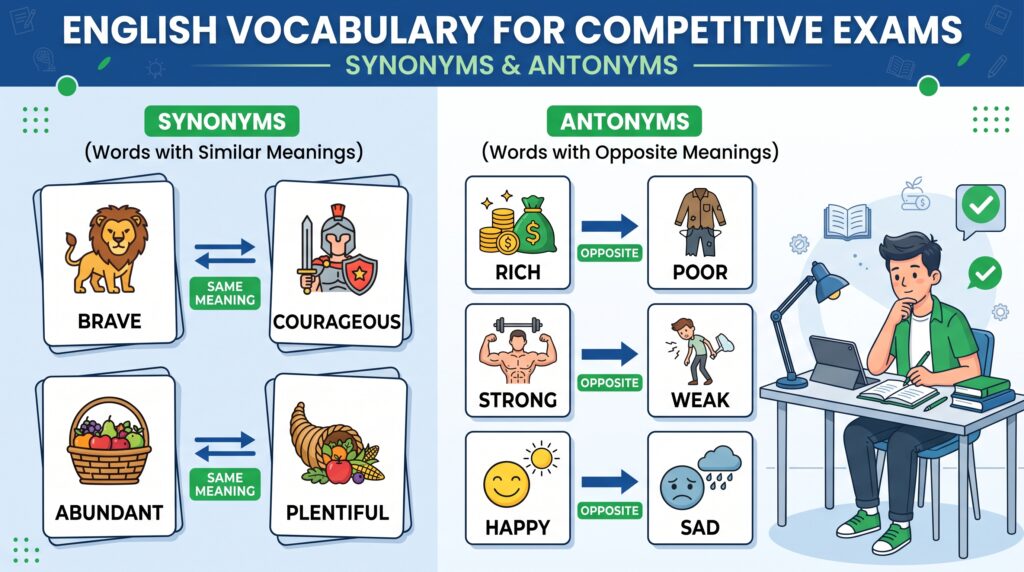
A synonym is a word with the same or nearly the same meaning as another word. Synonyms are not always interchangeable in every context, so choose the option closest to the meaning used in the question.
1. Choose the word closest in meaning to magnanimous.
A. Naive
B. Proud
C. Selfish
D. Generous
2. Choose the synonym of arrogant.
A. Conceited
B. Noble
C. Progressive
D. Humble
3. Choose the closest meaning of alert.
A. Vigilant
B. Sleepy
C. Careless
D. Dull
4. Choose the synonym of industrious.
A. Negligent
B. Idle
C. Diligent
D. Lazy
5. Choose the closest synonym of gregarious.
A. Timid
B. Uninteresting
C. Solitary
D. Sociable
6. Choose the synonym of abundant.
A. Rare
B. Scarce
C. Plentiful
D. Insufficient
7. Choose the word closest in meaning to beautiful.
A. Rough
B. Ugly
C. Gorgeous
D. Plain
8. Choose the synonym of brave.
A. Courageous
B. Timid
C. Cowardly
D. Fearful
9. Choose the word closest in meaning to clever.
A. Foolish
B. Intelligent
C. Dull
D. Unwise
10. Choose the synonym of famous.
A. Hidden
B. Unknown
C. Renowned
D. Obscure
11. Choose the closest meaning of happy.
A. Depressed
B. Joyful
C. Sad
D. Miserable
12. Choose the synonym of honest.
A. Deceptive
B. Dishonest
C. Truthful
D. Corrupt
13. Choose the closest synonym of large.
A. Huge
B. Narrow
C. Small
D. Tiny
14. Choose the synonym of quick.
A. Sluggish
B. Delayed
C. Slow
D. Fast
15. Choose the word closest in meaning to rich.
A. Penniless
B. Needy
C. Poor
D. Wealthy
16. Choose the synonym of strong.
A. Powerful
B. Weak
C. Fragile
D. Feeble
17. Choose the most suitable synonym of wise.
A. Prudent
B. Foolish
C. Ignorant
D. Careless
18. Choose the closest meaning of angry.
A. Calm
B. Cheerful
C. Peaceful
D. Furious
19. Choose the synonym of begin.
A. Stop
B. Finish
C. Start
D. End
20. Choose the closest synonym of bright.
A. Dim
B. Shining
C. Dark
D. Gloomy
21. Choose the word closest in meaning to cold.
A. Hot
B. Warm
C. Chilly
D. Boiling
22. Choose the synonym of dangerous.
A. Risky
B. Safe
C. Secure
D. Harmless
23. Choose the closest meaning of easy.
A. Simple
B. Difficult
C. Tough
D. Complicated
24. Choose the synonym of fast.
A. Swift
B. Slow
C. Motionless
D. Delayed
25. Choose the word closest in meaning to good.
A. Poor
B. Excellent
C. Bad
D. Inferior
Synonyms Answer Key
- D — Generous | 2. A — Conceited | 3. A — Vigilant | 4. C — Diligent | 5. D — Sociable
- C — Plentiful | 7. C — Gorgeous | 8. A — Courageous | 9. B — Intelligent | 10. C — Renowned
- B — Joyful | 12. C — Truthful | 13. A — Huge | 14. D — Fast | 15. D — Wealthy
- A — Powerful | 17. A — Prudent | 18. D — Furious | 19. C — Start | 20. B — Shining
- C — Chilly | 22. A — Risky | 23. A — Simple | 24. A — Swift | 25. B — Excellent
FIA Constable English Antonyms MCQs
An antonym is a word with an opposite meaning. Learning vocabulary in synonym-antonym groups can make words easier to remember.
26. Choose the antonym of industrious.
A. Hard-working
B. Lazy
C. Active
D. Energetic
27. Choose the word opposite in meaning to gregarious.
A. Friendly
B. Talkative
C. Sociable
D. Solitary
28. Choose the antonym of arrogant.
A. Conceited
B. Humble
C. Proud
D. Haughty
29. Choose the word opposite in meaning to generous.
A. Stingy
B. Kind
C. Magnanimous
D. Liberal
30. Choose the antonym of beautiful.
A. Ugly
B. Pretty
C. Gorgeous
D. Attractive
31. Choose the word opposite in meaning to brave.
A. Courageous
B. Cowardly
C. Bold
D. Fearless
32. Choose the antonym of clever.
A. Stupid
B. Smart
C. Intelligent
D. Wise
33. Choose the word opposite in meaning to happy.
A. Pleased
B. Cheerful
C. Joyful
D. Sad
34. Choose the antonym of honest.
A. Sincere
B. Truthful
C. Dishonest
D. Loyal
35. Choose the word opposite in meaning to large.
A. Big
B. Huge
C. Small
D. Enormous
36. Choose the antonym of quick.
A. Rapid
B. Slow
C. Fast
D. Speedy
37. Choose the word opposite in meaning to rich.
A. Poor
B. Prosperous
C. Affluent
D. Wealthy
38. Choose the antonym of strong.
A. Mighty
B. Weak
C. Sturdy
D. Powerful
39. Choose the word opposite in meaning to wise.
A. Sensible
B. Intelligent
C. Prudent
D. Foolish
40. Choose the antonym of angry.
A. Furious
B. Enraged
C. Irritated
D. Calm
41. Choose the word opposite in meaning to begin.
A. Commence
B. Initiate
C. End
D. Start
42. Choose the antonym of bright.
A. Dark
B. Shining
C. Brilliant
D. Light
43. Choose the word opposite in meaning to cold.
A. Cool
B. Freezing
C. Hot
D. Chilly
44. Choose the antonym of dangerous.
A. Risky
B. Safe
C. Hazardous
D. Perilous
45. Choose the word opposite in meaning to easy.
A. Effortless
B. Difficult
C. Manageable
D. Simple
46. Choose the antonym of fast.
A. Speedy
B. Quick
C. Slow
D. Rapid
47. Choose the word opposite in meaning to good.
A. Fine
B. Great
C. Bad
D. Excellent
48. Choose the antonym of big.
A. Huge
B. Small
C. Large
D. Enormous
49. Choose the word opposite in meaning to love.
A. Adore
B. Hate
C. Affection
D. Like
50. Choose the antonym of success.
A. Achievement
B. Triumph
C. Victory
D. Failure
Antonyms Answer Key
- B — Lazy | 27. D — Solitary | 28. B — Humble | 29. A — Stingy | 30. A — Ugly
- B — Cowardly | 32. A — Stupid | 33. D — Sad | 34. C — Dishonest | 35. C — Small
- B — Slow | 37. A — Poor | 38. B — Weak | 39. D — Foolish | 40. D — Calm
- C — End | 42. A — Dark | 43. C — Hot | 44. B — Safe | 45. B — Difficult
- C — Slow | 47. C — Bad | 48. B — Small | 49. B — Hate | 50. D — Failure
FIA Constable Preposition MCQs
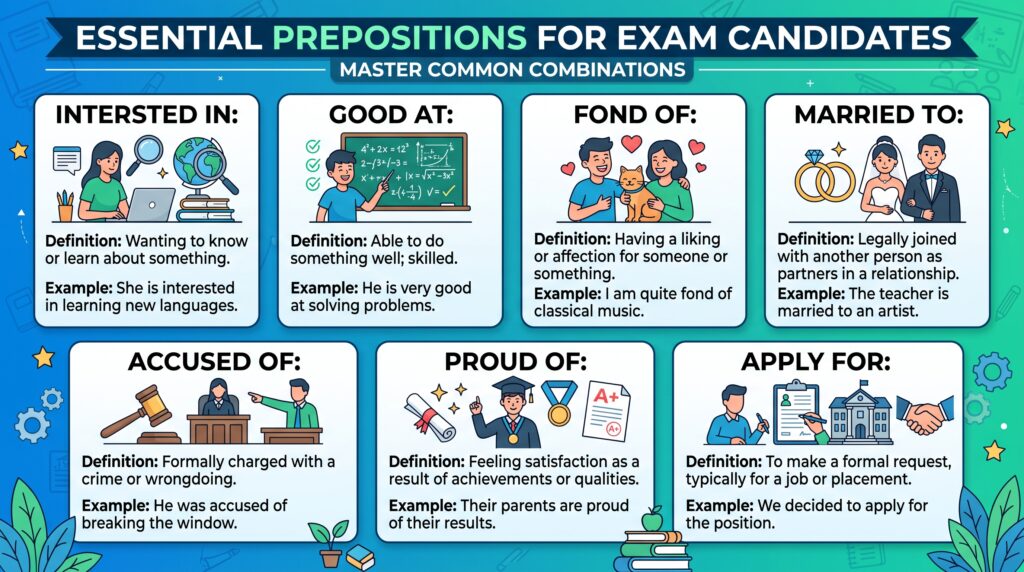
Prepositions frequently appear in fixed combinations. Learn the complete expression, such as interested in, good at, and accused of, rather than memorising the preposition alone.
51. I insisted _____ going with them.
A. with
B. for
C. to
D. on
52. He is tired _____ doing the same work every day.
A. from
B. at
C. by
D. of
53. She is good _____ English.
A. at
B. in
C. on
D. with
54. He died _____ cancer.
A. by
B. of
C. from
D. with
55. The book is divided _____ three sections.
A. to
B. into
C. in
D. with
56. She is afraid _____ dogs.
A. by
B. of
C. with
D. from
57. He is fond _____ classical music.
A. of
B. with
C. for
D. to
58. They arrived _____ the railway station late.
A. in
B. at
C. on
D. by
59. The cat jumped _____ the wall.
A. at
B. on
C. in
D. over
60. He is married _____ a doctor.
A. with
B. by
C. for
D. to
61. She is interested _____ painting.
A. on
B. with
C. at
D. in
62. We travelled there _____ bus.
A. on
B. by
C. in
D. with
63. He lives _____ Lahore.
A. at
B. in
C. on
D. by
64. The train arrived _____ time.
A. by
B. on
C. at
D. in
65. She is suffering _____ a fever.
A. by
B. of
C. from
D. with
66. He was accused _____ theft.
A. of
B. with
C. for
D. by
67. They are proud _____ their son.
A. for
B. with
C. of
D. on
68. She applied _____ the vacant position.
A. with
B. to
C. for
D. on
69. He is good _____ mathematics.
A. at
B. on
C. with
D. in
70. The meeting was put _____ until next week.
A. off
B. in
C. on
D. at
Prepositions Answer Key
- D — on | 52. D — of | 53. A — at | 54. B — of | 55. B — into
- B — of | 57. A — of | 58. B — at | 59. D — over | 60. D — to
- D — in | 62. B — by | 63. B — in | 64. B — on | 65. C — from
- A — of | 67. C — of | 68. C — for | 69. A — at | 70. A — off
FIA Constable Grammar, Tenses, Voice, and Narration MCQs
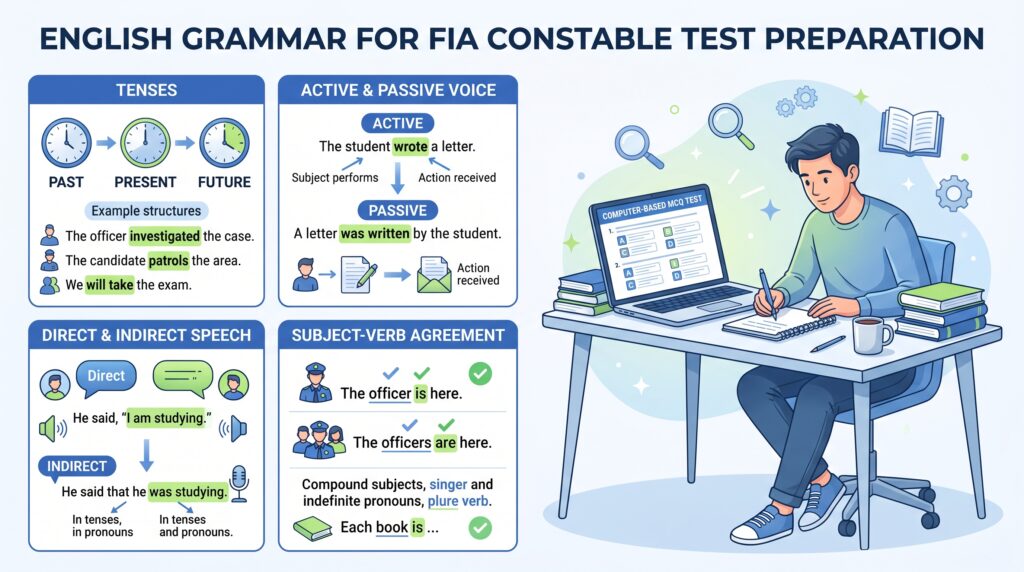
71. Choose the correct passive form of “He is reading a book.”
A. A book is read by him.
B. A book read him.
C. A book is being read by him.
D. A book was being read by him.
72. Choose the passive form of “They eat food.”
A. They are eating food.
B. Food is eaten by them.
C. Food was eaten by them.
D. Food eats them.
73. Change into indirect speech: He said, “I am busy.”
A. He said that I am busy.
B. He says that he was busy.
C. He said that he was busy.
D. He told that he is busy.
74. Change into indirect speech: She said, “I can help you.”
A. She said me that she could help.
B. She told that she could help me.
C. She said that she could help me.
D. She said that she can help me.
75. Complete the future continuous sentence: “I _____ television at 8 p.m.”
A. will be watching
B. watch
C. watched
D. am watching
76. Complete the past perfect sentence: “She _____ before I arrived.”
A. left
B. had left
C. has left
D. leaves
77. Choose the grammatically correct sentence.
A. She is more taller than I am.
B. She is more tall than I am.
C. She is tallest than I am.
D. She is taller than I am.
78. Choose the correct article: “_____ honest man is respected.”
A. A
B. An
C. No article
D. The
79. Complete the sentence: “Neither he nor I _____ going.”
A. were
B. is
C. are
D. am
80. Complete the sentence: “One of the boys _____ absent.”
A. is
B. have
C. were
D. are
81. Choose the correct passive form of “She wrote a letter.”
A. A letter is written by her.
B. A letter was written by her.
C. A letter had written by her.
D. She was written a letter.
82. Complete the first conditional: “If it rains, we _____ at home.”
A. would stay
B. staying
C. stayed
D. will stay
83. Choose the correctly spelled word.
A. Accomodation
B. Acommodation
C. Accommodation
D. Accommadation
84. Choose the synonym of eager.
A. Reluctant
B. Unwilling
C. Lazy
D. Keen
85. Choose the antonym of ancient.
A. Historic
B. Old
C. Antique
D. Modern
86. Complete the sentence: “He is fond _____ swimming.”
A. to
B. of
C. with
D. for
87. Complete the sentence: “She has been living here _____ 2010.”
A. by
B. since
C. for
D. from
88. Choose the correct passive form of “They built the house.”
A. The house has built by them.
B. The house was built by them.
C. The house is built by them.
D. They were built the house.
89. Complete the sentence: “He, as well as his friends, _____ coming.”
A. have
B. were
C. are
D. is
90. Complete the sentence: “The news _____ true.”
A. are
B. were
C. is
D. have
91. Complete the sentence: “I have never _____ to London.”
A. gone
B. went
C. go
D. been
92. Complete the sentence: “She is one of the best _____ in the class.”
A. student
B. student’s
C. students
D. peoples
93. Complete the sentence: “He died _____ a heart attack.”
A. of
B. with
C. from
D. by
94. Choose the antonym of abundant.
A. Ample
B. Sufficient
C. Plentiful
D. Scarce
95. Complete the formal sentence: “This is the boy _____ I met yesterday.”
A. whom
B. whose
C. which
D. who
96. Choose the best passive form of “She speaks English fluently.”
A. She is spoken English fluently.
B. English is spoken fluently by her.
C. English speaks fluently by her.
D. English was spoken fluently by her.
97. Complete the hypothetical conditional: “If I _____ rich, I would help the poor.”
A. were
B. was
C. be
D. am
98. Choose the synonym of miserable.
A. Unhappy
B. Joyful
C. Delighted
D. Cheerful
99. Complete the sentence: “He is senior _____ me.”
A. with
B. than
C. from
D. to
100. Choose the correct verb in standard British English: “The jury _____ divided in their opinions.”
A. has
B. is
C. was
D. were
Grammar Answer Key
- C — A book is being read by him. | 72. B — Food is eaten by them. | 73. C — He said that he was busy. | 74. C — She said that she could help me. | 75. A — will be watching
- B — had left | 77. D — She is taller than I am. | 78. B — An | 79. D — am | 80. A — is
- B — A letter was written by her. | 82. D — will stay | 83. C — Accommodation | 84. D — Keen | 85. D — Modern
- B — of | 87. B — since | 88. B — The house was built by them. | 89. D — is | 90. C — is
- D — been | 92. C — students | 93. A — of | 94. D — Scarce | 95. A — whom
- B — English is spoken fluently by her. | 97. A — were | 98. A — Unhappy | 99. D — to | 100. D — were
Important English Rules to Remember
Present Continuous Passive Voice
The structure is:
Object + is/am/are + being + past participle
Example:
He is reading a book.
A book is being read by him.
Past Perfect Tense
Use the past perfect for an action completed before another past action:
Subject + had + past participle
Example:
She had left before I arrived.
First Conditional
Use the first conditional for a realistic future possibility:
If + present simple, will + base verb
Example:
If it rains, we will stay at home.
Neither…Nor Agreement
The verb normally agrees with the subject closest to it:
Neither he nor I am going.
Because I is nearest to the verb, am is correct.
“One of” Uses a Singular Verb
The subject is one, not boys:
One of the boys is absent.
However, the noun following one of the should normally be plural:
She is one of the best students.
Articles Depend on Sound
Use an before a vowel sound:
- An honest person
- An hour
- An honour
The letter h is silent in these words.
Since and For
Use since with a starting point:
Since 2010
Since Monday
Use for with a duration:
For five years
For two weeks
Senior Takes “To”
Correct:
He is senior to me.
Incorrect:
He is senior than me.
The same pattern is commonly used with junior, superior, and inferior.
Who and Whom
Use who as a subject and whom as an object in formal grammar:
Who called you?
Whom did you meet?
In everyday English, who is frequently used instead of whom, but formal examinations may still expect the traditional distinction.
Collective Nouns in British English
A collective noun may take a plural verb when its members are considered individually:
The jury were divided in their opinions.
A singular verb is used when the group acts as one unit:
The jury has reached its verdict.
Common Mistakes to Avoid
Do not memorise only A, B, C, or D. Option positions may change in the actual examination.
Avoid treating every similar word as an exact replacement. Wise, intelligent, and prudent, for example, are related but have different shades of meaning.
Learn fixed expressions as complete units:
- Fond of
- Interested in
- Good at
- Married to
- Accused of
- Proud of
- Apply for
Do not rely on unverified “leaked papers.” Use official recruitment notices for dates and eligibility information, and use practice material only for preparation.
FIA English MCQs Scoring Guide
| Correct Answers | Performance |
|---|---|
| 90–100 | Excellent |
| 75–89 | Very good |
| 60–74 | Good, but revision is needed |
| 40–59 | Basic preparation |
| Below 40 | More topic-wise practice required |
Review the relevant rule behind every wrong answer before attempting another full test.
Suggested Internal Link Opportunities
- FIA Constable complete test preparation guide
- FIA physical and endurance test requirements
- English antonyms MCQs with answers
- Active and passive voice practice questions
- Direct and indirect speech MCQs for entry tests
Frequently Asked Questions About English Grammar MCQs
1. What are MCQs in English grammar?
English grammar MCQs are multiple-choice questions that test vocabulary, sentence structure, tenses, prepositions, articles, voice, narration, punctuation, and other language rules.
2. How do I prepare for grammar MCQs?
Study one grammar topic at a time, learn its rules with examples, practise topic-wise questions, review mistakes, and finish with timed mixed tests.
3. How do I improve my grammar skills?
Improve your grammar by reading quality English, studying rules in context, writing regularly, checking corrections, and revising recurring mistakes.
4. What are questions in English grammar?
English grammar questions commonly include fill-in-the-blanks, error detection, sentence correction, tense selection, narration, voice, vocabulary, and preposition exercises.
5. What are the seven rules of grammar?
Seven essential grammar rules cover subject-verb agreement, correct word order, tense consistency, pronoun agreement, article use, modifier placement, and punctuation.
6. Can ChatGPT correct grammar?
Yes, ChatGPT can identify and correct grammar, spelling, clarity, tone, and sentence-structure problems, although important writing should still be reviewed by the user.
7. What are the different types of grammar?
Common types include descriptive, prescriptive, traditional, transformational-generative, functional, comparative, and pedagogical grammar.
8. What are grammar rules?
Grammar rules are conventions and structural patterns that explain how words change, combine, and function to create meaningful phrases and sentences.
9. What are the main tenses in grammar?
English teaching commonly groups verb forms into present, past, and future, each expressed through simple, continuous, perfect, and perfect-continuous forms, although linguists often describe English as having two grammatical tenses: present and past.
10. What is Type 3 grammar?
In the Chomsky hierarchy of formal languages, Type 3 is regular grammar, the simplest category, which generates regular languages recognisable by finite-state machines.
11. Why is grammar important?
Grammar makes communication clearer, reduces misunderstandings, improves professional credibility, and helps readers understand the intended relationship between ideas.
12. What are the different types of writing in English grammar?
The four commonly taught writing types are narrative, descriptive, expository, and persuasive writing, although individual texts may combine several styles.
13. What are 12 basic rules of grammar?
Twelve basic rules cover sentence completeness, word order, subject-verb agreement, tense consistency, pronouns, articles, noun number, modifiers, prepositions, conjunctions, capitalization, and punctuation.
14. What are the basic parts of grammar?
The basic parts of grammar include word classes, word formation, phrases, clauses, sentence structure, agreement, tense, voice, and relationships between sentence elements.
15. What are the five key principles of English grammar?
Five key principles are clear word order, subject-verb agreement, consistent tense, accurate pronoun reference, and correct punctuation.
16. What is A Comprehensive Grammar of the English Language?
A Comprehensive Grammar of the English Language is an influential 1985 reference work by Randolph Quirk, Sidney Greenbaum, Geoffrey Leech, and Jan Svartvik.
17. What is the highest level of English grammar?
Grammar has no absolute final level, but C2 is the highest proficiency level in the six-level Common European Framework of Reference for Languages.
18. What is English grammar called?
English grammar is the system governing English word formation and sentence structure, with morphology and syntax forming its central components.
19. Who is the king of English grammar?
There is no officially recognised “king of English grammar,” although scholars such as Noam Chomsky, Randolph Quirk, and Rodney Huddleston have greatly influenced grammatical study.
20. What is the best strategy for grammar MCQs?
Read the entire sentence, identify the tested rule, eliminate clearly incorrect options, check agreement and tense clues, and select the most contextually accurate answer.
21. What are some good grammar questions?
Good grammar questions test verb agreement, tense selection, pronoun use, articles, prepositions, conditionals, modifiers, voice, narration, and sentence correction.
22. What is the usage of grammar in English?
Grammar is used to arrange words logically, express time and relationships, form statements and questions, and communicate precise meanings in speaking and writing.
23. What are the 20 rules of grammar?
Twenty useful areas are complete sentences, agreement, tense, pronouns, articles, noun number, adjective order, adverb placement, prepositions, conjunctions, modifiers, comparisons, parallelism, voice, conditionals, questions, capitalization, punctuation, spelling, and word choice.
24. What is the trick to solve MCQs?
The best MCQ technique is to understand the question first, predict the answer, eliminate distractors, compare the remaining options, and avoid changing a well-reasoned choice without evidence.
25. What grammar topics are in MCQs?
Grammar MCQs usually cover parts of speech, tenses, articles, prepositions, subject-verb agreement, narration, voice, conditionals, punctuation, spelling, vocabulary, and sentence correction.
26. What are the basic rules of English grammar?
Basic English grammar requires complete sentences, logical word order, matching subjects and verbs, consistent tenses, clear pronouns, accurate modifiers, and suitable punctuation.
27. What are common grammar mistakes?
Common grammar mistakes include subject-verb disagreement, tense shifts, sentence fragments, run-on sentences, misplaced modifiers, pronoun errors, and incorrect articles or prepositions.
28. What is the definition of grammar?
Grammar is the system or study of how words are formed, classified, changed, and arranged to create meaningful sentences in a language.
29. What is the most important grammar rule?
No single rule covers every situation, but maintaining clarity through correct sentence structure, agreement, and consistent tense is the most useful general principle.
30. How do you make grammar questions?
Choose one specific rule, write a clear sentence or instruction, provide one defensible correct answer, add plausible distractors, and verify that context removes ambiguity.
31. Why is asking questions important?
Asking questions improves understanding, exposes missing information, encourages critical thinking, checks assumptions, and helps people communicate more accurately.
32. What are the four types of grammar?
One common classification identifies descriptive, prescriptive, traditional, and transformational-generative grammar, although linguistic classifications differ by purpose.
33. How do you use correct grammar?
Use correct grammar by writing complete sentences, checking word order, agreement, tense, pronouns, and punctuation, and revising unclear passages before publication.
34. What are the 120 rules in English?
The “120 rules” are not an official universal grammar standard and commonly refer to an exam-preparation collection or the book 120 Rules of Grammar by Nimisha Bansal.
35. Is incorrect grammar correct?
Incorrect grammar is not correct within the standard being tested, although expressions considered nonstandard in formal English may be valid within regional dialects or informal contexts.
36. What is the full form of GPT in ChatGPT?
GPT stands for Generative Pre-trained Transformer, referring to a type of language model trained to understand and generate content from patterns in data.
37. What is grammar in AI?
In artificial intelligence, grammar can mean formal rules or learned language patterns that help a system analyse, generate, classify, or validate sequences of words and symbols.
38. What is grammar in English and what are its types?
English grammar is the system governing word and sentence construction, and its types include descriptive, prescriptive, traditional, functional, generative, and pedagogical grammar.
39. What are the principles of grammar?
The main principles include meaningful structure, logical word order, agreement, consistency, correct modification, clear reference, and appropriate usage for the context.
40. How can I improve English grammar?
Learn grammar through examples, practise one rule daily, read edited English, write short passages, obtain corrections, and maintain a notebook of repeated errors.
41. What are some effective writing techniques?
Effective techniques include planning, using a clear structure, choosing precise words, varying sentence length, supporting claims with examples, editing unnecessary phrases, and proofreading.
42. What are all the different styles of writing?
The four broad styles are narrative, descriptive, expository, and persuasive, while practical categories also include academic, technical, business, journalistic, and creative writing.
43. What is the difference between narrative and descriptive writing?
Narrative writing presents connected events as a story, whereas descriptive writing creates a detailed picture of a person, place, object, experience, or atmosphere.
44. What are all the elements of grammar?
Core grammatical elements include morphology, word classes, phrases, clauses, syntax, agreement, tense, aspect, mood, voice, and grammatical relationships between words.
45. What are the basic rules for grammar?
Basic grammar rules require complete thoughts, standard word order, correct agreement, logical tense use, clear pronoun references, properly placed modifiers, and accurate punctuation.
46. What are the different types of words in English?
Common word classes include nouns, pronouns, verbs, adjectives, adverbs, determiners, prepositions, conjunctions, and interjections, with nouns, verbs, adjectives, and adverbs regarded as four major open classes.
47. What is another name for grammar?
Syntax is sometimes used informally as another name for grammar, but syntax specifically concerns sentence structure while grammar also includes word formation and inflection.
48. What are the common grammar mistakes?
Frequently observed mistakes include incorrect verb forms, disagreement, missing articles, confused prepositions, faulty pronouns, misplaced apostrophes, fragments, comma splices, and tense inconsistency.
49. Do all languages use grammar?
Yes, every natural language has systematic patterns for forming and interpreting expressions, even when those patterns differ greatly or have never been formally written down.
50. Which grammar is important for speaking English?
Spoken English mainly requires sentence patterns, common tenses, questions and negatives, modal verbs, pronouns, agreement, prepositions, and everyday word order.
51. What are V1, V2, V3, V4, and V5 in English grammar?
V1 is the base verb, V2 is the simple past, V3 is the past participle, V4 is the “-ing” form, and V5 is the third-person singular present form.
52. What are the 12 basic rules of English grammar?
The 12 basics are sentence structure, word order, subject-verb agreement, tense consistency, noun number, pronouns, articles, adjectives, adverbs, prepositions, capitalization, and punctuation.
53. What are the five types of grammar?
Five widely discussed types are descriptive grammar, prescriptive grammar, traditional grammar, generative grammar, and functional grammar.
54. Who made the 120 rules of grammar?
There is no official set created by one grammar authority, but the popular exam-preparation title 120 Rules of Grammar was written by Nimisha Bansal.
55. What is the golden rule of grammar?
The practical golden rule is to make every sentence clear, complete, consistent, and appropriate for its intended reader and context.
56. What is a grammar mistake?
A grammar mistake is a word form, arrangement, or sentence relationship that violates the rules of the language standard required in a particular context.
57. What are the most common errors?
The most common errors involve agreement, tense, articles, prepositions, pronouns, spelling, punctuation, fragments, run-on sentences, and confusing similar words.
58. How can I fix English grammar?
Fix grammar by identifying the exact error, reviewing the relevant rule, rewriting the sentence, reading it aloud, checking the surrounding context, and proofreading the final version.
Read More : Islamabad Police: Current Affairs and Institutional Development, 2001 to August 2026
Final Thoughts
These FIA Constable English most important MCQs with answers 2026 provide focused practice in vocabulary, prepositions, sentence structure, tenses, narration, and voice.
The most productive preparation method is to understand the rule behind each answer, record mistakes, and repeat the same topics under timed conditions. Candidates should also distinguish clearly between official recruitment information and independent practice resources.
This page contains Questions 1–100. Add clearly labelled sets for Questions 101–200 and onward before presenting the full collection as a completed 1000+ MCQ resource.