Introduction
From 2002 to 2026, the world experienced some of the most significant political, economic, technological, and social transformations in modern history. During this period, global affairs were shaped by major events such as the War on Terror, the Iraq War, the global financial crisis, the Arab Spring, the COVID-19 pandemic, the Russia-Ukraine conflict, and the ongoing tensions in the Middle East. At the same time, the rapid rise of China as a global power, the growth of artificial intelligence, cyber security challenges, climate change concerns, and increasing geopolitical competition reshaped the international landscape. These developments influenced governments, economies, societies, and international relations across every region of the world.
Understanding the major world affairs from 2002 to 2026 helps readers see how global events are connected and how decisions made by world leaders continue to affect security, trade, technology, energy, climate policy, and everyday life. This collection of questions and discussions explores the most important international developments of the past two decades, providing valuable insights into the changing global order and the challenges that continue to shape the future of the world.
World Affairs 2000
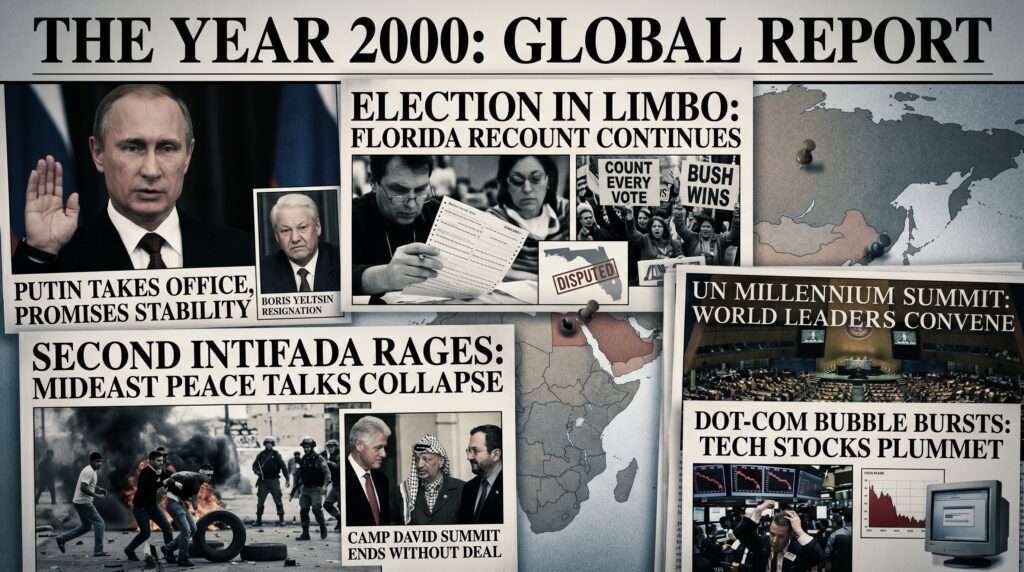
1. Was the Camp David Summit 2000 a turning point in Middle East politics?
Discussion: Yes, it exposed the deep gaps between Israel and Palestine. The failure of talks weakened hopes for a peaceful settlement.
2. Why did the Camp David Summit fail?
Discussion: The main disputes were Jerusalem, refugees, borders, and security. Both sides could not accept the final terms.
3. Did the Second Intifada change Israeli-Palestinian relations?
Discussion: Yes, it increased violence and mistrust. It made future peace talks more difficult.
4. Was Ariel Sharon’s visit the only reason for the Second Intifada?
Discussion: No, tensions were already high before the visit. The visit became a trigger for deeper anger.
5. Why was Jerusalem the most sensitive issue in 2000?
Discussion: Jerusalem has religious and political importance for both sides. Neither Israel nor Palestine wanted to compromise easily.
6. Did the Oslo Peace Process fail by 2000?
Discussion: It lost strength because key issues remained unresolved. Trust between both sides continued to decline.
7. How did the Camp David failure affect US diplomacy?
Discussion: It showed the limits of American mediation. The US could not force both sides to accept peace.
8. Why was the Palestinian refugee issue difficult to solve?
Discussion: Palestinians demanded the right of return. Israel feared this would change its demographic balance.
9. Did power imbalance affect peace negotiations?
Discussion: Yes, Israel had stronger military and diplomatic power. Palestinians felt the talks were not equal.
10. Why did peace efforts collapse after 2000?
Discussion: Violence increased after the summit failed. Political trust disappeared on both sides.
11. Why was the UN Millennium Summit important?
Discussion: It brought world leaders together to discuss global problems. Poverty, health, education, and peace were major topics.
12. What were the Millennium Development Goals?
Discussion: They were global targets to reduce poverty and improve human life. They shaped development policy for many years.
13. Did the Millennium Summit improve global cooperation?
Discussion: It helped create a common development agenda. However, implementation remained difficult.
14. Why was human security important in 2000?
Discussion: The world started focusing on people, not just states. Poverty, disease, and conflict became security concerns.
15. Were the MDGs fair for developing countries?
Discussion: They addressed real problems in poor countries. But some critics said rich countries controlled the agenda.
16. Did the UN become stronger in 2000?
Discussion: The UN gained importance in development discussions. Still, it had limited power to enforce change.
17. Why was poverty a major global issue in 2000?
Discussion: Many countries faced extreme poverty and weak health systems. Global leaders wanted measurable targets to reduce it.
18. Did globalization influence the Millennium Goals?
Discussion: Yes, globalization made problems more connected. Leaders understood that poverty and disease could affect global stability.
19. Why was Africa a major focus of global development?
Discussion: Many African countries faced poverty, conflict, and disease. The AIDS crisis made the situation more urgent.
20. Did the Millennium Declaration shape future global policy?
Discussion: Yes, it later influenced the Sustainable Development Goals. It became a foundation for global development planning.
21. Why was the 2000 US presidential election controversial?
Discussion: The result depended on a vote recount in Florida. The dispute reached the US Supreme Court.
22. Did Bush v. Gore affect American democracy?
Discussion: Yes, it raised questions about election fairness. But the peaceful transfer of power showed institutional stability.
23. Why was the Florida recount important?
Discussion: Florida’s votes decided the election result. A small margin created a national political crisis.
24. Did the Electoral College face criticism in 2000?
Discussion: Yes, because the winner did not win the popular vote. Many people questioned whether the system was fully democratic.
25. Did the 2000 election increase political polarization?
Discussion: Yes, it deepened mistrust between Republicans and Democrats. It became a sign of future political division.
26. How did George W. Bush’s victory affect world politics?
Discussion: His administration later changed US foreign policy. This became especially clear after 9/11.
27. Did the 2000 election affect US soft power?
Discussion: Yes, the dispute damaged America’s democratic image. Other countries saw weaknesses in the US election system.
28. Was the Supreme Court decision politically important?
Discussion: Yes, it effectively decided the presidency. This made the court’s role highly controversial.
29. Why did election legitimacy become a major issue?
Discussion: Many people questioned whether every vote was counted fairly. This created debate about democratic trust.
30. Did 2000 mark a shift in US politics?
Discussion: Yes, it showed deeper ideological division. It also shaped the leadership that handled future global crises.
31. Why was Vladimir Putin’s rise important in 2000?
Discussion: Putin became Russia’s president and promised stability. His rise marked the beginning of a stronger centralized Russian state.
32. Did Putin restore state power in Russia?
Discussion: Yes, he focused on order and central control. This reduced the chaos of the 1990s.
33. Why did Russian democracy weaken after 2000?
Discussion: Power became concentrated in the presidency. Media and opposition groups faced increasing pressure.
34. How did Chechnya shape Putin’s leadership?
Discussion: The Chechen conflict helped Putin present himself as a strong leader. It also justified strict security policies.
35. Was 2000 the beginning of modern Russian nationalism?
Discussion: Yes, Russia started emphasizing national strength and sovereignty. This later shaped its foreign policy.
36. Did Russia begin challenging Western influence in 2000?
Discussion: Slowly, yes. Putin wanted Russia to regain respect as a major power.
37. Why was Russian centralization important?
Discussion: Putin believed strong central authority was needed for stability. Critics argued it weakened democracy.
38. Did Putin’s rise affect NATO-Russia relations?
Discussion: Yes, Russia became more cautious about NATO expansion. This created long-term distrust.
39. Was Putinism new or old?
Discussion: It combined Soviet-style control with modern nationalism and capitalism. It was a new model with old features.
40. Did 2000 shape future Russia-West tensions?
Discussion: Yes, Russia’s desire for great-power status grew stronger. This later affected Ukraine, NATO, and European security.
41. Why was the USS Cole attack important?
Discussion: It showed that terrorist groups could attack powerful military targets. It was a warning before 9/11.
42. Did the US underestimate Al-Qaeda in 2000?
Discussion: Yes, Al-Qaeda was already a growing threat. But the full danger was not understood until 2001.
43. Why were non-state actors becoming dangerous?
Discussion: Groups without states could still create global instability. Terror networks used modern communication and finance.
44. How did globalization help terror networks?
Discussion: Global travel, money systems, and communication made networks stronger. Terror groups used the same tools as global businesses.
45. Why was Afghanistan important in global security?
Discussion: The Taliban controlled Afghanistan and allowed extremist groups space. This made Afghanistan a global security concern.
46. Did the world fail to respond to terrorism in 2000?
Discussion: Many warnings existed, but action was limited. Security systems were not fully prepared.
47. Why was intelligence failure a concern in 2000?
Discussion: Agencies had information about threats but lacked coordination. This weakness became clearer after 9/11.
48. Did terrorism challenge traditional security ideas?
Discussion: Yes, security was no longer only about armies and states. Small groups could now affect global politics.
49. Was 2000 the last year of the old world order?
Discussion: In many ways, yes. The world still looked stable, but major threats were already rising.
50. Why was 2000 a warning year for the 21st century?
Discussion: It revealed problems in peace, security, democracy, and global governance. Many of these problems became bigger after 2001.
World Affairs 2001
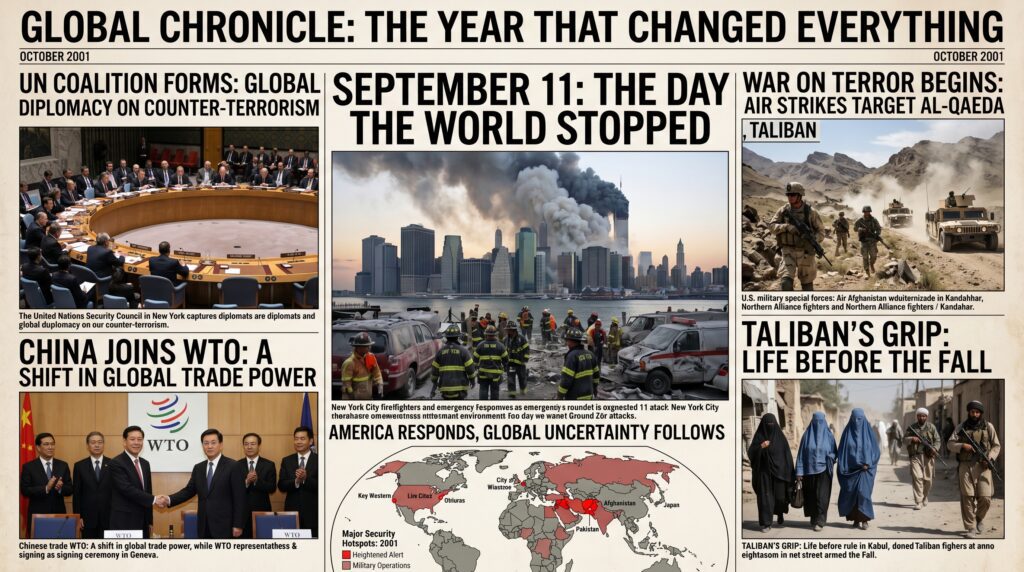
1. Did the 9/11 attacks change the direction of world politics?
Discussion: Yes, 9/11 shifted global focus from traditional state conflicts to terrorism. It changed security laws, foreign policy, and international alliances.
2. Why were the 9/11 attacks considered a turning point in global security?
Discussion: They showed that non-state actors could attack the world’s most powerful country. This changed how states understood security threats.
3. Did 9/11 weaken the idea of American invincibility?
Discussion: Yes, the attacks exposed vulnerabilities inside the United States. They challenged the image of America as fully secure after the Cold War.
4. How did 9/11 affect international law?
Discussion: It expanded debate on self-defense against non-state actors. The use of force against terrorist networks became a major legal issue.
5. Was the War on Terror a security response or a geopolitical project?
Discussion: It began as a response to terrorism. However, it later became connected with broader US strategic goals in the Middle East and South Asia.
6. Why did the United States invade Afghanistan in 2001?
Discussion: The US accused the Taliban of sheltering Al-Qaeda. The invasion aimed to remove Taliban rule and destroy terrorist bases.
7. Did the Afghanistan invasion have strong international support?
Discussion: Yes, many countries supported the US after 9/11. NATO also treated the attacks as an attack on collective security.
8. Why did the Taliban become the center of global attention in 2001?
Discussion: The Taliban controlled Afghanistan and hosted Al-Qaeda leaders. This made Afghanistan central to the War on Terror.
9. Did the fall of Kabul end the Afghan crisis?
Discussion: No, it removed the Taliban from power temporarily. But Afghanistan still faced insurgency, weak institutions, and foreign dependence.
10. Why was nation-building difficult in Afghanistan?
Discussion: Afghanistan had weak institutions, ethnic divisions, and decades of war. Foreign military success did not automatically create political stability.
11. How did UN Security Council Resolution 1373 change counter-terrorism policy?
Discussion: It required states to stop terrorist financing and improve cooperation. It made counter-terrorism a global legal obligation.
12. Did the UN become more important after 9/11?
Discussion: Yes, the UN helped create global counter-terrorism rules. But major military decisions were still led mainly by powerful states.
13. Why did terrorism become a global governance issue?
Discussion: Terror networks crossed borders and used global finance. No single country could handle the threat alone.
14. Did 9/11 change the meaning of sovereignty?
Discussion: Yes, states hosting terrorist groups faced external military pressure. Sovereignty became linked with responsibility to control threats inside borders.
15. Did the War on Terror create new human rights concerns?
Discussion: Yes, detention, surveillance, torture allegations, and profiling became major issues. Security policies often clashed with civil liberties.
16. Why did NATO’s role change after 9/11?
Discussion: NATO invoked collective defense for the first time. This moved the alliance beyond Europe into global security operations.
17. Did 9/11 strengthen US alliances?
Discussion: In the short term, yes. Many countries showed solidarity with the United States and joined counter-terrorism efforts.
18. Did 9/11 also create future divisions among allies?
Discussion: Yes, later US policies caused disagreements with some allies. The Iraq debate later exposed these divisions more clearly.
19. Why was intelligence failure a major debate after 9/11?
Discussion: Agencies had warning signs but failed to connect them effectively. The attacks exposed gaps in coordination and threat assessment.
20. Did 9/11 prove that globalization had security risks?
Discussion: Yes, terrorists used global travel, communication, and finance. Globalization connected people but also expanded security vulnerabilities.
21. Why was China’s WTO entry in 2001 historically important?
Discussion: It integrated China deeply into the global trading system. This changed manufacturing, supply chains, and global economic power.
22. Did China’s WTO membership strengthen globalization?
Discussion: Yes, it accelerated global trade and production networks. China became a central player in the world economy.
23. Did the West misread China’s WTO entry?
Discussion: Many Western leaders expected trade to encourage political liberalization. China instead became economically powerful while keeping strong political control.
24. How did China’s rise affect the balance of power?
Discussion: China’s economic growth increased its strategic influence. It slowly challenged the US-led economic order.
25. Why was 2001 important for global capitalism?
Discussion: China’s WTO entry and the Doha Round shaped trade debates. The year linked security shocks with economic transformation.
26. Why was the Doha Round launched in 2001?
Discussion: It aimed to reform global trade rules and address development concerns. Poor countries wanted fairer access to markets.
27. Was the Doha Round truly a development round?
Discussion: It claimed to focus on developing countries. But disputes over agriculture, subsidies, and market access limited progress.
28. Why did trade fairness become a major issue in 2001?
Discussion: Developing countries argued that rich states protected their own markets. They wanted fairer rules in agriculture and industrial goods.
29. Did the WTO gain or lose legitimacy in 2001?
Discussion: The launch of Doha gave the WTO new purpose. However, disagreements between rich and poor countries continued to weaken trust.
30. How did 9/11 affect the global economy?
Discussion: It disrupted markets, travel, tourism, and investor confidence. The world economy was already weak after the dot-com crash.
31. Did the dot-com crash continue to affect world affairs in 2001?
Discussion: Yes, technology markets remained weak. It showed that digital growth could also create financial instability.
32. Why was Argentina’s economic crisis important in 2001?
Discussion: Argentina’s collapse exposed risks of debt, austerity, and financial dependence. It became a major case in debates about IMF policies.
33. Did the IMF face criticism after Argentina’s crisis?
Discussion: Yes, critics blamed strict economic policies and poor crisis management. The crisis raised doubts about international financial governance.
34. Why did anti-globalization movements remain strong in 2001?
Discussion: Protesters opposed inequality, corporate power, and unfair trade rules. They believed globalization benefited powerful economies more than poor societies.
35. What did the Genoa G8 protests show about global politics?
Discussion: They showed deep public anger toward elite-led globalization. The protests also revealed tensions between civil society and global institutions.
36. Why was the Durban Conference important in 2001?
Discussion: It addressed racism, colonialism, slavery, and discrimination. The conference exposed deep disagreements over history, justice, and reparations.
37. Did the Durban Conference strengthen global human rights debates?
Discussion: Yes, it placed racism and historical injustice at the center of international discussion. But political controversies limited its unity.
38. Why did climate diplomacy remain difficult in 2001?
Discussion: Countries disagreed over responsibility, cost, and development rights. The US position on Kyoto created major tension.
39. Did the US rejection of Kyoto damage climate cooperation?
Discussion: Yes, it weakened confidence in global climate agreements. It showed how powerful states could limit environmental diplomacy.
40. Why was environmental governance becoming more important?
Discussion: Climate change was increasingly seen as a global threat. States realized environmental problems could affect economies and security.
41. Why did India-Pakistan tensions rise in 2001?
Discussion: The attack on the Indian Parliament increased military confrontation. Both nuclear-armed states moved closer to a major crisis.
42. Did nuclear weapons prevent war in South Asia in 2001?
Discussion: They discouraged full-scale war but did not stop escalation. The crisis showed that nuclear deterrence can still be dangerous.
43. How did 9/11 affect Pakistan’s foreign policy?
Discussion: Pakistan became a key US ally in the War on Terror. This shifted its regional strategy and international position.
44. Why was Pakistan strategically important after 9/11?
Discussion: Pakistan shared a border with Afghanistan and had influence in the region. The US needed Pakistan for logistics and intelligence.
45. Did 2001 change the geopolitics of South Asia?
Discussion: Yes, Afghanistan, Pakistan, India, and the US became more closely linked. Terrorism became central to regional politics.
46. Why was the Second Intifada still important in 2001?
Discussion: Violence continued between Israelis and Palestinians. The conflict weakened peace prospects and increased regional instability.
47. Did 9/11 affect the Palestinian issue?
Discussion: Yes, global attention shifted toward terrorism. Palestinian resistance was increasingly viewed through a security lens.
48. Why did Indonesia face political change in 2001?
Discussion: President Abdurrahman Wahid was removed from office. This showed Indonesia’s difficult transition after authoritarian rule.
49. Was 2001 the end of post-Cold War optimism?
Discussion: Yes, 9/11 ended the belief that globalization and US dominance would bring stable peace. Security fear replaced liberal optimism.
50. Why can 2001 be called the beginning of the modern security era?
Discussion: It introduced terrorism, surveillance, intervention, and homeland security as central global issues. Many world affairs after 2001 were shaped by this shift.
World Affairs 2002
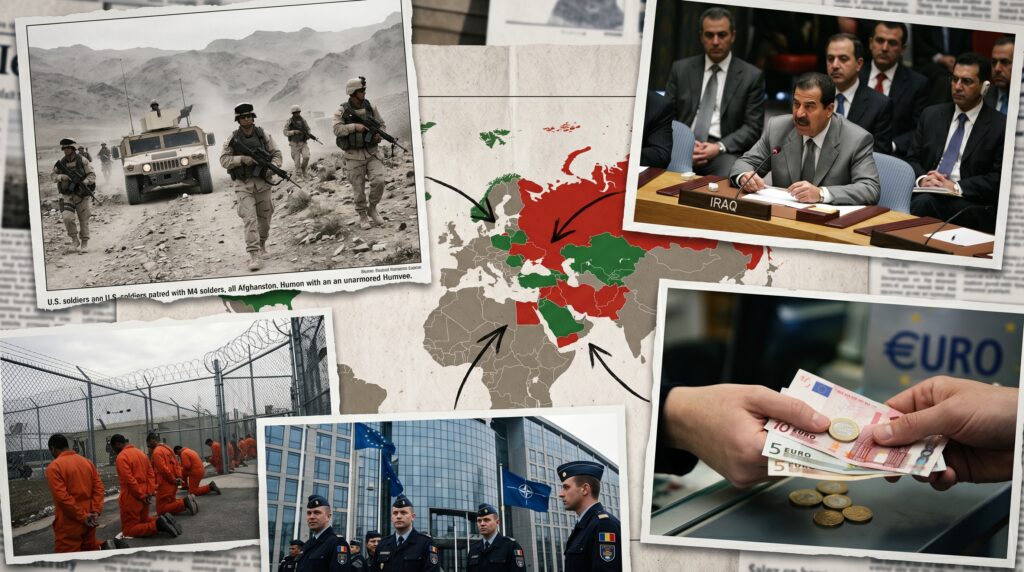
1. Why was 2002 important in the evolution of the War on Terror?
Discussion: 2002 expanded the War on Terror beyond Afghanistan. The United States began framing terrorism as a long-term global conflict.
2. Did the Bush Doctrine change international relations in 2002?
Discussion: Yes, it promoted pre-emptive action against perceived threats. This challenged traditional ideas of sovereignty and international law.
3. Why was the idea of pre-emptive war controversial?
Discussion: It allowed states to attack before being attacked. Critics argued this could weaken global legal norms and encourage unilateral wars.
4. How did the “Axis of Evil” speech affect world politics?
Discussion: It identified Iraq, Iran, and North Korea as major threats. The speech increased tensions and shaped future US foreign policy.
5. Did the Axis of Evil concept simplify complex geopolitical issues?
Discussion: Yes, it grouped very different states under one security label. This made diplomacy more difficult with Iran and North Korea.
6. Why did Iraq become a central issue in 2002?
Discussion: The US accused Iraq of possessing weapons of mass destruction. Iraq became the main focus of debates over intervention and security.
7. Did the Iraq WMD debate weaken trust in global intelligence?
Discussion: Yes, competing claims about weapons created global doubt. The debate later damaged confidence in intelligence-based policymaking.
8. Why was UN Security Council Resolution 1441 significant?
Discussion: It gave Iraq a final chance to comply with weapons inspections. It also created the diplomatic path toward the 2003 Iraq War.
9. Did the UN inspections process reduce the chance of war?
Discussion: It delayed military action and created space for diplomacy. However, it did not remove US suspicion toward Iraq.
10. Was the Iraq crisis a test of the United Nations?
Discussion: Yes, it tested whether the UN could manage disputes involving powerful states. The crisis exposed limits in collective security.
11. How did 2002 affect US-Europe relations?
Discussion: Divisions grew over Iraq and pre-emptive war. Some European states supported the US, while others preferred diplomacy.
12. Did 2002 mark the rise of American unilateralism?
Discussion: Yes, US policy increasingly emphasized acting alone if necessary. This worried allies who supported multilateral decision-making.
13. Why did anti-war sentiment grow in 2002?
Discussion: Many people feared a war in Iraq would destabilize the Middle East. Doubts about WMD claims also increased public opposition.
14. Did the War on Terror weaken human rights protections?
Discussion: Yes, detention, surveillance, and interrogation policies raised serious concerns. Security priorities often overpowered civil liberty debates.
15. Why was Guantanamo Bay controversial in 2002?
Discussion: Detainees were held outside normal legal protections. This created major criticism from human rights groups and international lawyers.
16. Did NATO change after the 2002 Prague Summit?
Discussion: Yes, NATO prepared for enlargement and new security missions. It moved further from Cold War defense toward global crisis response.
17. Why was NATO enlargement important in 2002?
Discussion: Several Eastern European states were invited to join. This expanded Western influence and increased Russian concerns.
18. How did Russia view NATO expansion in 2002?
Discussion: Russia saw it as a threat to its strategic space. This added to long-term mistrust between Russia and the West.
19. Did the NATO-Russia Council reduce tensions?
Discussion: It created a platform for cooperation after 9/11. But it did not remove deeper disagreements over security and influence.
20. Was 2002 a year of temporary US-Russia cooperation?
Discussion: Yes, both cooperated against terrorism. However, NATO expansion and US missile defense plans continued to create tension.
21. Why was the US withdrawal from the ABM Treaty important?
Discussion: It allowed the US to develop missile defense systems. Russia feared this could weaken strategic nuclear balance.
22. Did the end of the ABM Treaty affect arms control?
Discussion: Yes, it weakened a major Cold War-era arms control agreement. It signaled a shift toward more flexible US strategic policy.
23. Why was the Moscow Treaty significant?
Discussion: The US and Russia agreed to reduce deployed nuclear warheads. However, critics said the treaty had weak verification mechanisms.
24. Did arms control become weaker or stronger in 2002?
Discussion: It had mixed results. Warhead reductions were agreed, but missile defense disputes weakened strategic trust.
25. How did 2002 shape future great-power competition?
Discussion: NATO expansion, missile defense, and US unilateralism created new distrust. These tensions later influenced Russia-West relations.
26. Why was the Bali bombing important in global terrorism?
Discussion: It showed that terrorism was not limited to the Middle East or the West. Southeast Asia became a major front in counter-terrorism.
27. How did the Bali bombing affect Indonesia?
Discussion: It forced Indonesia to strengthen counter-terrorism policies. It also damaged tourism and exposed extremist networks.
28. Did Al-Qaeda become a decentralized threat in 2002?
Discussion: Yes, attacks and linked groups showed a wider network. Terrorism became harder to fight because it operated across regions.
29. Why did counter-terrorism become more global in 2002?
Discussion: Attacks occurred in different countries and regions. States realized terrorist networks used international links and local partners.
30. Did 2002 prove that military power alone could not defeat terrorism?
Discussion: Yes, extremist networks survived despite military operations. Intelligence, policing, finance control, and local governance became equally important.
31. Why was Afghanistan still unstable in 2002?
Discussion: The Taliban had fallen, but state institutions remained weak. Warlordism, insecurity, and foreign dependence continued.
32. Did the Bonn Process solve Afghanistan’s political problems?
Discussion: It created a political roadmap, but it had limits. Many local power structures and security problems remained unresolved.
33. Why was nation-building difficult after the Taliban’s fall?
Discussion: Afghanistan lacked strong institutions and national unity. Foreign aid and military support could not quickly build stable governance.
34. Did Pakistan’s role become more complicated in 2002?
Discussion: Yes, Pakistan was a US ally but faced internal extremist pressures. Its border with Afghanistan made its role strategically sensitive.
35. How did the War on Terror affect South Asia?
Discussion: It made Pakistan central to US policy and increased focus on terrorism. It also affected India-Pakistan tensions.
36. Why was the India-Pakistan military standoff dangerous in 2002?
Discussion: Both countries were nuclear powers and had deployed forces. A small incident could have escalated into a major war.
37. Did nuclear deterrence prevent war between India and Pakistan?
Discussion: It helped prevent full-scale war. But the crisis showed that nuclear weapons do not remove the risk of escalation.
38. Why did terrorism become central to India-Pakistan relations?
Discussion: India accused Pakistan-based groups of attacks. Pakistan denied direct involvement but faced strong international pressure.
39. How did global pressure reduce the India-Pakistan crisis?
Discussion: Major powers pushed both sides to avoid war. Diplomatic pressure helped lower tensions gradually.
40. Did 2002 reshape regional security in South Asia?
Discussion: Yes, terrorism, nuclear risk, and US involvement became more connected. South Asia became part of the wider War on Terror.
41. Why was the Euro’s physical launch important in 2002?
Discussion: Euro banknotes and coins entered daily use. This marked a major step in European economic integration.
42. Did the Euro strengthen European identity?
Discussion: Yes, a shared currency created a stronger sense of common Europe. But it also raised concerns about national economic sovereignty.
43. Why was the Euro a challenge for national governments?
Discussion: Countries gave up control over their own monetary policy. Economic decisions became more tied to European institutions.
44. Did the Euro increase Europe’s global influence?
Discussion: It gave Europe a stronger financial identity. The Euro became an alternative major currency in global markets.
45. Why did climate politics remain difficult in 2002?
Discussion: States disagreed over responsibility, cost, and development rights. The US rejection of Kyoto continued to weaken climate cooperation.
46. Why was the World Summit on Sustainable Development important?
Discussion: It focused on poverty, environment, water, energy, and development. It showed that development and environment were linked.
47. Did sustainable development become a stronger global idea in 2002?
Discussion: Yes, world leaders increasingly connected economic growth with environmental protection. But implementation remained slow.
48. Why was corporate accountability discussed in 2002?
Discussion: Global companies had increasing influence over economies and societies. Scandals and globalization debates raised demands for responsibility.
49. Was 2002 a bridge between 9/11 and the Iraq War?
Discussion: Yes, it connected the shock of 9/11 with the coming Iraq invasion. Security debates moved from terrorism to regime change.
50. Why can 2002 be called a year of strategic preparation?
Discussion: The US prepared its doctrine, alliances, and arguments for future action. Many decisions in 2002 shaped the wars and crises that followed.
World Affairs 2003
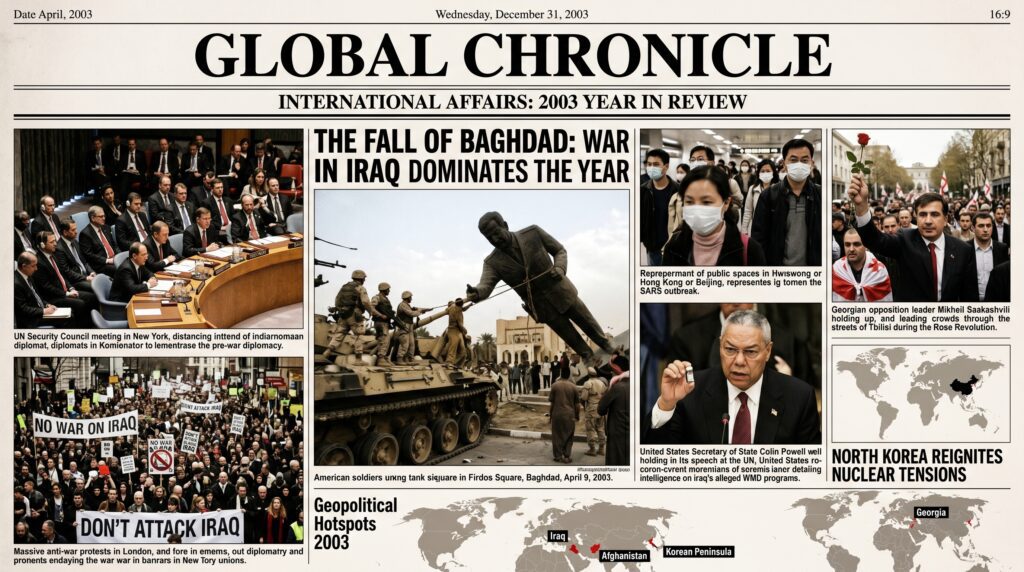
1. Why was the Iraq War the most important world affair of 2003?
Discussion: The US-led invasion of Iraq changed Middle Eastern politics and global security debates. It also created long-term controversy over international law and military intervention.
2. Was the Iraq War legal under international law?
Discussion: Many critics argued it lacked clear UN authorization. Supporters claimed Iraq had violated previous UN resolutions, but the legal debate remained highly disputed.
3. Did the Iraq War weaken the United Nations?
Discussion: Yes, the war exposed the UN’s limited ability to restrain powerful states. It created doubts about collective security and multilateral diplomacy.
4. Why did the United States invade Iraq in 2003?
Discussion: The US claimed Iraq had weapons of mass destruction and links to terrorism. Later, these claims became highly controversial.
5. Did the WMD issue damage trust in Western intelligence?
Discussion: Yes, the failure to find WMDs damaged public trust. It raised serious questions about intelligence, politics, and war justification.
6. Was the Iraq invasion a war of security or regime change?
Discussion: It was presented as a security action, but it also removed Saddam Hussein. This made regime change a central feature of the conflict.
7. Did the Iraq War strengthen or weaken American global leadership?
Discussion: It showed US military power but damaged US moral authority. Many countries saw the war as unilateral and destabilizing.
8. How did the Iraq War affect US-Europe relations?
Discussion: It divided Europe between supporters and opponents of the war. France and Germany opposed it, while the UK strongly supported the US.
9. Why did global anti-war protests become historic in 2003?
Discussion: Millions of people protested before the invasion. The protests showed strong global public opposition to preventive war.
10. Did the Iraq War prove the limits of military power?
Discussion: Yes, the US quickly defeated Saddam’s army but struggled with occupation. Winning the war was easier than building stability.
11. Why did the fall of Baghdad not end the Iraq crisis?
Discussion: Saddam’s government collapsed, but security and governance problems grew. Insurgency, sectarian tensions, and state collapse followed.
12. Was de-Baathification a major mistake in Iraq?
Discussion: Many analysts see it as a mistake because it removed experienced officials. It also increased unemployment, resentment, and instability.
13. Why was the disbanding of the Iraqi army controversial?
Discussion: It left many armed men without jobs or status. This helped fuel insurgency and weakened postwar security.
14. Did Iraq become a center of global jihad after 2003?
Discussion: Yes, the invasion created conditions for extremist groups to grow. Iraq became a battlefield for militants from different regions.
15. How did the Iraq War affect Iran’s regional influence?
Discussion: The removal of Saddam eliminated Iran’s major rival. This allowed Iran to expand influence in Iraq and the wider region.
16. Did the Iraq War reshape the Middle East balance of power?
Discussion: Yes, it weakened Iraq and strengthened Iran’s relative position. It also increased sectarian and geopolitical competition.
17. Why did the occupation of Iraq face legitimacy problems?
Discussion: Many Iraqis saw foreign troops as occupiers, not liberators. Lack of security and political uncertainty weakened trust.
18. Did the Iraq War affect the global image of democracy promotion?
Discussion: Yes, democracy promotion became associated with military intervention. This made many countries suspicious of Western political agendas.
19. Was 2003 a turning point in US foreign policy?
Discussion: Yes, it showed the peak of the Bush Doctrine. Pre-emptive war and regime change became central to US strategy.
20. Did the Iraq War create a crisis of international legitimacy?
Discussion: Yes, the war raised doubts about who has authority to use force. It challenged the role of the UN and international law.
21. Why was the Road Map for Peace important in 2003?
Discussion: It was a plan to restart Israeli-Palestinian peace efforts. It aimed for a two-state solution but faced weak implementation.
22. Did the Iraq War affect the Israeli-Palestinian conflict?
Discussion: Yes, regional attention shifted toward Iraq. The broader War on Terror also influenced how Palestinian violence was framed.
23. Why did the Second Intifada continue to shape Middle East politics?
Discussion: Violence and mistrust remained high. Peace efforts struggled because both sides faced security and political pressures.
24. Did the US gain or lose influence in the Middle East after Iraq?
Discussion: Militarily, the US gained presence, but politically it lost trust. Many people in the region viewed the war negatively.
25. Why was Turkey’s position on Iraq important?
Discussion: Turkey refused to allow US troops to invade Iraq from its territory. This showed limits to US influence even among allies.
26. Why was North Korea’s nuclear issue important in 2003?
Discussion: North Korea withdrew from the Nuclear Non-Proliferation Treaty. This created a major crisis in global nuclear security.
27. Did North Korea challenge the non-proliferation regime?
Discussion: Yes, its withdrawal showed weaknesses in nuclear control systems. It proved that determined states could challenge global rules.
28. Why were the Six-Party Talks launched?
Discussion: They aimed to resolve North Korea’s nuclear crisis through diplomacy. The talks included China, the US, Russia, Japan, and both Koreas.
29. Did China’s role increase in Korean Peninsula diplomacy?
Discussion: Yes, China hosted the Six-Party Talks and became central to negotiations. This showed China’s rising diplomatic influence.
30. Was diplomacy more successful with North Korea than Iraq?
Discussion: In 2003, North Korea was handled through talks, while Iraq faced invasion. This contrast exposed inconsistency in international security policy.
31. Why was the SARS outbreak important in 2003?
Discussion: SARS showed how quickly diseases could spread through global travel. It made public health a major international security concern.
32. Did SARS change global health governance?
Discussion: Yes, it increased the importance of international disease reporting and cooperation. The WHO became more central in managing outbreaks.
33. Why did China face criticism during the SARS outbreak?
Discussion: China was criticized for delayed reporting and lack of transparency. This raised concerns about state secrecy during health emergencies.
34. Did SARS prove that globalization creates health risks?
Discussion: Yes, global travel helped the virus spread across borders. Health threats became linked with mobility and international connectivity.
35. Why was public health seen as a security issue after SARS?
Discussion: Disease outbreaks could disrupt economies, travel, and state stability. SARS showed that security was not only about war and terrorism.
36. Why was the Rose Revolution in Georgia significant?
Discussion: It removed Eduard Shevardnadze through mass protests. It became an example of post-Soviet democratic mobilization.
37. Did the Rose Revolution affect Russia-West competition?
Discussion: Yes, it increased Western influence in Georgia. Russia viewed such political changes near its borders with suspicion.
38. Why did color revolutions matter in post-Soviet politics?
Discussion: They challenged corrupt and authoritarian governments. They also became part of wider struggles over influence between Russia and the West.
39. Was 2003 important for European Union expansion?
Discussion: Yes, the EU prepared for its 2004 enlargement. This marked a major shift in post-Cold War European integration.
40. Did EU enlargement change Europe’s political map?
Discussion: Yes, it brought former communist states closer to Western institutions. It expanded the EU’s influence eastward.
41. Why was NATO’s role still changing in 2003?
Discussion: NATO was moving beyond traditional defense. Afghanistan and post-9/11 missions gave it a more global security role.
42. Did Afghanistan remain unstable in 2003?
Discussion: Yes, the Taliban insurgency began rebuilding in some areas. Weak governance and security problems continued.
43. Why was nation-building in Afghanistan difficult?
Discussion: The Afghan state lacked strong institutions and resources. Local powerbrokers and insecurity limited central government authority.
44. How did Pakistan remain central to the War on Terror in 2003?
Discussion: Pakistan provided logistical and intelligence support to the US. It also faced pressure over militants near the Afghan border.
45. Did the War on Terror increase instability in Pakistan?
Discussion: Yes, Pakistan faced militant backlash and internal security challenges. Its alliance with the US created domestic political tensions.
46. Why was Iran’s nuclear program a growing concern in 2003?
Discussion: Reports about Iran’s nuclear activities increased international pressure. The issue became a major challenge for non-proliferation diplomacy.
47. Did the Iraq War influence Iran’s nuclear strategy?
Discussion: It likely increased Iran’s security concerns. Seeing Iraq invaded may have strengthened Iran’s desire for deterrence.
48. Why was 2003 important for global anti-Americanism?
Discussion: The Iraq War increased anger toward US policy in many regions. It weakened America’s image as a defender of international rules.
49. Was 2003 the peak of the unipolar moment?
Discussion: Yes, the US showed unmatched military power. But the problems that followed also revealed the limits of unipolar dominance.
50. Why can 2003 be called a year of intervention and instability?
Discussion: The Iraq War, nuclear crises, SARS, and regional tensions reshaped global politics. The year showed how military, health, and security issues were becoming interconnected.
World Affairs 2004
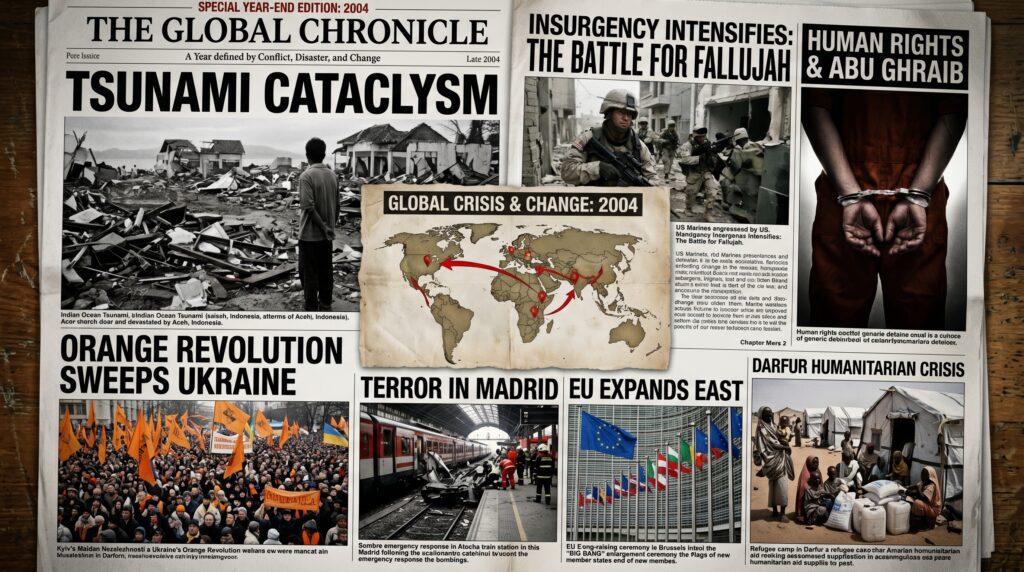
1. Why was the 2004 Indian Ocean tsunami a major global event?
Discussion: It caused massive destruction across several Asian and African countries. The disaster showed the need for stronger early-warning systems and global humanitarian cooperation.
2. Did the Indian Ocean tsunami change disaster management policies?
Discussion: Yes, it exposed the weakness of regional warning systems. After the disaster, countries focused more on preparedness and emergency response.
3. Why was international aid important after the 2004 tsunami?
Discussion: The scale of destruction was too large for affected countries alone. Global aid helped with rescue, relief, and reconstruction.
4. Did the tsunami prove that natural disasters can become international security issues?
Discussion: Yes, disasters can damage economies, displace people, and weaken state capacity. Human security became a major concern after the tsunami.
5. How did the tsunami affect Indonesia and Sri Lanka politically?
Discussion: Both countries faced huge humanitarian pressure. In some areas, the disaster also influenced conflict dynamics and peace efforts.
6. Why was the Iraq insurgency a major issue in 2004?
Discussion: Armed resistance against US-led forces grew stronger. It showed that removing Saddam Hussein did not create stability.
7. Did the Iraq War become harder for the United States in 2004?
Discussion: Yes, insurgency, sectarian tensions, and governance problems increased. The occupation faced serious legitimacy and security challenges.
8. Why was the Battle of Fallujah significant?
Discussion: Fallujah became a symbol of Iraqi resistance and urban warfare. The battle showed the difficulty of controlling Iraq militarily.
9. Did Abu Ghraib damage America’s global image?
Discussion: Yes, prisoner abuse images created worldwide outrage. They weakened US claims of promoting human rights and democracy.
10. Why was Abu Ghraib important in human rights debates?
Discussion: It raised questions about torture, accountability, and military detention. The scandal became a symbol of abuses in the War on Terror.
11. Did the Iraq occupation weaken international law?
Discussion: It increased debate about occupation, prisoner treatment, and sovereignty. Many critics argued that powerful states were avoiding legal accountability.
12. How did Iraq affect the 2004 US presidential election?
Discussion: The war became a major campaign issue. George W. Bush defended the war, while critics questioned its cost and justification.
13. Why did George W. Bush win re-election in 2004?
Discussion: Security after 9/11 remained a central concern for many voters. Bush presented himself as a strong wartime leader.
14. Did the 2004 US election strengthen the War on Terror agenda?
Discussion: Yes, Bush’s victory gave political support to continuing his security policies. It also reinforced America’s military role abroad.
15. Why was Afghanistan still unstable in 2004?
Discussion: The Taliban was rebuilding influence in some regions. Weak governance, warlords, and insecurity remained major problems.
16. Why was Afghanistan’s first presidential election important?
Discussion: It marked a step toward formal democracy after Taliban rule. Hamid Karzai’s election gave the new government greater legitimacy.
17. Did Afghanistan’s election solve its political problems?
Discussion: No, elections created formal legitimacy but did not end insecurity. The state remained dependent on foreign support.
18. Why was NATO’s role in Afghanistan expanding?
Discussion: NATO took greater responsibility for security and stabilization. This showed the alliance’s shift toward out-of-area missions.
19. Did NATO become a global security actor in 2004?
Discussion: Yes, Afghanistan pushed NATO beyond traditional European defense. It became more involved in crisis management outside Europe.
20. Why was Pakistan important in the Afghan conflict?
Discussion: Pakistan’s border areas were linked to militant movement and logistics. Its cooperation was crucial but also complicated.
21. Why did the Madrid train bombings matter globally?
Discussion: The attacks showed that Europe was also vulnerable to terrorism. They increased fear of Al-Qaeda-linked networks in Western societies.
22. Did the Madrid bombings affect Spanish politics?
Discussion: Yes, they influenced Spain’s election and public opinion on Iraq. The new government later withdrew Spanish troops from Iraq.
23. Why did terrorism remain a central world issue in 2004?
Discussion: Attacks in Iraq, Europe, and other regions showed the threat was global. Counter-terrorism became a permanent part of state policy.
24. Did the War on Terror divide Western allies?
Discussion: Yes, Iraq created major disagreements among allies. Some countries supported US policy, while others opposed military intervention.
25. Why was the EU enlargement of 2004 historically important?
Discussion: Ten new countries joined the European Union, many from Central and Eastern Europe. This ended much of Europe’s Cold War division.
26. Did EU enlargement strengthen European integration?
Discussion: Yes, it expanded the EU’s political and economic reach. But it also created challenges in governance and economic inequality.
27. How did EU enlargement affect Russia?
Discussion: Russia saw Western institutions moving closer to its borders. This increased long-term concern about Western influence in Eastern Europe.
28. Why was the Orange Revolution in Ukraine important?
Discussion: It challenged a disputed election and demanded democratic reforms. Ukraine became a major arena of Russia-West competition.
29. Did the Orange Revolution increase tensions between Russia and the West?
Discussion: Yes, Western support for Ukrainian democracy worried Russia. Moscow viewed it as interference in its sphere of influence.
30. Why did Ukraine become geopolitically important in 2004?
Discussion: Ukraine stood between Russia and the expanding European order. Its political direction affected the regional balance of power.
31. Did color revolutions change post-Soviet politics?
Discussion: Yes, they showed public resistance to corrupt elections and authoritarian rule. They also intensified rivalry between Russia and Western states.
32. Why was Putin’s Russia concerned about democratic revolutions nearby?
Discussion: Russia feared similar movements could weaken its influence and inspire domestic opposition. It saw them as strategic threats.
33. Did 2004 mark a turning point in Russia-West relations?
Discussion: Yes, EU enlargement and Ukraine’s Orange Revolution deepened mistrust. Cooperation after 9/11 started giving way to rivalry.
34. Why was China’s economic rise important in 2004?
Discussion: China’s trade and manufacturing power continued to grow rapidly. It became more central to global supply chains and economic competition.
35. Did China’s rise change global trade patterns?
Discussion: Yes, more companies shifted production to China. This increased China’s influence in world markets.
36. Why was Taiwan a sensitive issue in 2004?
Discussion: Taiwan’s politics raised concerns about cross-strait tensions. China strongly opposed moves toward Taiwanese independence.
37. Did Asia become more important in global affairs in 2004?
Discussion: Yes, China’s rise, India’s growth, and security tensions increased Asia’s global importance. Economic power was shifting eastward.
38. Why was India-Pakistan dialogue important in 2004?
Discussion: Both countries restarted peace efforts after years of tension. Dialogue helped reduce immediate risk between two nuclear states.
39. Did the India-Pakistan peace process create real hope?
Discussion: Yes, it improved communication and lowered tensions. But Kashmir and terrorism remained difficult unresolved issues.
40. Why was nuclear stability important in South Asia?
Discussion: India and Pakistan both had nuclear weapons. Any conflict carried the risk of dangerous escalation.
41. Why did Iran’s nuclear issue continue in 2004?
Discussion: International concern grew over Iran’s nuclear activities. Iran insisted on its right to peaceful nuclear technology.
42. Did Europe play a diplomatic role with Iran in 2004?
Discussion: Yes, European states tried to negotiate limits on Iran’s nuclear program. This showed diplomacy as an alternative to military pressure.
43. Why was nuclear non-proliferation under pressure in 2004?
Discussion: North Korea and Iran challenged global nuclear rules. The Iraq War also made security concerns more intense.
44. Did North Korea remain a serious nuclear concern?
Discussion: Yes, the Six-Party Talks continued but progress was limited. North Korea’s nuclear ambitions remained unresolved.
45. Why was Sudan’s Darfur crisis important in 2004?
Discussion: Darfur became a major humanitarian emergency. Mass violence, displacement, and ethnic conflict drew global concern.
46. Did the Darfur crisis expose limits of international intervention?
Discussion: Yes, the world condemned the violence but acted slowly. It showed the gap between humanitarian principles and political action.
47. Why was the African Union important in Darfur?
Discussion: The African Union played a role in monitoring and peace efforts. It showed growing regional responsibility for African conflicts.
48. Did global media affect the Darfur debate?
Discussion: Yes, media coverage and advocacy groups increased pressure on governments. Darfur became a symbol of humanitarian failure.
49. Was 2004 a year of humanitarian crises and geopolitical shifts?
Discussion: Yes, the tsunami, Darfur, Iraq, and Ukraine all shaped world affairs. The year combined human suffering with strategic competition.
50. Why can 2004 be called a year of instability and transition?
Discussion: Iraq worsened, terrorism spread, Europe expanded, and Russia-West tensions grew. These events shaped the politics of the following decade.
World Affairs 2005
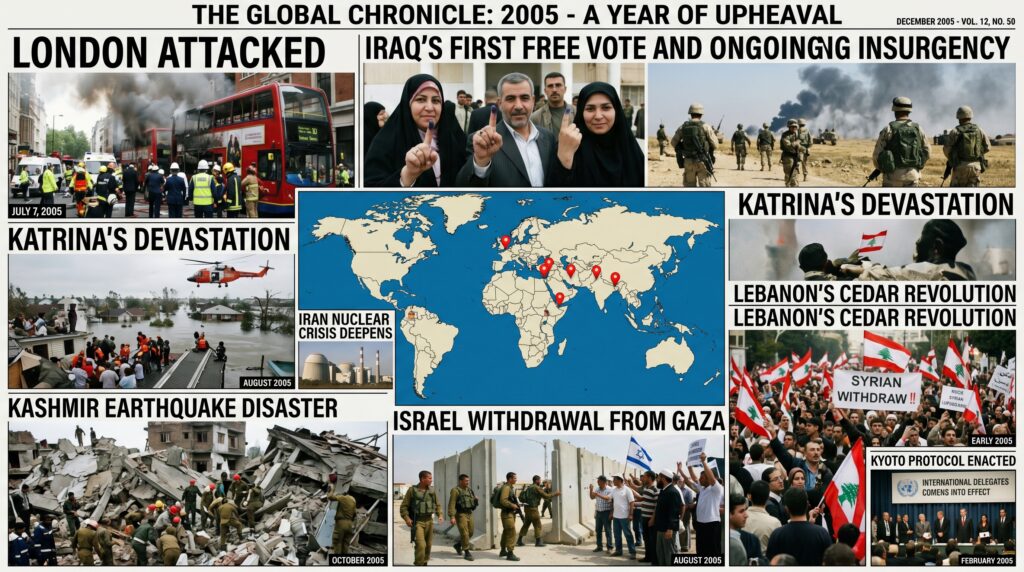
1. Why was 2005 important for global counter-terrorism?
Discussion: Terrorist attacks continued despite major security efforts after 9/11. This showed that terrorism had become a long-term global challenge.
2. Why were the London bombings significant in 2005?
Discussion: The London attacks showed that Western cities remained vulnerable. They also raised concerns about homegrown radicalization.
3. Did the London bombings change European security policy?
Discussion: Yes, European states increased surveillance, policing, and counter-terrorism cooperation. Civil liberties also became part of the debate.
4. Why did homegrown terrorism become a major concern?
Discussion: Some attackers were citizens or residents of the countries they targeted. This challenged the idea that terrorism was only an external threat.
5. Did the War on Terror become harder in 2005?
Discussion: Yes, terrorism spread through decentralized networks. Military action alone could not remove extremist ideology or local grievances.
6. Why was Iraq highly unstable in 2005?
Discussion: Insurgency, sectarian violence, and weak institutions continued. Elections did not immediately create peace or effective governance.
7. Did Iraq’s 2005 election strengthen democracy?
Discussion: It gave Iraq a formal political process. However, sectarian divisions limited its ability to create national unity.
8. Why was Iraq’s constitution controversial?
Discussion: Different groups disagreed over federalism, oil, religion, and political power. The constitution reflected deep divisions in Iraqi society.
9. Did sectarian politics increase after Iraq’s elections?
Discussion: Yes, political competition became strongly linked with ethnic and sectarian identity. This weakened national cohesion.
10. Why did the Iraq War damage US credibility?
Discussion: WMD claims had already collapsed, and violence continued. Many countries questioned American judgment and motives.
11. Why was Afghanistan still insecure in 2005?
Discussion: The Taliban insurgency was growing again. Weak governance and rural insecurity made stabilization difficult.
12. Did parliamentary elections help Afghanistan in 2005?
Discussion: They gave Afghanistan a more complete political structure. But elections could not solve corruption, insecurity, and warlord influence.
13. Why was NATO’s mission in Afghanistan becoming more complex?
Discussion: NATO faced insurgency, reconstruction, and governance problems. It was no longer only a peacekeeping mission.
14. Did Pakistan remain central to the Afghan conflict?
Discussion: Yes, border areas were important for militant movement and refuge. Pakistan faced pressure from both the US and internal groups.
15. Why was US-Pakistan cooperation complicated?
Discussion: Pakistan supported the US but had domestic political and security pressures. Its regional interests did not always match American goals.
16. Why was the Israel withdrawal from Gaza important?
Discussion: Israel removed settlements and troops from Gaza. It changed the territorial situation but did not end the conflict.
17. Did Gaza disengagement improve peace prospects?
Discussion: It created some hope but also left major issues unresolved. Gaza later became more isolated and politically unstable.
18. Why did Ariel Sharon’s policy create debate inside Israel?
Discussion: Some Israelis supported withdrawal for security reasons. Others saw it as surrendering land without a final peace agreement.
19. Did the Palestinian issue change after Gaza disengagement?
Discussion: Yes, Gaza became more central to the conflict. Control, borders, security, and governance remained disputed.
20. Why was Mahmoud Abbas’s election important?
Discussion: He became Palestinian president after Yasser Arafat’s death. His leadership was seen as a chance to restart diplomacy.
21. Why was the Cedar Revolution in Lebanon important?
Discussion: It followed the assassination of Rafik Hariri. Mass protests forced Syrian troops to withdraw from Lebanon.
22. Did the Cedar Revolution weaken Syrian influence?
Discussion: Yes, Syria ended its long military presence in Lebanon. But political influence and regional tensions continued.
23. Why did Rafik Hariri’s assassination affect regional politics?
Discussion: It triggered international pressure on Syria. Lebanon became a major issue in Middle Eastern geopolitics.
24. Did Lebanon become part of wider Iran-Syria-West rivalry?
Discussion: Yes, Lebanese politics reflected regional power struggles. Hezbollah, Syria, Iran, and Western-backed groups competed for influence.
25. Why was Iran’s nuclear program a major issue in 2005?
Discussion: International concern increased over Iran’s nuclear intentions. The issue became central to Middle East security diplomacy.
26. Did Mahmoud Ahmadinejad’s election affect Iran-West relations?
Discussion: Yes, his hardline position increased tensions. Nuclear negotiations became more difficult after his rise.
27. Why was nuclear non-proliferation under pressure in 2005?
Discussion: Iran and North Korea challenged global nuclear rules. The system struggled to stop states from pursuing sensitive technology.
28. Why was North Korea’s nuclear statement important?
Discussion: North Korea declared it had nuclear weapons. This increased pressure on the Six-Party Talks.
29. Did diplomacy with North Korea make progress in 2005?
Discussion: A joint statement created hope for denuclearization. But mistrust and implementation problems remained serious.
30. Why was China important in North Korea diplomacy?
Discussion: China hosted and supported the Six-Party Talks. Its influence over North Korea made it central to regional diplomacy.
31. Why was the EU Constitutional Treaty crisis important?
Discussion: French and Dutch voters rejected the treaty. This created a major crisis for European integration.
32. Did the EU face an identity crisis in 2005?
Discussion: Yes, citizens questioned the direction and speed of integration. Enlargement and sovereignty concerns shaped the debate.
33. Why was Turkey’s EU accession debate important?
Discussion: It raised questions about European identity, religion, geography, and democracy. Turkey’s candidacy became highly controversial.
34. Did EU enlargement create political pressure?
Discussion: Yes, rapid expansion created fears about jobs, migration, and governance. Some voters felt disconnected from EU decision-making.
35. Why was Angela Merkel’s rise important in Germany?
Discussion: Merkel became Germany’s first female chancellor. Her leadership later shaped EU crisis management and European politics.
36. Why was the Kyoto Protocol’s entry into force important?
Discussion: It made climate commitments legally active for participating states. Climate change became a stronger issue in global diplomacy.
37. Did Kyoto solve the climate problem?
Discussion: No, it was an important step but had limited coverage. Major emitters and enforcement challenges reduced its impact.
38. Why was climate change becoming a security issue?
Discussion: Climate risks affected food, water, migration, and disasters. States began seeing it as more than an environmental problem.
39. Why was Hurricane Katrina globally significant?
Discussion: It exposed weaknesses in disaster response in a wealthy country. It also showed how climate and inequality could deepen crises.
40. Did Katrina damage America’s global image?
Discussion: Yes, the poor response shocked many observers. It challenged the image of strong US state capacity.
41. Why was the Kashmir earthquake important in 2005?
Discussion: It caused massive destruction in Pakistan-administered Kashmir and nearby areas. The disaster required major national and international relief efforts.
42. Did the Kashmir earthquake affect India-Pakistan relations?
Discussion: It created limited humanitarian cooperation across the Line of Control. However, deeper political issues remained unresolved.
43. Why was South Asia still strategically sensitive in 2005?
Discussion: India and Pakistan remained nuclear rivals. Terrorism, Kashmir, and military mistrust continued to shape the region.
44. Why was China’s rise more visible in 2005?
Discussion: China’s economy was expanding rapidly and attracting global investment. Its influence in trade and diplomacy continued to grow.
45. Did China’s rise create anxiety in the West?
Discussion: Yes, Western states saw both opportunity and competition. China’s growth raised questions about jobs, trade, and future power balance.
46. Why was Africa a major focus of global development in 2005?
Discussion: Poverty, debt, disease, and conflict remained urgent issues. Global campaigns pushed rich countries to increase aid and debt relief.
47. Did the G8 Gleneagles Summit help Africa?
Discussion: It promised more aid and debt relief for poor countries. Critics argued that implementation and long-term impact were uncertain.
48. Why was the Responsibility to Protect important in 2005?
Discussion: World leaders accepted that states have a duty to protect populations from mass atrocities. It changed debates on sovereignty and intervention.
49. Did 2005 reshape the idea of sovereignty?
Discussion: Yes, R2P suggested sovereignty includes responsibility, not just control. This challenged traditional non-interference principles.
50. Why can 2005 be called a year of security, reform, and humanitarian pressure?
Discussion: Terrorism, Iraq, climate, disasters, nuclear issues, and UN reform all shaped the year. It showed how global politics was becoming more interconnected.
World Affairs 2006
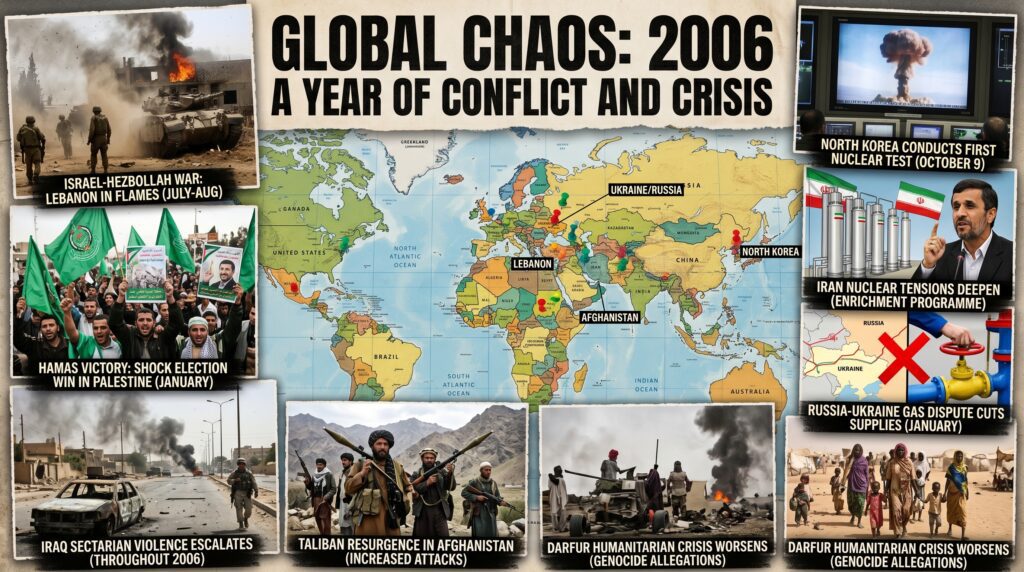
1. Why was the 2006 Israel-Hezbollah War important in Middle East politics?
Discussion: The war showed Hezbollah’s growing military and political power. It also exposed Israel’s difficulty in defeating non-state armed groups.
2. Did the 2006 Lebanon War change the balance of power in the region?
Discussion: Yes, Hezbollah gained symbolic strength despite heavy damage in Lebanon. Iran’s regional influence also became more visible through Hezbollah.
3. Why did Hezbollah become more influential after 2006?
Discussion: Hezbollah presented itself as a resistance force against Israel. Its survival after the war increased its popularity among some regional audiences.
4. Did the war weaken Israel’s deterrence?
Discussion: Yes, many analysts argued Israel failed to achieve a clear victory. This raised questions about Israeli military strategy against irregular forces.
5. Why was civilian suffering central to the Lebanon War debate?
Discussion: Large civilian casualties and infrastructure damage drew global criticism. The war raised questions about proportionality and humanitarian law.
6. Why was Hamas’s election victory important in 2006?
Discussion: Hamas won Palestinian legislative elections, changing Palestinian politics. It challenged Fatah’s dominance and complicated peace diplomacy.
7. Did Hamas’s victory weaken the peace process?
Discussion: Yes, many Western states refused to deal with Hamas unless it accepted key conditions. This deepened political division among Palestinians.
8. Why did Palestinian politics become more divided in 2006?
Discussion: Rivalry between Hamas and Fatah intensified after the election. Competing authority weakened Palestinian unity and governance.
9. Did democracy create a diplomatic problem in Palestine?
Discussion: Yes, Hamas won through elections but was rejected by many international actors. This created tension between democratic choice and security policy.
10. Why was Gaza becoming more central to Middle East conflict?
Discussion: Hamas’s rise and Israeli security concerns increased Gaza’s importance. Gaza became a major focus of blockade, conflict, and humanitarian debate.
11. Why was Iraq close to civil war in 2006?
Discussion: Sectarian violence sharply increased after the Samarra mosque bombing. Sunni-Shia conflict made national stability extremely difficult.
12. Did the Samarra bombing change Iraq’s conflict?
Discussion: Yes, it triggered widespread sectarian revenge attacks. It turned political instability into deeper communal violence.
13. Why was the execution of Saddam Hussein significant?
Discussion: It symbolized the end of the old Iraqi regime. However, the way it happened deepened sectarian tensions and controversy.
14. Did Iraq’s new government bring stability in 2006?
Discussion: No, political institutions existed but could not control violence. Militias and sectarian groups held major influence.
15. Why did the US face a strategic crisis in Iraq in 2006?
Discussion: Violence increased despite years of military presence. The US had to rethink its strategy, leading toward the later troop surge.
16. Why did Afghanistan worsen in 2006?
Discussion: The Taliban insurgency became stronger, especially in southern Afghanistan. NATO faced heavier fighting and greater security challenges.
17. Did NATO’s mission in Afghanistan become a war mission in 2006?
Discussion: Yes, NATO forces moved into more dangerous combat zones. The mission shifted from stabilization toward counter-insurgency.
18. Why was Pakistan important to Afghanistan’s instability?
Discussion: Militants used border areas for movement and refuge. This made Pakistan’s border policy central to Afghan security.
19. Did the War on Terror face setbacks in 2006?
Discussion: Yes, Iraq and Afghanistan both became more unstable. Terrorism and insurgency proved harder to defeat than expected.
20. Why did counter-insurgency become more important in 2006?
Discussion: Conventional military power could not control insurgent networks. States needed political, intelligence, and local governance strategies.
21. Why was North Korea’s nuclear test important in 2006?
Discussion: It was North Korea’s first nuclear test. This directly challenged the global non-proliferation system.
22. Did North Korea’s nuclear test weaken the NPT system?
Discussion: Yes, it showed that a state could leave the system and develop nuclear weapons. This damaged confidence in non-proliferation rules.
23. Why did the UN impose sanctions on North Korea?
Discussion: The test was seen as a threat to international peace and security. Sanctions aimed to pressure North Korea to stop its nuclear program.
24. Did China’s role become more important after the nuclear test?
Discussion: Yes, China was essential because of its influence over North Korea. It became a key actor in crisis diplomacy.
25. Why was nuclear diplomacy difficult with North Korea?
Discussion: North Korea used nuclear capability as security leverage. Trust between North Korea, the US, and regional powers was very weak.
26. Why was Iran’s nuclear issue serious in 2006?
Discussion: Iran continued uranium enrichment despite international pressure. The issue moved more strongly to the UN Security Council.
27. Did Iran’s nuclear program increase Middle East tensions?
Discussion: Yes, Gulf states, Israel, and Western powers feared Iran’s intentions. Iran argued it had a right to peaceful nuclear energy.
28. Why were sanctions used against Iran?
Discussion: Sanctions aimed to pressure Iran to limit its nuclear activities. They became a central tool of international diplomacy.
29. Did 2006 show a crisis in nuclear non-proliferation?
Discussion: Yes, North Korea tested a bomb and Iran faced sanctions. The global system struggled to manage multiple nuclear challenges.
30. Why was energy politics important in 2006?
Discussion: High oil prices and gas disputes increased concern about energy security. States realized energy supply could be used as political power.
31. Why was the Russia-Ukraine gas dispute important?
Discussion: It showed Europe’s dependence on Russian energy. Energy became a strategic weapon in Russia-West relations.
32. Did Russia use energy as geopolitical leverage?
Discussion: Yes, many viewed gas supply pressure as political influence. This increased European concern about energy diversification.
33. Why did Russia become more assertive in 2006?
Discussion: Strong energy revenues gave Russia more confidence. Moscow began defending its interests more openly against Western influence.
34. Did 2006 deepen Russia-West mistrust?
Discussion: Yes, energy disputes, NATO concerns, and post-Soviet politics increased tension. Cooperation after 9/11 continued to decline.
35. Why was the death of Alexander Litvinenko globally controversial?
Discussion: He was poisoned in London, creating a major diplomatic crisis. The case increased suspicion of Russian state involvement abroad.
36. Why was China’s rise still important in 2006?
Discussion: China’s economy continued expanding rapidly. Its growing trade, investment, and energy needs affected global markets.
37. Did China’s rise create strategic anxiety?
Discussion: Yes, many countries welcomed trade but worried about future power shifts. China’s growth changed the global balance gradually.
38. Why was Africa becoming more important to China?
Discussion: China needed energy, minerals, and markets. Its investment and diplomacy in Africa expanded significantly.
39. Did China-Africa relations challenge Western influence?
Discussion: Yes, China offered trade and investment without the same political conditions as Western donors. This gave African states more options.
40. Why was Sudan’s Darfur crisis still important in 2006?
Discussion: Violence and displacement continued despite global concern. The crisis remained a major test of humanitarian intervention.
41. Did the Darfur crisis expose weakness in Responsibility to Protect?
Discussion: Yes, the world accepted R2P in 2005 but struggled to act effectively. Darfur showed the gap between principle and action.
42. Why was the African Union mission in Darfur limited?
Discussion: It lacked enough resources, troops, and enforcement power. International support was not strong enough to stop the violence.
43. Why was the UN Human Rights Council created in 2006?
Discussion: It replaced the old Human Rights Commission. The goal was to improve global human rights monitoring and credibility.
44. Did the new Human Rights Council solve human rights politics?
Discussion: No, it improved structure but remained politically contested. Powerful states and blocs still influenced human rights debates.
45. Why was climate change gaining more attention in 2006?
Discussion: Scientific and public concern increased. Climate change was becoming a major political and economic issue.
46. Did energy security and climate policy become connected in 2006?
Discussion: Yes, dependence on fossil fuels created both strategic and environmental problems. States began linking energy choices with climate risk.
47. Why was the 2006 FIFA World Cup politically symbolic?
Discussion: Germany used the event to project a modern, united national image. It also showed the soft-power value of global sports.
48. Did global sports become part of international image-building?
Discussion: Yes, major events helped states promote identity, tourism, and diplomacy. Sports became a tool of soft power.
49. Was 2006 a year of rising non-state power?
Discussion: Yes, Hezbollah, Hamas, insurgents, and terrorist networks shaped major conflicts. Non-state actors challenged traditional state power.
50. Why can 2006 be called a year of fragmented global order?
Discussion: Iraq, Afghanistan, Lebanon, nuclear crises, and energy disputes showed growing instability. Power was becoming more dispersed among states and non-state actors.
World Affairs 2007
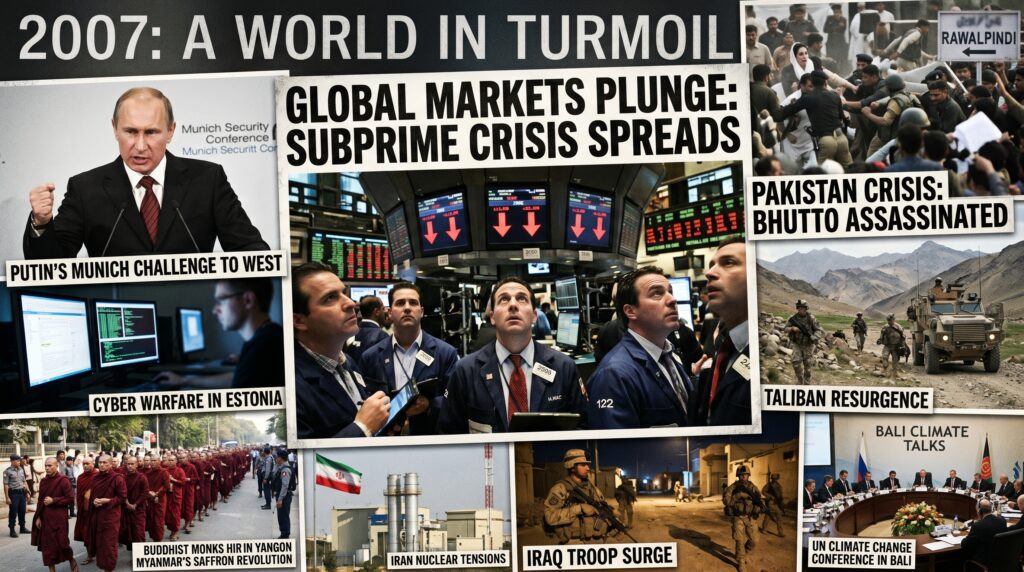
1. Why was the 2007 global financial crisis beginning important?
Discussion: The US subprime mortgage crisis started shaking global markets. It showed how deeply connected modern financial systems had become.
2. Did the subprime mortgage crisis expose weakness in global capitalism?
Discussion: Yes, risky lending and complex financial products created instability. The crisis proved that poor regulation in one country could affect the whole world.
3. Why did financial globalization become risky in 2007?
Discussion: Banks and investors were linked across borders. When US housing markets weakened, losses spread quickly through global finance.
4. Did 2007 prepare the ground for the 2008 financial collapse?
Discussion: Yes, 2007 exposed early cracks in banking and credit markets. The deeper collapse came when confidence fully broke in 2008.
5. Why did trust become central to the financial crisis?
Discussion: Banks became unsure about each other’s losses. This reduced lending and created fear across financial markets.
6. Why was the Iraq troop surge important in 2007?
Discussion: The US increased troops to reduce violence and stabilize Iraq. It temporarily improved security in some areas.
7. Did the Iraq surge solve Iraq’s political problems?
Discussion: No, it reduced violence but did not fully fix sectarian mistrust. Political reconciliation remained weak.
8. Why did counter-insurgency become central in Iraq?
Discussion: The US shifted from conventional war to protecting civilians and working with local groups. This showed military strategy had to adapt to insurgency.
9. Did the Anbar Awakening change the Iraq conflict?
Discussion: Yes, Sunni tribal groups turned against Al-Qaeda in Iraq. This helped reduce violence but created new political challenges.
10. Why was Iraq still unstable despite security gains?
Discussion: Militias, sectarian politics, and weak institutions remained serious problems. Security improvement did not automatically create national unity.
11. Why was Afghanistan deteriorating in 2007?
Discussion: The Taliban insurgency expanded and violence increased. NATO struggled to control rural areas and protect governance efforts.
12. Did NATO face strategic pressure in Afghanistan?
Discussion: Yes, member states disagreed over troop roles and combat risks. The mission became a major test of alliance unity.
13. Why did the Taliban regain strength after 2001?
Discussion: Weak Afghan governance, rural grievances, and cross-border sanctuaries helped the Taliban recover. Military victory had not removed the movement’s roots.
14. Why was Pakistan’s internal crisis important in 2007?
Discussion: Political instability, militancy, and the lawyers’ movement weakened the Musharraf government. Pakistan’s crisis affected regional security.
15. Why was Benazir Bhutto’s assassination globally significant?
Discussion: Her killing deepened Pakistan’s political crisis. It raised fears about extremism, democracy, and nuclear security.
16. Did Pakistan become more unstable in 2007?
Discussion: Yes, the Lal Masjid operation, emergency rule, and political violence increased instability. The state faced pressure from both militants and democratic forces.
17. Why was the Lal Masjid crisis important?
Discussion: It showed the growing challenge of militancy inside Pakistan’s capital. The operation also triggered militant backlash.
18. Did Pakistan’s emergency rule damage democracy?
Discussion: Yes, it weakened judicial independence and political freedoms. It increased public opposition to military-led rule.
19. Why did Pakistan matter to the War on Terror in 2007?
Discussion: Pakistan was central because of its border with Afghanistan and militant networks. Instability there affected US and NATO strategy.
20. Did 2007 show the link between domestic politics and global security?
Discussion: Yes, Pakistan’s internal crisis affected Afghanistan, terrorism, and nuclear concerns. Local instability became an international issue.
21. Why was Kosovo’s status debate important in 2007?
Discussion: Kosovo’s future challenged ideas of sovereignty and self-determination. It also created tension between Western states and Russia.
22. Did Kosovo create a precedent for separatist movements?
Discussion: Many feared it could encourage other independence claims. Russia later used similar arguments in post-Soviet conflicts.
23. Why did Russia oppose Kosovo’s independence?
Discussion: Russia supported Serbia and defended state sovereignty. It also opposed Western influence in the Balkans.
24. Did Kosovo deepen Russia-West tensions?
Discussion: Yes, disagreement over Kosovo added to mistrust. It became part of a wider struggle over international rules.
25. Why was Putin’s Munich speech important in 2007?
Discussion: Putin openly criticized US dominance and NATO expansion. The speech signaled a more confrontational Russian foreign policy.
26. Did the Munich speech mark a turning point in global politics?
Discussion: Yes, it showed Russia’s rejection of the US-led order. It warned that great-power rivalry was returning.
27. Why was missile defense a major issue in 2007?
Discussion: The US planned missile defense sites in Eastern Europe. Russia viewed them as a threat to strategic balance.
28. Did Russia become more assertive in 2007?
Discussion: Yes, Russia used energy power, diplomacy, and military rhetoric more confidently. High oil prices strengthened Moscow’s position.
29. Why was the Estonia cyberattack important?
Discussion: It was one of the first major cyber crises between states. It showed that cyberattacks could become tools of geopolitical pressure.
30. Did 2007 introduce cyber warfare into world affairs?
Discussion: Yes, the Estonia case highlighted digital vulnerability. Cybersecurity became a serious national security issue.
31. Why was Iran’s nuclear issue still serious in 2007?
Discussion: Iran continued nuclear activities despite pressure. The issue remained central to Middle East security and global diplomacy.
32. Did sanctions change Iran’s behavior in 2007?
Discussion: Sanctions increased pressure but did not end Iran’s nuclear ambitions. Iran continued to frame its program as a sovereign right.
33. Why was the US intelligence assessment on Iran important?
Discussion: A US report said Iran had halted a weapons program earlier. This complicated arguments for military action against Iran.
34. Did the Iran issue expose limits of coercive diplomacy?
Discussion: Yes, pressure alone did not produce full compliance. Diplomacy, sanctions, and security guarantees all remained contested.
35. Why was North Korea diplomacy important in 2007?
Discussion: North Korea agreed to steps toward disabling nuclear facilities. It showed that negotiations could sometimes reduce nuclear tensions.
36. Did the Six-Party Talks make real progress in 2007?
Discussion: Yes, there was some progress on denuclearization steps. But mistrust and verification problems remained.
37. Why was climate change a major global issue in 2007?
Discussion: The IPCC report increased scientific urgency. Climate change became a mainstream political and security concern.
38. Why was the Bali Climate Conference important?
Discussion: It launched a roadmap for future climate negotiations. The conference aimed to shape a post-Kyoto climate framework.
39. Did climate change become a security issue in 2007?
Discussion: Yes, climate risks were linked to food, water, migration, and conflict. States began treating climate as a strategic challenge.
40. Why did Al Gore and the IPCC winning the Nobel Peace Prize matter?
Discussion: It showed climate change was connected to peace and security. Environmental issues gained stronger global political importance.
41. Why was the EU’s Lisbon Treaty important in 2007?
Discussion: It aimed to improve EU decision-making after enlargement. The treaty helped the EU function with more member states.
42. Did the Lisbon Treaty solve the EU’s identity crisis?
Discussion: It improved institutions but did not remove public doubts. Questions about sovereignty and democracy remained.
43. Why did Turkey’s EU membership debate continue?
Discussion: Turkey’s candidacy raised issues of identity, religion, migration, and democracy. Many EU states remained divided.
44. Why was China’s rise highly visible in 2007?
Discussion: China became more central in trade, investment, and global production. Its growing power created both opportunity and anxiety.
45. Did China become more confident internationally in 2007?
Discussion: Yes, its economic strength supported a more active global role. China increased influence in Africa, Asia, and global markets.
46. Why was food and energy inflation becoming a global concern?
Discussion: Rising prices affected poor countries and consumers worldwide. Energy costs and demand growth created economic pressure.
47. Did globalization increase vulnerability to price shocks?
Discussion: Yes, connected markets spread price increases quickly. Poor states were especially vulnerable to food and fuel instability.
48. Why was Myanmar’s Saffron Revolution important?
Discussion: Buddhist monks led protests against military rule. The crackdown showed the limits of international pressure on authoritarian regimes.
49. Did 2007 show the weakness of democratic movements?
Discussion: In some places, yes. Myanmar and Pakistan showed that pro-democracy movements faced strong state resistance.
50. Why can 2007 be called a year of warning signs?
Discussion: Financial instability, cyber threats, climate urgency, Russia-West tension, and regional crises all grew stronger. Many of these warnings became larger global problems after 2007.
World Affairs 2008
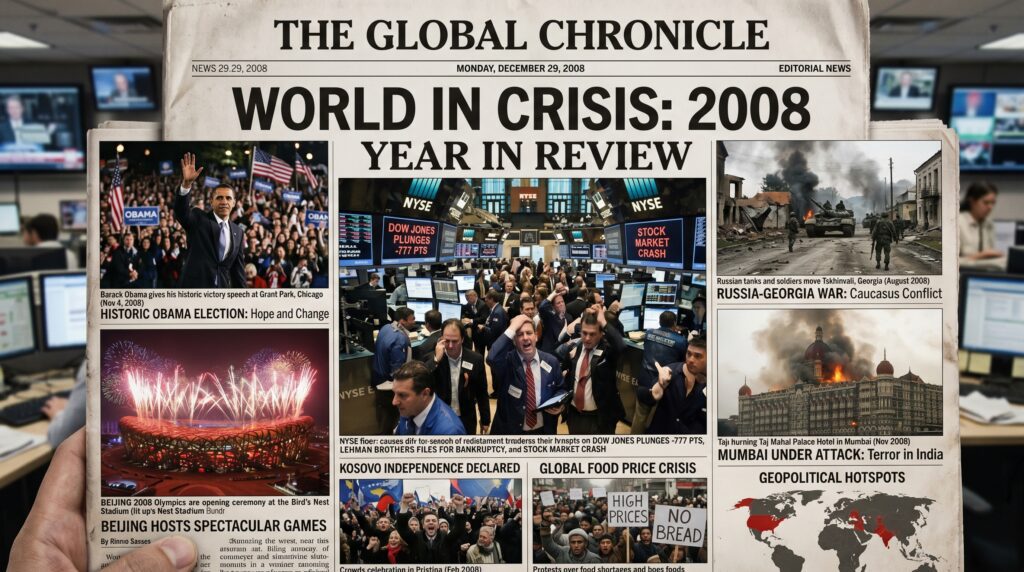
1. Why was the 2008 global financial crisis a turning point in world affairs?
Discussion: It exposed major weaknesses in global banking, credit markets, and financial regulation. The crisis affected economies worldwide and reduced trust in free-market capitalism.
2. Did the collapse of Lehman Brothers trigger a global panic?
Discussion: Yes, Lehman’s collapse shocked financial markets and destroyed confidence. Banks, investors, and governments feared a wider collapse of the global financial system.
3. Why did the US housing crisis become a global crisis?
Discussion: Mortgage-related financial products were sold across global markets. When US housing collapsed, losses spread to banks and investors worldwide.
4. Did the crisis expose the failure of financial regulation?
Discussion: Yes, regulators failed to control risky lending and complex financial products. The crisis showed that markets could not always regulate themselves.
5. Why was government intervention necessary in 2008?
Discussion: Banks were failing and credit markets were freezing. Governments had to rescue financial institutions to prevent total economic collapse.
6. Did the 2008 crisis weaken American economic leadership?
Discussion: Yes, the crisis began in the US financial system and damaged its credibility. It also strengthened arguments for reforming global economic governance.
7. Why did the G20 become more important after the crisis?
Discussion: The crisis showed that the G7 alone could not manage the global economy. Emerging economies like China, India, and Brazil became more important in global decision-making.
8. Did the financial crisis increase criticism of neoliberalism?
Discussion: Yes, many critics blamed deregulation, privatization, and excessive faith in markets. The crisis revived debates about state control and social protection.
9. How did the crisis affect developing countries?
Discussion: Many developing economies faced lower exports, reduced investment, and job losses. Even countries not responsible for the crisis suffered its consequences.
10. Did 2008 mark the end of blind faith in globalization?
Discussion: Yes, the crisis showed that global interdependence could spread danger quickly. It made people question whether globalization was always beneficial.
11. Why was Barack Obama’s election globally significant?
Discussion: Obama’s victory symbolized change in American politics and global image. Many countries expected a shift from Bush-era foreign policy.
12. Did Obama’s election improve America’s soft power?
Discussion: Yes, it created hope for diplomacy, multilateralism, and better global relations. However, expectations were very high and difficult to meet.
13. Why was Obama’s message of change important internationally?
Discussion: The world wanted a different US approach after Iraq and the War on Terror. Obama represented the possibility of renewed American legitimacy.
14. Did Obama’s election change perceptions of race and democracy?
Discussion: Yes, his election as the first African American president had symbolic global importance. It showed a major social and political shift inside the United States.
15. Why did the 2008 US election matter beyond America?
Discussion: US leadership strongly affects global security, trade, and diplomacy. A change in Washington meant possible changes in international politics.
16. Why was the Russia-Georgia War important in 2008?
Discussion: The war showed Russia’s willingness to use force in its neighborhood. It challenged Western influence in the post-Soviet space.
17. Did the Georgia War mark the return of great-power rivalry?
Discussion: Yes, it exposed deep tension between Russia and the West. It showed that post-Cold War cooperation was weakening.
18. Why did Russia recognize Abkhazia and South Ossetia?
Discussion: Russia used recognition to strengthen its influence and weaken Georgia’s territorial control. Western states saw it as a violation of sovereignty.
19. Did the Georgia War challenge the principle of territorial integrity?
Discussion: Yes, it raised questions about sovereignty, separatism, and military intervention. Russia and the West used different legal arguments.
20. How did the Georgia War affect NATO expansion debates?
Discussion: It made NATO membership for Georgia and Ukraine more controversial. Russia strongly opposed NATO moving closer to its borders.
21. Why was Kosovo’s declaration of independence important in 2008?
Discussion: Kosovo’s independence challenged traditional ideas of state sovereignty. It also created tension between Western states, Serbia, and Russia.
22. Did Kosovo create a precedent for other separatist regions?
Discussion: Many countries feared that Kosovo could encourage other independence claims. Russia later used Kosovo as an argument in other territorial disputes.
23. Why did many Western states recognize Kosovo?
Discussion: They argued Kosovo was a unique case after conflict and international administration. Serbia and Russia rejected this argument.
24. Did Kosovo deepen Russia-West disagreements?
Discussion: Yes, it increased mistrust over international law and sovereignty. Kosovo became part of wider geopolitical competition.
25. Why was the Beijing Olympics important for China?
Discussion: The Olympics allowed China to display its economic rise and national confidence. It was a major soft-power moment for Beijing.
26. Did the Beijing Olympics change China’s global image?
Discussion: Yes, China presented itself as modern, powerful, and globally important. But human rights criticism also remained strong.
27. Why were human rights debates linked to the Beijing Olympics?
Discussion: Activists highlighted issues such as Tibet, censorship, and political freedoms. China rejected foreign criticism as interference.
28. Did 2008 show China’s arrival as a major world power?
Discussion: Yes, China’s economic strength and Olympic success made its rise highly visible. The global financial crisis also made China appear more stable.
29. Why did China become more important during the financial crisis?
Discussion: China held large reserves and continued strong growth. Its role in global recovery and trade became more significant.
30. Did the financial crisis shift power toward emerging economies?
Discussion: Yes, Western economies were weakened while some emerging states gained influence. This accelerated debate about a multipolar world.
31. Why was the Mumbai attack important in 2008?
Discussion: The attacks targeted India’s financial capital and shocked the world. They increased India-Pakistan tensions and global concern about terrorism.
32. Did the Mumbai attacks damage India-Pakistan relations?
Discussion: Yes, India blamed Pakistan-based militants, raising diplomatic pressure. Peace talks suffered and regional tensions increased.
33. Why was urban terrorism a major concern after Mumbai?
Discussion: The attacks showed how small groups could paralyze a major city. Hotels, transport hubs, and public places became security concerns.
34. Did Mumbai show weaknesses in counter-terrorism preparedness?
Discussion: Yes, the response exposed gaps in intelligence, coordination, and crisis management. India later reviewed its security systems.
35. Why did terrorism remain central to world affairs in 2008?
Discussion: Iraq, Afghanistan, Pakistan, and India all faced major security threats. Terrorism remained a transnational and regional challenge.
36. Why did Afghanistan remain unstable in 2008?
Discussion: Taliban attacks increased and governance remained weak. NATO and Afghan forces struggled to secure rural areas.
37. Did Pakistan’s internal instability affect Afghanistan?
Discussion: Yes, militant networks used border areas and safe havens. Pakistan’s internal politics influenced the wider Afghan war.
38. Why was Pakistan’s democratic transition important in 2008?
Discussion: Elections ended Musharraf’s dominance and brought civilian rule back. However, militancy and economic problems remained serious.
39. Did Benazir Bhutto’s assassination shape Pakistan’s 2008 politics?
Discussion: Yes, her death created sympathy for the PPP and changed the election environment. It also deepened concerns about extremism.
40. Why was Asif Ali Zardari’s presidency significant?
Discussion: It marked a civilian political transition after military rule. Pakistan still faced terrorism, economic stress, and institutional tension.
41. Why was the food price crisis important in 2008?
Discussion: Rising food prices caused hardship in many developing countries. Food insecurity became linked with poverty, protests, and political instability.
42. Did the food crisis show the weakness of global markets?
Discussion: Yes, global price shocks quickly affected poor consumers. It showed that food security depends on trade, climate, energy, and policy.
43. Why did oil prices matter in 2008?
Discussion: Oil prices reached very high levels before collapsing during the crisis. This affected inflation, energy policy, and global economic stability.
44. Did energy security become more important in 2008?
Discussion: Yes, high oil prices and geopolitical tensions made energy supply a major concern. States looked for more stable and diverse energy sources.
45. Why was climate diplomacy still difficult in 2008?
Discussion: Countries disagreed over emissions responsibility and economic costs. Developing countries wanted growth space while rich countries pushed climate commitments.
46. Did the financial crisis weaken climate action?
Discussion: Yes, economic survival became the priority for many governments. Climate policy faced delays as states focused on financial rescue.
47. Why was the Doha trade round still struggling in 2008?
Discussion: Rich and developing countries disagreed over agriculture, subsidies, and market access. The failure showed deep inequality in trade politics.
48. Did the collapse of Doha weaken the WTO?
Discussion: Yes, it damaged confidence in multilateral trade negotiations. Countries increasingly looked toward bilateral and regional trade deals.
49. Was 2008 a year of global power transition?
Discussion: Yes, the financial crisis weakened Western confidence while China and emerging economies gained importance. Russia also showed renewed assertiveness in Georgia.
50. Why can 2008 be called a year of crisis and transition?
Discussion: Financial collapse, Obama’s election, the Georgia War, Kosovo, Mumbai, and China’s Olympics all reshaped world affairs. The year marked a shift toward a more unstable multipolar order.
World Affairs 2009
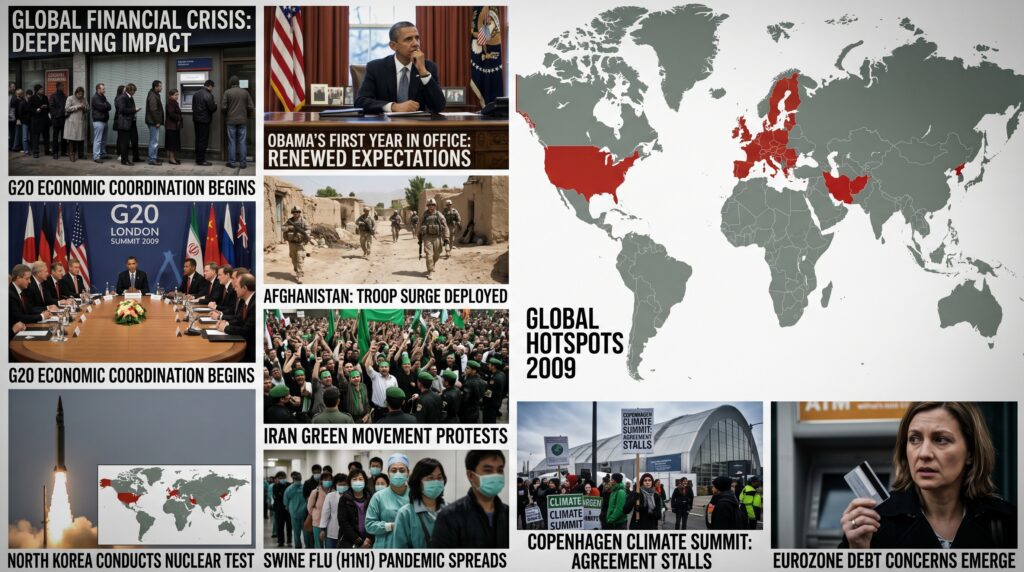
1. Why was 2009 important after the global financial crisis?
Discussion: The world was still recovering from the 2008 financial collapse. Governments used stimulus packages, bailouts, and reforms to prevent deeper economic depression.
2. Did the 2009 recovery prove the importance of state intervention?
Discussion: Yes, governments played a major role in saving banks and supporting demand. The crisis weakened the idea that markets alone could manage global stability.
3. Why did the G20 become central to global economic governance in 2009?
Discussion: The crisis showed that emerging economies were essential to recovery. The G20 became more important than the G7 in managing global economic coordination.
4. Did the financial crisis shift power toward emerging economies?
Discussion: Yes, China, India, Brazil, and other emerging economies gained more voice. Western dominance in economic decision-making looked weaker.
5. Why was financial regulation a major debate in 2009?
Discussion: Risky banking practices had helped create the crisis. Leaders discussed stricter rules to prevent another collapse.
6. Did the crisis create a legitimacy problem for capitalism?
Discussion: Yes, many people questioned inequality, bank bailouts, and deregulation. Public anger increased toward financial elites and weak oversight.
7. Why was Barack Obama’s first year globally significant?
Discussion: Obama promised diplomacy, multilateralism, and a different US image. Many countries expected a break from Bush-era unilateralism.
8. Did Obama improve America’s soft power in 2009?
Discussion: Yes, his speeches and diplomatic tone improved global perceptions. However, wars in Afghanistan and Iraq still limited the change.
9. Why was Obama’s Cairo speech important?
Discussion: It aimed to reset relations between the United States and the Muslim world. The speech focused on respect, dialogue, and shared interests.
10. Did Obama’s foreign policy fully break from the Bush era?
Discussion: Not completely. He changed the tone, but counter-terrorism, drones, and Afghanistan remained central.
11. Why was the Afghanistan troop surge important in 2009?
Discussion: Obama sent more troops to fight the Taliban and stabilize Afghanistan. It showed that Afghanistan had become his main war priority.
12. Did the Afghan surge solve the conflict?
Discussion: No, it increased military pressure but did not end the insurgency. Weak governance and cross-border militancy remained major problems.
13. Why was counter-insurgency important in Afghanistan?
Discussion: The strategy focused on protecting civilians and building local trust. Military force alone could not defeat the Taliban.
14. Did Pakistan become more important in US strategy?
Discussion: Yes, militants operated across the Afghanistan-Pakistan border. US policy increasingly treated both countries as one connected security theater.
15. Why was the term “AfPak” controversial?
Discussion: It linked Afghanistan and Pakistan in one strategic framework. Many Pakistanis disliked it because it seemed to reduce Pakistan to a security problem.
16. Why was Pakistan’s Swat operation important in 2009?
Discussion: Pakistan launched military action against militants in Swat. It showed the state responding more directly to internal Taliban control.
17. Did militancy threaten Pakistan’s internal stability in 2009?
Discussion: Yes, attacks and militant control in some areas raised serious concerns. Pakistan’s security crisis became an international issue.
18. Why was the Kerry-Lugar Bill important for Pakistan-US relations?
Discussion: It offered major civilian aid to Pakistan. But conditions attached to the aid created political controversy inside Pakistan.
19. Did drone strikes become more controversial in 2009?
Discussion: Yes, the US expanded drone use in Pakistan’s tribal areas. Supporters saw them as effective, while critics highlighted sovereignty and civilian casualty concerns.
20. Why was terrorism still central to world affairs in 2009?
Discussion: Afghanistan, Pakistan, Iraq, and global terror networks remained active. Security policies continued to shape international relations.
21. Why was Iraq still unstable in 2009?
Discussion: Violence had declined, but political divisions remained. The US began preparing for withdrawal while Iraq’s institutions were still fragile.
22. Did US withdrawal plans change Iraq’s politics?
Discussion: Yes, Iraqi leaders had to take more responsibility for security. However, sectarian tensions and governance problems continued.
23. Why was Iran’s Green Movement globally significant?
Discussion: Protests after Iran’s disputed election showed public anger and demands for political rights. The movement drew global attention to Iran’s internal politics.
24. Did the Green Movement weaken Iran’s regime?
Discussion: It challenged the regime’s legitimacy but did not remove it. The state used repression to control the protests.
25. Why did Iran’s nuclear issue remain serious in 2009?
Discussion: International concern continued over uranium enrichment and possible military dimensions. Diplomacy remained difficult because of mistrust.
26. Did Iran’s domestic unrest affect nuclear diplomacy?
Discussion: Yes, political instability made negotiations more complicated. Western states had to balance pressure on nuclear issues with support for human rights.
27. Why was North Korea’s nuclear test important in 2009?
Discussion: North Korea conducted another nuclear test, increasing regional tension. It showed that earlier diplomacy had not stopped its nuclear program.
28. Did North Korea weaken the non-proliferation system?
Discussion: Yes, its continued tests challenged global nuclear rules. The case showed the difficulty of forcing compliance from isolated regimes.
29. Why did the Six-Party Talks struggle in 2009?
Discussion: North Korea resisted full denuclearization and used nuclear capability as leverage. Trust between the parties remained very low.
30. Why was China important in managing North Korea?
Discussion: China had economic and political influence over North Korea. Its role was essential for sanctions, diplomacy, and regional stability.
31. Why was the Copenhagen Climate Summit important?
Discussion: It was expected to create a major global climate agreement. The summit showed both urgency and deep divisions among states.
32. Did Copenhagen succeed or fail?
Discussion: It produced a limited political accord, not a strong binding treaty. Many saw it as a disappointment for climate diplomacy.
33. Why did climate negotiations become difficult in 2009?
Discussion: Developed and developing countries disagreed over responsibility, finance, and emissions cuts. Trust between rich and poor states was weak.
34. Did climate change become a major global justice issue?
Discussion: Yes, poorer countries argued they suffered most despite contributing less to emissions. Climate finance and historical responsibility became central debates.
35. Why was China-US climate cooperation important?
Discussion: The US and China were major emitters. Without cooperation between them, any global climate deal was difficult.
36. Why was the Lisbon Treaty important in 2009?
Discussion: It came into force and changed how the European Union worked. It aimed to make EU decision-making more effective after enlargement.
37. Did the Lisbon Treaty strengthen the EU?
Discussion: Yes, it created stronger institutional roles and improved coordination. But public doubts about EU democracy and sovereignty remained.
38. Why was the Eurozone under pressure in 2009?
Discussion: The financial crisis exposed debt and banking weaknesses in some European countries. These problems later developed into the Eurozone debt crisis.
39. Did 2009 expose weaknesses in European integration?
Discussion: Yes, shared currency did not mean shared fiscal policy. Economic differences between member states became more visible.
40. Why was Russia-West reset policy important?
Discussion: Obama tried to improve relations with Russia after years of tension. The reset aimed at cooperation on arms control, Iran, and security.
41. Did the Russia reset solve deeper tensions?
Discussion: No, it improved tone temporarily but did not remove strategic mistrust. NATO, missile defense, and post-Soviet politics remained sensitive.
42. Why was NATO still important in 2009?
Discussion: NATO remained heavily involved in Afghanistan. Its mission tested alliance unity and military capacity.
43. Why was China’s rise more visible after the financial crisis?
Discussion: China recovered faster than many Western economies. Its growth increased confidence in its economic model.
44. Did the crisis strengthen China’s global position?
Discussion: Yes, China’s stimulus and reserves helped sustain growth. Many observers saw China as a rising economic stabilizer.
45. Why was the Urumqi unrest important in China?
Discussion: Ethnic violence in Xinjiang exposed internal tensions. It raised global concerns about minority rights and state security policies.
46. Did human rights remain a global issue in 2009?
Discussion: Yes, Iran, China, Myanmar, and other cases kept rights debates active. Security and sovereignty often limited international action.
47. Why was the H1N1 pandemic important in 2009?
Discussion: It showed how quickly disease could spread globally. Public health preparedness became an international concern again.
48. Did H1N1 strengthen global health cooperation?
Discussion: Yes, governments and the WHO coordinated monitoring and response. However, vaccine access and public trust remained challenges.
49. Was 2009 a year of recovery or uncertainty?
Discussion: It was both. The world tried to recover economically, but security, climate, nuclear, and health crises continued.
50. Why can 2009 be called a year of global adjustment?
Discussion: States adjusted to financial crisis, Obama’s diplomacy, climate pressure, and rising multipolarity. The year showed that the post-2008 world would be more complex and less Western-dominated.
World Affairs 2010
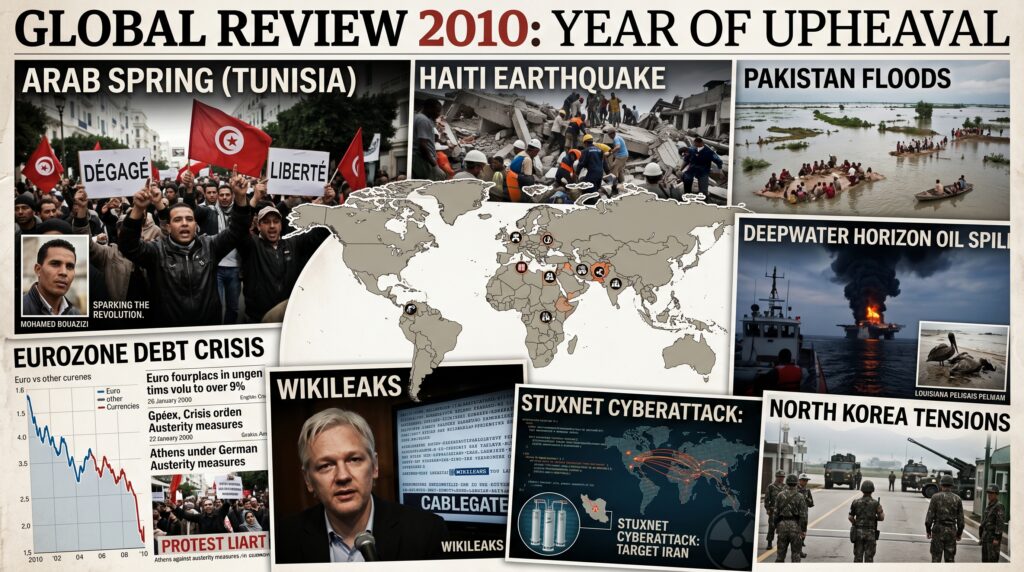
1. Why was 2010 important for the beginning of the Arab Spring?
Discussion: The Tunisian uprising began in late 2010 after public anger against corruption, unemployment, and authoritarian rule. It later inspired wider protests across the Arab world.
2. Did the Tunisian Revolution expose the weakness of Arab authoritarian regimes?
Discussion: Yes, it showed that long-ruling regimes could fall under public pressure. It also proved that economic frustration could quickly become political revolution.
3. Why was Mohamed Bouazizi’s self-immolation globally significant?
Discussion: His act became a symbol of dignity, unemployment, and state injustice. It triggered protests that changed Middle Eastern politics.
4. Did social media influence the Arab Spring’s early phase?
Discussion: Yes, social media helped spread images, anger, and protest messages. However, deeper causes were economic hardship and political repression.
5. Why was Tunisia considered the starting point of a regional wave?
Discussion: Tunisia’s protests showed that mass mobilization could challenge dictatorship. Other Arab societies saw it as proof that change was possible.
6. Why was the Eurozone debt crisis a major issue in 2010?
Discussion: Greece’s debt crisis exposed weaknesses in the Eurozone system. It showed that a shared currency without strong fiscal unity could create instability.
7. Did the Greek debt crisis threaten European integration?
Discussion: Yes, it created doubts about the euro’s survival and EU solidarity. Wealthier states and debtor countries disagreed over bailouts and austerity.
8. Why was austerity controversial in Europe?
Discussion: Supporters said austerity was needed to control debt. Critics argued it increased unemployment, poverty, and political anger.
9. Did the Eurozone crisis reveal a north-south divide in Europe?
Discussion: Yes, stronger economies demanded discipline while weaker economies needed support. This created political tension inside the European Union.
10. Why did financial markets lose confidence in some European states?
Discussion: Investors feared that countries like Greece could default on debt. Rising borrowing costs made the crisis more dangerous.
11. Why was the Haiti earthquake a major global humanitarian crisis?
Discussion: It caused massive destruction and loss of life in a poor and fragile state. The disaster exposed the link between poverty, weak institutions, and human vulnerability.
12. Did the Haiti earthquake test international humanitarian response?
Discussion: Yes, global aid arrived quickly but coordination problems appeared. The crisis showed that relief work needs strong local and international planning.
13. Why was Haiti’s state capacity a major concern after the earthquake?
Discussion: The government lacked resources and institutional strength to manage the disaster alone. This made international assistance essential but also complicated.
14. Did the Haiti crisis show the limits of global aid?
Discussion: Yes, aid saved lives but long-term reconstruction was slow. It showed that emergency relief cannot easily fix structural poverty.
15. Why was the Pakistan flood disaster important in 2010?
Discussion: The floods affected millions and damaged homes, crops, and infrastructure. It became one of Pakistan’s largest humanitarian disasters.
16. Did the Pakistan floods become a human security issue?
Discussion: Yes, the disaster affected food, health, shelter, and livelihoods. It showed how climate-related disasters can threaten national stability.
17. Why did climate vulnerability become more visible in 2010?
Discussion: Floods, heatwaves, and disasters increased concern about climate risks. Poor and developing countries appeared especially vulnerable.
18. Did natural disasters affect international politics in 2010?
Discussion: Yes, Haiti and Pakistan required global humanitarian attention. Disasters became linked with governance, development, and security debates.
19. Why was the Deepwater Horizon oil spill globally significant?
Discussion: It was one of the worst environmental disasters in US history. It raised questions about corporate responsibility and offshore drilling safety.
20. Did the oil spill change environmental governance debates?
Discussion: Yes, it exposed risks of energy extraction and weak regulation. It strengthened calls for accountability and environmental protection.
21. Why was the New START Treaty important in 2010?
Discussion: The United States and Russia agreed to reduce strategic nuclear weapons. It was a major achievement of the Obama-Russia reset.
22. Did New START improve US-Russia relations?
Discussion: Yes, it created limited cooperation on arms control. However, deeper disagreements over NATO, missile defense, and influence remained.
23. Why was nuclear arms control still important after the Cold War?
Discussion: The US and Russia still held large nuclear arsenals. Arms control reduced risks and supported global non-proliferation norms.
24. Did 2010 strengthen the nuclear non-proliferation regime?
Discussion: Partly, because New START and nuclear security talks supported arms control. But Iran and North Korea remained major challenges.
25. Why was Iran’s nuclear issue serious in 2010?
Discussion: Iran continued enrichment activities despite international concern. The UN imposed stronger sanctions to pressure Tehran.
26. Did sanctions against Iran work in 2010?
Discussion: They increased economic pressure but did not end Iran’s nuclear program. Sanctions became a tool to force future negotiations.
27. Why was the Stuxnet cyberattack important?
Discussion: Stuxnet targeted Iran’s nuclear program and showed cyber tools could damage physical infrastructure. It marked a new era of cyber conflict.
28. Did Stuxnet change the meaning of warfare?
Discussion: Yes, it showed that states could use code as a strategic weapon. Cyber operations became part of national security planning.
29. Why was cybersecurity becoming a major global issue?
Discussion: Governments, banks, energy systems, and militaries depended on digital networks. Cyberattacks could now create real political and economic damage.
30. Did 2010 show the rise of hybrid conflict?
Discussion: Yes, cyber operations, sanctions, information politics, and covert tools became more visible. Conflict was no longer limited to open military force.
31. Why was WikiLeaks globally important in 2010?
Discussion: WikiLeaks released secret US diplomatic cables, exposing sensitive global communications. It changed debates about transparency, secrecy, and diplomacy.
32. Did WikiLeaks weaken traditional diplomacy?
Discussion: Yes, it embarrassed governments and made diplomats more cautious. It also raised questions about public right to know versus national security.
33. Why was information power important in 2010?
Discussion: Digital leaks showed that information could challenge powerful states. Control over data became a new form of political power.
34. Did WikiLeaks strengthen global accountability?
Discussion: Supporters argued it exposed hidden state behavior. Critics said it endangered diplomacy, security, and confidential communication.
35. Why was the Afghanistan war still central in 2010?
Discussion: The US troop surge continued, but Taliban resistance remained strong. Afghanistan remained a major test of Western military strategy.
36. Did the Afghan surge bring lasting stability?
Discussion: It increased pressure on militants in some areas. But weak governance and Taliban resilience limited long-term success.
37. Why was the Afghanistan-Pakistan border important?
Discussion: Militants moved across the border and used safe havens. This made Pakistan central to any Afghan strategy.
38. Did drone warfare expand in 2010?
Discussion: Yes, drone strikes became a major US counter-terrorism tool, especially in Pakistan. They raised debates over effectiveness, sovereignty, and civilian harm.
39. Why was Pakistan strategically important in 2010?
Discussion: Pakistan was central to Afghanistan, counter-terrorism, and nuclear security. Its internal instability had regional and global effects.
40. Did the War on Terror face legitimacy problems in 2010?
Discussion: Yes, civilian casualties, drones, detention, and long wars weakened support. Many questioned whether security policies created more instability.
41. Why was North Korea’s sinking of the Cheonan important?
Discussion: South Korea blamed North Korea for sinking the warship. The incident increased tension on the Korean Peninsula.
42. Did North Korea increase regional insecurity in 2010?
Discussion: Yes, the Cheonan sinking and shelling of Yeonpyeong raised fears of conflict. North Korea used military pressure to gain leverage.
43. Why was China important in Korean Peninsula stability?
Discussion: China was North Korea’s main ally and economic supporter. Its cooperation was necessary for pressure and diplomacy.
44. Did the Korean crisis expose limits of sanctions?
Discussion: Yes, sanctions increased pressure but did not stop North Korean provocations. Diplomacy remained difficult because of security mistrust.
45. Why was China’s global influence rising in 2010?
Discussion: China had recovered strongly after the financial crisis and expanded trade links. Its economic power gave it greater diplomatic influence.
46. Did China’s rise create strategic competition?
Discussion: Yes, neighboring states and the US watched China’s military and economic growth carefully. Asia became more central to global power politics.
47. Why was the Nobel Peace Prize to Liu Xiaobo controversial?
Discussion: It highlighted human rights and political freedom in China. Beijing strongly rejected the award as foreign interference.
48. Did human rights tensions with China increase in 2010?
Discussion: Yes, the Liu Xiaobo case increased criticism of China’s political system. It showed tension between China’s rise and liberal human rights norms.
49. Was 2010 a year of hidden transitions?
Discussion: Yes, the Arab Spring began, cyber conflict rose, and the Eurozone crisis deepened. Many changes were early signs of larger global shifts.
50. Why can 2010 be called a bridge between crisis and revolution?
Discussion: The world was still dealing with financial crisis, wars, climate disasters, and nuclear tensions. At the same time, new forces like protest movements, cyber warfare, and digital leaks were reshaping global affairs.
World Affairs 2011
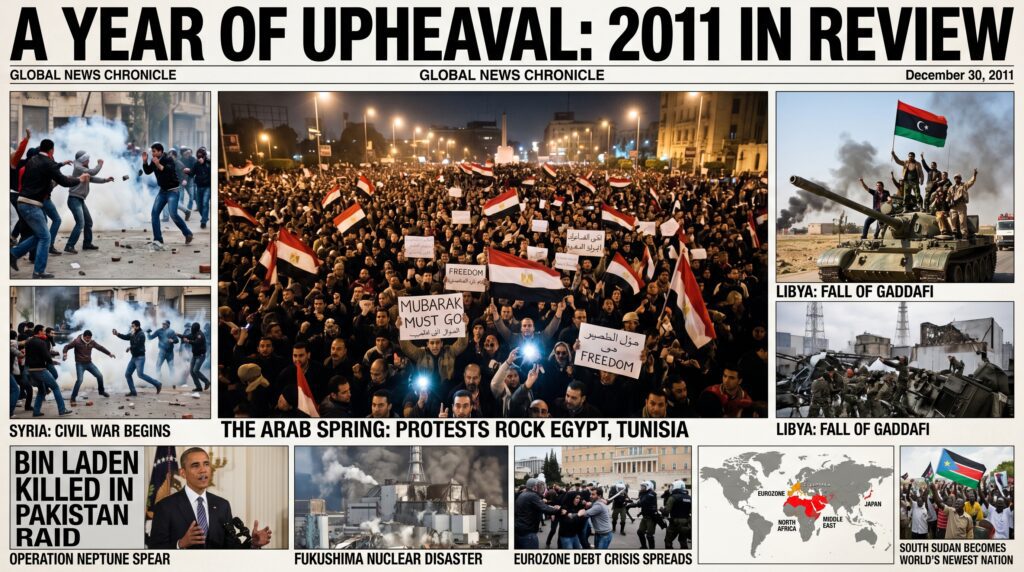
1. Why was 2011 a turning point in Middle Eastern politics?
Discussion: The Arab Spring spread across several countries and challenged long-standing authoritarian regimes. It changed regional politics, security, and global diplomacy.
2. Did the Arab Spring prove the weakness of authoritarian rule?
Discussion: Yes, public anger over corruption, unemployment, and repression became impossible to control. However, later outcomes showed that removing rulers was easier than building stable democracy.
3. Why was Egypt’s revolution globally significant?
Discussion: Egypt was the most populous Arab country and a key US ally. Hosni Mubarak’s fall showed that even powerful regimes could collapse under mass protest.
4. Did Tahrir Square become a symbol of people power?
Discussion: Yes, it became a global image of protest, youth activism, and democratic hope. It inspired movements inside and outside the Arab world.
5. Why did Tunisia’s transition appear more successful than others?
Discussion: Tunisia had stronger civil society and less military domination in politics. This helped create a more peaceful democratic transition compared with other Arab states.
6. Why did Libya become an international intervention case in 2011?
Discussion: Muammar Gaddafi’s violent response to protests raised fears of mass atrocities. NATO intervention was justified through civilian protection and Responsibility to Protect.
7. Did NATO’s Libya intervention strengthen or weaken R2P?
Discussion: It initially strengthened R2P by preventing possible mass killings. But later chaos in Libya created criticism that intervention caused long-term instability.
8. Why did Libya collapse after Gaddafi’s fall?
Discussion: State institutions were weak and armed groups gained power. Removing the ruler did not create a functioning political order.
9. Did the Libya intervention damage trust between Russia and the West?
Discussion: Yes, Russia believed NATO exceeded the UN mandate. This later made Moscow more suspicious of Western intervention proposals.
10. Why was Syria’s uprising different from Tunisia and Egypt?
Discussion: The Syrian regime used severe force and retained support from security institutions. Regional and sectarian divisions also made the conflict more complex.
11. Did Syria’s crisis become internationalized in 2011?
Discussion: Yes, regional powers and global actors quickly took interest. Syria became a battlefield of domestic conflict and external rivalry.
12. Why was Bashar al-Assad able to survive early protests?
Discussion: The regime maintained military loyalty and used strong repression. It also relied on support from key domestic and foreign allies.
13. Did the Arab Spring create democratic hope or regional disorder?
Discussion: It created hope for political freedom but also produced instability in several states. The results varied widely from country to country.
14. Why did Yemen become unstable in 2011?
Discussion: Protests against Ali Abdullah Saleh weakened the state and intensified political divisions. Tribal, regional, and militant pressures made transition difficult.
15. Did Bahrain’s protests expose sectarian and geopolitical tensions?
Discussion: Yes, the protests raised demands for reform but were framed through sectarian and regional rivalry. Saudi and Gulf intervention showed the strategic importance of Bahrain.
16. Why did Gulf monarchies survive the Arab Spring better than republics?
Discussion: Many Gulf states used wealth, welfare spending, and security control to manage unrest. Monarchies also had different legitimacy structures than republican dictatorships.
17. Did social media cause the Arab Spring?
Discussion: No, social media helped mobilization and communication, but deeper causes were political repression and economic frustration. Technology accelerated protests but did not create the grievances.
18. Why did youth unemployment matter in the Arab Spring?
Discussion: Large numbers of educated young people faced limited opportunities. Economic exclusion became a major driver of political anger.
19. Did the Arab Spring change Western policy toward democracy?
Discussion: Yes, Western states had to balance support for democracy with security and strategic interests. This exposed contradictions in their Middle East policies.
20. Why did Islamists gain political space after the uprisings?
Discussion: Islamist groups were often better organized than liberal opposition movements. After authoritarian control weakened, they quickly entered electoral politics.
21. Why was Osama bin Laden’s killing important in 2011?
Discussion: It was a major symbolic victory for the United States in the War on Terror. However, it did not end Al-Qaeda or global militancy.
22. Did bin Laden’s death end the War on Terror?
Discussion: No, terrorism had already become decentralized. New groups and local branches continued to operate in different regions.
23. Why did the Abbottabad operation affect Pakistan-US relations?
Discussion: The operation was conducted inside Pakistan without public prior approval. It raised questions about sovereignty, trust, and intelligence cooperation.
24. Did bin Laden’s presence in Pakistan damage Pakistan’s global image?
Discussion: Yes, it created international suspicion and pressure. Many questioned how bin Laden lived near a major military area for years.
25. Why was unilateral military action controversial in Abbottabad?
Discussion: The US defended it as necessary for security. Pakistan saw it as a violation of sovereignty and a sign of weak trust.
26. Why did the US announce withdrawal plans from Iraq in 2011?
Discussion: The US wanted to end its long military occupation and transfer responsibility to Iraqi forces. Public fatigue and political pressure also shaped the decision.
27. Did the US withdrawal bring stability to Iraq?
Discussion: No, Iraq remained politically fragile and sectarian divisions continued. Later instability showed that withdrawal did not solve deeper problems.
28. Why was Afghanistan still central to world affairs in 2011?
Discussion: NATO forces were still fighting the Taliban while planning future transition. The war remained costly and politically difficult.
29. Did the Taliban remain resilient in 2011?
Discussion: Yes, the Taliban survived years of military pressure. Weak governance and safe havens helped it continue fighting.
30. Why was Pakistan’s security situation serious in 2011?
Discussion: Militancy, drone strikes, and tensions with the US created pressure. The Salala incident further damaged Pakistan-US relations.
31. Why was the Fukushima nuclear disaster globally important?
Discussion: It raised worldwide concerns about nuclear safety after an earthquake and tsunami caused reactor failures. Many countries reviewed their nuclear energy policies.
32. Did Fukushima change global energy debates?
Discussion: Yes, it increased doubts about nuclear power and strengthened safety demands. Some states moved toward reducing nuclear dependence.
33. Why did Japan’s disaster become a global economic issue?
Discussion: Japan was a major economy and part of global supply chains. The disaster disrupted production, trade, and energy planning.
34. Did 2011 show the link between natural disasters and technology risk?
Discussion: Yes, Fukushima showed that advanced technology can fail under extreme natural conditions. Disaster planning became a major governance concern.
35. Why was the Eurozone crisis severe in 2011?
Discussion: Debt problems spread beyond Greece and threatened the euro’s future. Bailouts and austerity created political conflict across Europe.
36. Did austerity weaken public trust in European institutions?
Discussion: Yes, many citizens saw austerity as unfair and harmful. Protests increased in countries facing cuts and unemployment.
37. Why did Greece remain central to the Eurozone crisis?
Discussion: Greece had high debt and weak investor confidence. Its crisis tested whether the Eurozone could protect weaker members.
38. Did the Eurozone crisis create a democratic deficit debate?
Discussion: Yes, many decisions were made by EU institutions, creditors, and technocrats. Citizens questioned who controlled economic policy.
39. Why was the Occupy Wall Street movement important?
Discussion: It protested inequality, corporate power, and financial injustice after the crisis. The phrase “We are the 99%” became globally influential.
40. Did Occupy reflect a crisis of capitalism?
Discussion: Yes, it showed anger over inequality and bank bailouts. It challenged the fairness of the post-crisis economic order.
41. Why was China’s rise still important in 2011?
Discussion: China continued expanding economically and diplomatically. Its growing power increasingly shaped trade, investment, and regional security.
42. Did the US “Pivot to Asia” reflect concern about China?
Discussion: Yes, the policy aimed to strengthen US influence in Asia-Pacific. It showed that Asia was becoming the center of strategic competition.
43. Why was the South China Sea becoming more important?
Discussion: Competing claims, trade routes, and energy interests made it strategically sensitive. China’s growing assertiveness increased regional concern.
44. Did Asia become the new center of global power politics?
Discussion: Yes, economic growth and security competition shifted attention toward Asia. The US, China, India, and regional states became more central.
45. Why was South Sudan’s independence important?
Discussion: South Sudan became the world’s newest country after decades of conflict. Its independence raised hopes but also created challenges over borders, oil, and governance.
46. Did South Sudan’s independence solve Sudan’s conflicts?
Discussion: No, disputes over oil, territory, and internal divisions continued. Independence did not automatically create peace or stable institutions.
47. Why was climate diplomacy difficult in 2011?
Discussion: States disagreed over responsibility, finance, and legally binding emissions cuts. The gap between developed and developing countries remained wide.
48. Did the Durban Climate Conference make progress?
Discussion: It created a path toward a future global climate agreement. However, real action remained slow and politically difficult.
49. Was 2011 a year of revolution and uncertainty?
Discussion: Yes, revolutions, intervention, terrorism, nuclear disaster, and economic crisis all shaped the year. Many events created hope but also instability.
50. Why can 2011 be called a year that broke old political assumptions?
Discussion: It showed that dictatorships could fall, non-state threats could survive, and advanced states could face disasters. The year changed assumptions about power, stability, and governance.
World Affairs 2012
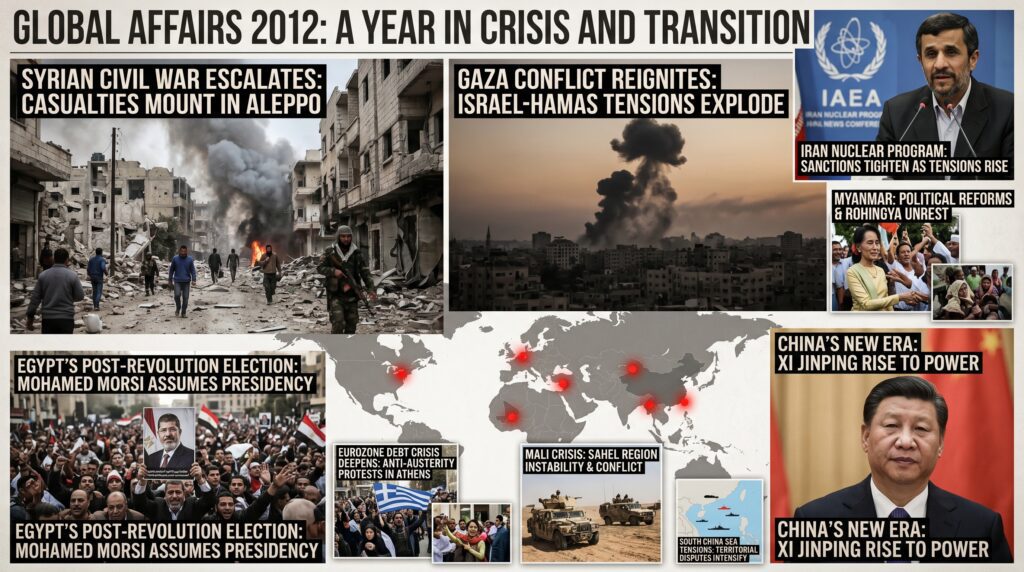
1. Why was 2012 important for the Syrian Civil War?
Discussion: The Syrian uprising became a full-scale armed conflict. Regional and global powers became more involved, making the crisis harder to solve.
2. Did Syria become a proxy battlefield in 2012?
Discussion: Yes, different states supported different sides of the conflict. This turned Syria from a domestic crisis into a regional and international struggle.
3. Why did diplomacy fail in Syria in 2012?
Discussion: The regime and opposition had opposing goals, and foreign powers disagreed on solutions. UN efforts could not stop the violence.
4. Did the Syrian conflict weaken the Arab Spring’s democratic hopes?
Discussion: Yes, Syria showed how popular uprising could turn into prolonged war. It reduced optimism about peaceful democratic change in the region.
5. Why did the refugee crisis begin to grow in 2012?
Discussion: Violence forced many Syrians to flee their homes. Neighboring countries started facing major humanitarian and political pressure.
6. Why was Egypt’s political transition important in 2012?
Discussion: Egypt elected Mohamed Morsi as president after Mubarak’s fall. It was a major test of post-revolution democracy in the Arab world.
7. Did Egypt’s transition create democratic stability?
Discussion: No, political polarization grew between Islamists, liberals, the military, and old regime forces. Institutions remained weak and contested.
8. Why was Morsi’s presidency controversial?
Discussion: His opponents accused him of concentrating power and ignoring wider political consensus. Supporters argued he represented Egypt’s first elected civilian leadership.
9. Did Egypt show the difficulty of post-authoritarian politics?
Discussion: Yes, removing a ruler did not automatically create democratic institutions. Power struggles continued between elected leaders, courts, army, and street movements.
10. Why did the military remain powerful in Egypt?
Discussion: The army controlled major security and institutional power. It remained the strongest actor even after elections.
11. Why was Libya unstable after the 2011 intervention?
Discussion: Armed militias and weak institutions prevented state-building. The fall of Gaddafi left a political vacuum that was difficult to fill.
12. Did the Benghazi attack affect US foreign policy debates?
Discussion: Yes, the attack on the US mission raised questions about security, intelligence, and intervention outcomes. It became a major political issue in America.
13. Why was Yemen’s transition fragile in 2012?
Discussion: Yemen changed leadership but kept many old power structures. Tribal divisions, militancy, and weak institutions continued to threaten stability.
14. Did the Arab Spring enter a more difficult phase in 2012?
Discussion: Yes, early revolutionary hope gave way to polarization, conflict, and institutional struggle. The region faced uncertain political outcomes.
15. Why was the Gaza conflict important in 2012?
Discussion: Fighting between Israel and Hamas showed that Gaza remained a major flashpoint. It also highlighted the role of Egypt in ceasefire diplomacy.
16. Why was Palestine’s UN observer state status important?
Discussion: The UN General Assembly upgraded Palestine to non-member observer state status. This strengthened Palestinian diplomatic recognition internationally.
17. Did Palestine’s UN status change the peace process?
Discussion: It improved Palestinian symbolic and legal position. However, it did not resolve borders, security, Jerusalem, or refugees.
18. Why did the two-state solution remain difficult in 2012?
Discussion: Settlement expansion, political mistrust, and divided Palestinian leadership blocked progress. Both sides lacked confidence in negotiations.
19. Why was Iran’s nuclear issue serious in 2012?
Discussion: Iran continued enrichment while sanctions became stronger. The issue raised fears of military conflict and regional instability.
20. Did sanctions deeply affect Iran in 2012?
Discussion: Yes, oil and banking sanctions hurt Iran’s economy. They increased pressure for future nuclear negotiations.
21. Why was Israel concerned about Iran in 2012?
Discussion: Israel saw Iran’s nuclear program as a direct security threat. Israeli leaders openly debated possible military action.
22. Did Iran’s nuclear crisis affect global energy markets?
Discussion: Yes, tensions around the Persian Gulf raised concerns over oil supply. Sanctions and conflict fears influenced energy prices.
23. Why was the Eurozone crisis still important in 2012?
Discussion: Greece, Spain, and other countries faced debt and banking pressure. The crisis threatened the survival of the euro.
24. Did the European Central Bank help stabilize the crisis?
Discussion: Yes, the ECB’s promise to do “whatever it takes” helped calm markets. It showed the importance of central bank power.
25. Why was austerity politically damaging in Europe?
Discussion: Austerity increased unemployment and public anger in several countries. It weakened trust in governments and EU institutions.
26. Did the Eurozone crisis create a democratic legitimacy problem?
Discussion: Yes, many citizens felt economic decisions were controlled by creditors and technocrats. This increased anti-establishment politics.
27. Why was Greece still central to the crisis?
Discussion: Greece faced debt restructuring, austerity, and social unrest. Its crisis tested European solidarity and financial discipline.
28. Did the crisis strengthen or weaken European integration?
Discussion: It forced more financial coordination but also created political resentment. Integration became deeper but more contested.
29. Why was Xi Jinping’s rise important in 2012?
Discussion: Xi became China’s top leader, marking a new political era. His leadership later brought stronger central control and a more assertive foreign policy.
30. Did China become more assertive under new leadership?
Discussion: Early signs suggested stronger nationalism and strategic ambition. China’s regional role became more confident and contested.
31. Why was the South China Sea more tense in 2012?
Discussion: Maritime disputes increased between China and neighboring states. Control over islands, resources, and sea routes became more sensitive.
32. Did the Scarborough Shoal standoff matter geopolitically?
Discussion: Yes, it increased tension between China and the Philippines. It showed how small maritime disputes could affect regional security.
33. Why was the US Pivot to Asia important in 2012?
Discussion: The US increased focus on Asia-Pacific security and alliances. It reflected concern over China’s rise and regional balance of power.
34. Did Asia become the center of strategic competition?
Discussion: Yes, China’s rise, US alliances, and maritime disputes made Asia central. Economic growth and military competition overlapped.
35. Why was North Korea’s missile program important in 2012?
Discussion: North Korea continued developing long-range missile capability. This increased concerns about nuclear delivery systems.
36. Did Kim Jong-un’s rise create uncertainty?
Discussion: Yes, his leadership was new and unpredictable. Regional powers watched closely for signs of policy direction.
37. Why was Myanmar’s political opening important?
Discussion: Myanmar began reforms after decades of military rule. The opening created hope for democracy and improved relations with the West.
38. Did Myanmar’s reforms fully solve human rights concerns?
Discussion: No, political reforms were limited and ethnic conflicts continued. Later events showed that transition remained fragile.
39. Why was the Rohingya issue important in 2012?
Discussion: Communal violence in Rakhine State exposed deep ethnic and religious tensions. It became an early warning of a larger humanitarian crisis.
40. Why was the Sahel crisis important in 2012?
Discussion: Militants and political instability spread in Mali and nearby areas. The Sahel became a major zone of terrorism, weak governance, and foreign intervention.
41. Did Mali’s crisis show the danger of state collapse?
Discussion: Yes, rebellion, military coup, and jihadist expansion weakened the state. It showed how local instability could become regional insecurity.
42. Why did the killing of US Ambassador in Libya matter?
Discussion: It showed the security vacuum after regime change. It also increased criticism of Western intervention and post-conflict planning.
43. Why was climate diplomacy difficult in 2012?
Discussion: States disagreed over responsibility, finance, and legally binding commitments. The gap between rich and developing countries remained large.
44. Did Superstorm Sandy affect climate politics?
Discussion: Yes, it raised public concern about extreme weather and urban vulnerability. It made climate risk more visible in the United States.
45. Why was the Doha Climate Conference important?
Discussion: It extended the Kyoto Protocol framework. However, it failed to create strong enough action against climate change.
46. Why was global cyber security becoming more important?
Discussion: States, companies, and infrastructure were increasingly dependent on digital systems. Cyberattacks became a serious economic and security risk.
47. Did 2012 show the rise of digital politics?
Discussion: Yes, social media, leaks, surveillance debates, and online mobilization affected politics. Digital space became part of global power.
48. Why was Obama’s re-election globally important?
Discussion: It meant continuity in US foreign policy after the financial crisis and wars. Allies and rivals expected continued focus on Asia, drones, and diplomacy.
49. Was 2012 a year of transition from revolution to disorder?
Discussion: Yes, Arab Spring countries faced instability, Syria worsened, and Libya struggled. The year showed that political change can produce uncertainty without strong institutions.
50. Why can 2012 be called a year of contested order?
Discussion: Syria, the Eurozone, China’s rise, Iran’s nuclear issue, and regional conflicts all challenged stability. The global order was becoming more fragmented and competitive.
World Affairs 2013
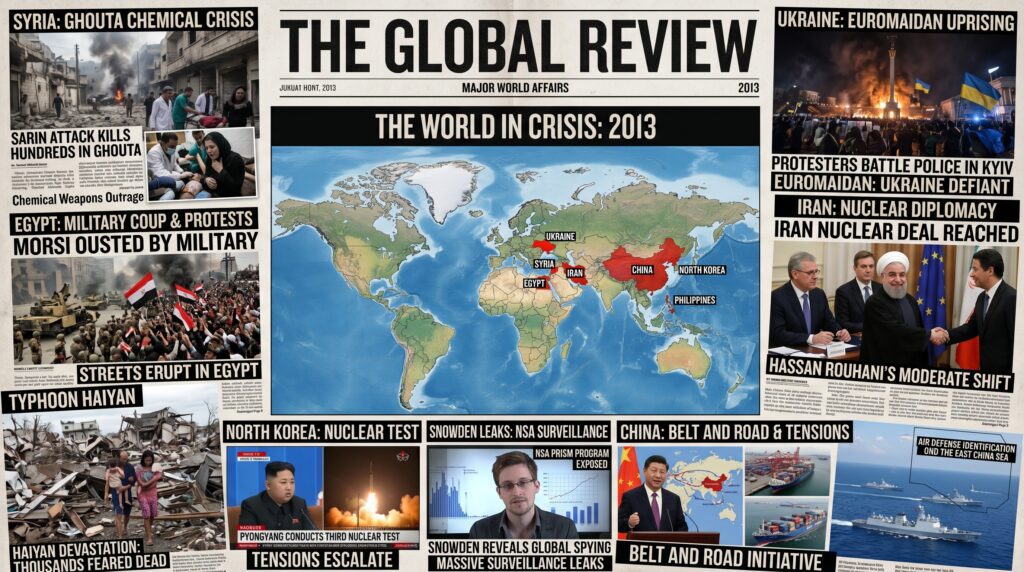
1. Why was 2013 important for the Syrian Civil War?
Discussion: Syria’s war became more brutal and internationalized in 2013. The chemical weapons crisis brought the conflict close to direct Western military intervention.
2. Why was the Ghouta chemical attack globally significant?
Discussion: The attack shocked the world and raised questions about the use of banned weapons. It forced global powers to debate punishment, deterrence, and diplomacy.
3. Did the chemical weapons crisis weaken international norms?
Discussion: Yes, the use of chemical weapons challenged one of the strongest global security norms. The crisis showed that norms need enforcement to remain credible.
4. Why did the United States avoid direct military strikes on Syria?
Discussion: The US faced domestic hesitation and diplomatic pressure. A Russia-backed deal to remove Syrian chemical weapons created an alternative to military action.
5. Did Russia gain diplomatic influence through the Syria chemical weapons deal?
Discussion: Yes, Russia positioned itself as a key diplomatic actor. It used the crisis to protect Assad and increase its Middle East influence.
6. Why did Syria become a proxy war by 2013?
Discussion: Regional and global powers supported different sides. Iran, Russia, Turkey, Gulf states, and Western actors all shaped the conflict.
7. Did extremist groups gain strength in Syria in 2013?
Discussion: Yes, groups linked to Al-Qaeda expanded in the chaos. The conflict became more complex as jihadist groups gained territory and influence.
8. Why did the Syrian refugee crisis become a major global issue?
Discussion: Millions of Syrians were displaced internally or fled to neighboring states. The crisis placed heavy pressure on Turkey, Lebanon, Jordan, and Europe.
9. Did Syria expose the failure of the Responsibility to Protect?
Discussion: Yes, global powers could not agree on decisive action. The crisis showed the weakness of humanitarian principles when great powers disagree.
10. Why was diplomacy so difficult in Syria?
Discussion: The regime, opposition, and foreign backers had conflicting goals. No side trusted the others enough to accept a political settlement.
11. Why was Egypt’s military coup important in 2013?
Discussion: The coup removed President Mohamed Morsi after mass protests. It ended Egypt’s short experiment with elected Islamist-led rule.
12. Did Egypt’s coup mark the failure of the Arab Spring?
Discussion: It became a major symbol of democratic reversal. Egypt showed how military power and political polarization could defeat democratic transition.
13. Why did Morsi’s government lose public support?
Discussion: Many Egyptians accused him of poor governance, power concentration, and ignoring opposition concerns. Economic problems also increased frustration.
14. Did the military remain Egypt’s most powerful institution?
Discussion: Yes, the coup showed that the army still controlled the political system. Civilian leadership could not survive without military acceptance.
15. Why was the Rabaa crackdown globally controversial?
Discussion: Security forces killed many protesters during the dispersal of pro-Morsi sit-ins. The crackdown raised major human rights concerns.
16. Did the Egyptian crisis divide international opinion?
Discussion: Yes, some states criticized the coup and repression, while others prioritized stability. This exposed contradictions in global democracy policy.
17. Why did the Arab Spring become more pessimistic in 2013?
Discussion: Syria was in civil war, Libya was unstable, and Egypt returned to military rule. Democratic hopes were replaced by conflict and authoritarian revival.
18. Did political Islam face a major setback in 2013?
Discussion: Yes, the fall of Morsi weakened Islamist electoral politics in Egypt. It also affected Islamist movements across the region.
19. Why was Tunisia still important in 2013?
Discussion: Tunisia faced political tensions but continued dialogue between rival groups. It remained the strongest hope for democratic transition after the Arab Spring.
20. Did Libya continue to struggle after Gaddafi?
Discussion: Yes, militias, weak institutions, and political fragmentation continued. Libya showed the danger of regime change without state-building.
21. Why was Iran’s 2013 presidential election important?
Discussion: Hassan Rouhani’s victory created hope for nuclear diplomacy. His more moderate tone opened space for negotiations with the West.
22. Did Rouhani’s election change Iran-West relations?
Discussion: It improved the diplomatic atmosphere but did not remove mistrust. Nuclear negotiations became more serious after his election.
23. Why was the interim Iran nuclear deal important?
Discussion: The Joint Plan of Action paused parts of Iran’s nuclear program in exchange for limited sanctions relief. It created the path toward the 2015 nuclear agreement.
24. Did sanctions push Iran toward negotiation?
Discussion: Yes, economic pressure made compromise more attractive. However, Iran also wanted recognition of its right to peaceful nuclear technology.
25. Why was Iran’s nuclear diplomacy important for the Middle East?
Discussion: It affected Israel, Gulf states, US policy, and regional power balances. A deal could reduce war risks but also raise concerns among Iran’s rivals.
26. Why was Edward Snowden’s leak globally important?
Discussion: Snowden exposed large-scale US surveillance programs. The leaks changed global debates about privacy, security, and state power.
27. Did Snowden damage America’s global image?
Discussion: Yes, allies and rivals criticized US surveillance practices. The leaks weakened trust in American digital leadership.
28. Why did surveillance become a world affairs issue?
Discussion: Digital technology allowed governments to collect huge amounts of data. Privacy became a major political and human rights concern.
29. Did Snowden’s revelations affect US-Europe relations?
Discussion: Yes, reports of surveillance on allies created diplomatic tension. European publics became more concerned about data protection and digital sovereignty.
30. Why was cyber power becoming central in 2013?
Discussion: States increasingly used digital tools for surveillance, espionage, and influence. Cybersecurity became a core part of national security.
31. Why was Xi Jinping’s Belt and Road Initiative important?
Discussion: China announced a major vision for infrastructure and connectivity across regions. It signaled China’s ambition to shape global trade and influence.
32. Did the Belt and Road Initiative challenge Western influence?
Discussion: Yes, it offered China-led investment and connectivity outside Western-led institutions. It expanded China’s diplomatic and economic reach.
33. Why was China’s rise more assertive in 2013?
Discussion: Under Xi Jinping, China showed stronger central control and wider global ambition. Maritime disputes and infrastructure diplomacy became more visible.
34. Why was the East China Sea Air Defense Identification Zone important?
Discussion: China’s ADIZ increased tensions with Japan and the United States. It showed rising competition over airspace, islands, and regional authority.
35. Did Asia-Pacific become a major arena of great-power competition?
Discussion: Yes, China’s rise and the US pivot made the region strategically important. Maritime disputes became linked to wider power rivalry.
36. Why was North Korea’s nuclear test important in 2013?
Discussion: North Korea conducted another nuclear test, increasing global concern. It showed continued progress in its weapons program despite sanctions.
37. Did North Korea challenge regional stability in 2013?
Discussion: Yes, its nuclear test and threats raised tensions on the Korean Peninsula. Regional powers struggled to balance pressure and diplomacy.
38. Why did sanctions fail to stop North Korea?
Discussion: North Korea accepted isolation as the cost of regime security. Its nuclear weapons were seen by the regime as survival tools.
39. Why was Ukraine’s Euromaidan movement important in 2013?
Discussion: Protests began after Ukraine’s government suspended an EU association agreement. The movement became a struggle over Ukraine’s future direction.
40. Did Euromaidan deepen Russia-West rivalry?
Discussion: Yes, Ukraine became a major geopolitical fault line. Russia feared Ukraine moving closer to the European Union and the West.
41. Why was Ukraine strategically important?
Discussion: Ukraine connects Russia, Europe, the Black Sea region, and energy routes. Its alignment affects the balance of power in Eastern Europe.
42. Did 2013 prepare the ground for the Ukraine crisis of 2014?
Discussion: Yes, Euromaidan created political confrontation that later escalated. The struggle over Ukraine’s orientation led directly into a major crisis.
43. Why was the Eurozone still fragile in 2013?
Discussion: Debt problems, unemployment, and austerity continued to affect Europe. The crisis weakened trust in EU economic governance.
44. Did austerity increase populism in Europe?
Discussion: Yes, economic pain helped anti-establishment and anti-EU parties gain support. Public frustration grew against elites and technocratic decision-making.
45. Why was Pope Francis’s election globally significant?
Discussion: Pope Francis brought a new tone focused on humility, poverty, and social justice. His leadership influenced global religious and moral debates.
46. Did global inequality become more visible in 2013?
Discussion: Yes, post-crisis economic recovery was uneven. Debates about wealth concentration, austerity, and social justice became stronger.
47. Why was climate diplomacy still difficult in 2013?
Discussion: States still disagreed over emissions, finance, and responsibility. Climate action remained slower than scientific warnings demanded.
48. Why was Typhoon Haiyan globally important?
Discussion: It caused massive destruction in the Philippines and highlighted climate vulnerability. It strengthened arguments about loss, damage, and climate justice.
49. Was 2013 a year of surveillance, instability, and power shifts?
Discussion: Yes, Snowden, Syria, Egypt, Ukraine, China, and Iran all shaped global politics. The year showed a world moving toward deeper mistrust and competition.
50. Why can 2013 be called a pre-crisis year for the modern world order?
Discussion: It prepared the ground for the Ukraine crisis, deeper Middle East instability, cyber politics, and China’s global expansion. Many tensions that exploded later were already visible in 2013.
World Affairs 2014
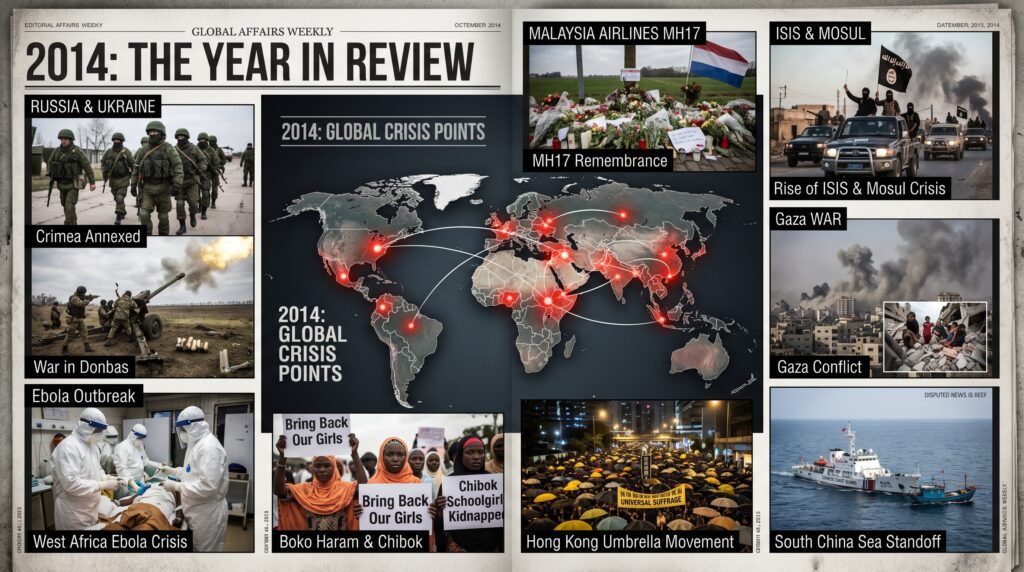
1. Why was 2014 a turning point in Russia-West relations?
Discussion: Russia’s annexation of Crimea deeply damaged relations with the West. It ended much of the post-Cold War hope for cooperation with Moscow.
2. Why was Crimea’s annexation globally significant?
Discussion: It challenged Ukraine’s territorial integrity and the post-Cold War European order. Many states saw it as a dangerous violation of international law.
3. Did the Crimea crisis weaken the principle of sovereignty?
Discussion: Yes, it showed that borders could still be changed by force. This created fear among states near Russia and beyond.
4. Why did Russia justify its actions in Crimea?
Discussion: Russia claimed it was protecting Russian speakers and responding to Crimea’s political will. Western states rejected this as illegal annexation.
5. Did Crimea create a new Cold War atmosphere?
Discussion: It created serious strategic mistrust between Russia and the West. Sanctions, military tension, and political confrontation increased sharply.
6. Why did the conflict in eastern Ukraine begin?
Discussion: Pro-Russian separatists, Ukrainian state weakness, and Russian support contributed to conflict. Donbas became a major battlefield after Crimea.
7. Did the Donbas war internationalize Ukraine’s crisis?
Discussion: Yes, the conflict involved Ukraine, Russia, Western sanctions, and global diplomacy. It became a major European security crisis.
8. Why was Malaysia Airlines Flight MH17 important?
Discussion: The plane was shot down over eastern Ukraine, killing civilians from many countries. It brought global attention to the danger of the conflict.
9. Did MH17 increase pressure on Russia?
Discussion: Yes, many Western states blamed Russian-backed separatists and increased sanctions. The incident made the Ukraine conflict a wider international issue.
10. Why were sanctions used against Russia?
Discussion: Sanctions were used to punish Russia for Crimea and actions in eastern Ukraine. They became a major tool of Western pressure.
11. Why was ISIS’s rise in 2014 globally alarming?
Discussion: ISIS captured large areas in Iraq and Syria and declared a caliphate. It became one of the most serious terrorist threats of the decade.
12. Did ISIS change the nature of terrorism?
Discussion: Yes, ISIS controlled territory, governed populations, and used global propaganda. It was more than a secret network; it acted like a violent proto-state.
13. Why did Mosul’s fall matter?
Discussion: Mosul’s capture showed the weakness of the Iraqi state and army. It gave ISIS major resources, territory, and symbolic power.
14. Did the Iraq War create conditions for ISIS?
Discussion: Yes, state collapse, sectarian politics, and insurgency after 2003 helped extremist groups grow. ISIS emerged from these deeper failures.
15. Why was Syria important to ISIS’s expansion?
Discussion: Syria’s civil war created ungoverned spaces and chaos. ISIS used the war to build territory and recruit fighters.
16. Did ISIS create a new global security challenge?
Discussion: Yes, it attracted foreign fighters and inspired attacks beyond the Middle East. It forced many states to rethink counter-terrorism.
17. Why did the US lead airstrikes against ISIS?
Discussion: ISIS threatened Iraq, Syria, minorities, and regional stability. The US formed a coalition to stop its expansion.
18. Why was the Yazidi crisis important?
Discussion: ISIS attacked Yazidis and committed mass atrocities. The crisis strengthened calls for humanitarian intervention.
19. Did ISIS use social media as a weapon?
Discussion: Yes, ISIS used online propaganda for recruitment, fear, and global messaging. Digital extremism became a major security concern.
20. Why did ISIS challenge existing borders?
Discussion: ISIS rejected the state system and claimed authority across Iraq and Syria. It directly challenged the Sykes-Picot-era regional order.
21. Why was the Gaza War of 2014 important?
Discussion: Fighting between Israel and Hamas caused heavy destruction and civilian suffering. It renewed global debate on occupation, security, and humanitarian law.
22. Did the Gaza War weaken peace prospects?
Discussion: Yes, violence deepened mistrust between Israelis and Palestinians. The two-state solution looked increasingly difficult.
23. Why was civilian harm central to the Gaza debate?
Discussion: High civilian casualties and destruction drew international criticism. The war raised questions about proportionality and military conduct.
24. Did Hamas’s role complicate Palestinian politics?
Discussion: Yes, Hamas controlled Gaza while Fatah dominated the West Bank. Palestinian division weakened unified diplomacy.
25. Why did Egypt matter in Gaza ceasefire talks?
Discussion: Egypt controlled a key border with Gaza and had influence over regional mediation. It played an important role in ceasefire diplomacy.
26. Why was Afghanistan’s 2014 election important?
Discussion: It marked a political transition as NATO combat operations were ending. The disputed election created fears of instability.
27. Did Afghanistan’s unity government solve its crisis?
Discussion: It prevented immediate collapse but created weak power-sharing. Political division and Taliban pressure continued.
28. Why did NATO end its combat mission in Afghanistan?
Discussion: NATO aimed to shift responsibility to Afghan forces. However, Afghanistan still needed foreign training, funding, and support.
29. Did the Taliban benefit from NATO’s drawdown?
Discussion: Yes, the Taliban used the transition to increase pressure. Afghan forces faced growing security challenges.
30. Why was Pakistan’s Operation Zarb-e-Azb important?
Discussion: Pakistan launched a major military operation against militants in North Waziristan. It aimed to reduce terrorist safe havens and restore state control.
31. Why was the Peshawar school attack globally shocking?
Discussion: Militants attacked schoolchildren, causing national trauma in Pakistan. It strengthened public demand for stronger action against terrorism.
32. Did the Peshawar attack change Pakistan’s security policy?
Discussion: Yes, it led to tougher counter-terrorism measures and the National Action Plan. The attack became a turning point in Pakistan’s internal security debate.
33. Why was Boko Haram’s rise important in 2014?
Discussion: Boko Haram expanded violence in Nigeria and kidnapped schoolgirls in Chibok. The group became a major symbol of extremist violence in Africa.
34. Did the Chibok kidnapping internationalize Boko Haram?
Discussion: Yes, global campaigns demanded action for the kidnapped girls. Boko Haram became a major international security concern.
35. Why was Ebola a major global health crisis in 2014?
Discussion: Ebola spread across West Africa and overwhelmed weak health systems. It showed how health crises can become international security threats.
36. Did Ebola expose weakness in global health governance?
Discussion: Yes, the response was initially slow and under-resourced. The crisis showed the need for stronger disease surveillance and emergency capacity.
37. Why was West Africa vulnerable to Ebola?
Discussion: Weak health systems, poverty, and limited infrastructure made containment difficult. Public mistrust also complicated response efforts.
38. Did Ebola affect global travel and economies?
Discussion: Yes, fear of infection affected movement, trade, and local economies. Health security became linked with economic stability.
39. Why was China’s rise still central in 2014?
Discussion: China’s economic and military influence continued expanding. Its maritime disputes and global investments drew more attention.
40. Why were South China Sea tensions important?
Discussion: Disputes over islands, resources, and sea routes increased regional anxiety. China’s actions worried neighboring states and the United States.
41. Did Japan’s security policy change in 2014?
Discussion: Yes, Japan reinterpreted its pacifist constitution to allow collective self-defense. This reflected concern over regional threats and alliance responsibilities.
42. Why was Xi Jinping’s anti-corruption campaign important?
Discussion: It strengthened Xi’s control over the Communist Party. It also showed a move toward stronger centralization of power in China.
43. Why were Hong Kong’s Umbrella Movement protests important?
Discussion: Protesters demanded greater democratic freedoms and electoral rights. The movement highlighted tensions between Hong Kong’s autonomy and Beijing’s control.
44. Did Hong Kong’s protests affect China’s global image?
Discussion: Yes, they drew international attention to political freedoms in Hong Kong. Beijing viewed foreign criticism as interference.
45. Why was climate diplomacy important in 2014?
Discussion: States were preparing for a future global climate agreement. The year helped build momentum toward the Paris Agreement.
46. Did the US-China climate announcement matter?
Discussion: Yes, cooperation between the two largest emitters was crucial. Their joint announcement improved prospects for global climate negotiations.
47. Why was the Lima climate conference important?
Discussion: It helped prepare the framework for the 2015 Paris climate talks. But disagreements over responsibility and finance remained.
48. Why was global inequality still a major issue in 2014?
Discussion: Economic recovery after the financial crisis was uneven. Many societies faced wage stagnation, unemployment, and public anger.
49. Was 2014 a year of renewed geopolitical conflict?
Discussion: Yes, Ukraine, ISIS, Gaza, Ebola, and South China Sea tensions all shaped global instability. The year showed that the world was becoming more conflict-prone.
50. Why can 2014 be called a year when the post-Cold War order cracked?
Discussion: Russia challenged European borders, ISIS challenged Middle Eastern states, and health crises exposed weak governance. The assumptions of stability after the Cold War looked increasingly fragile.
World Affairs 2015
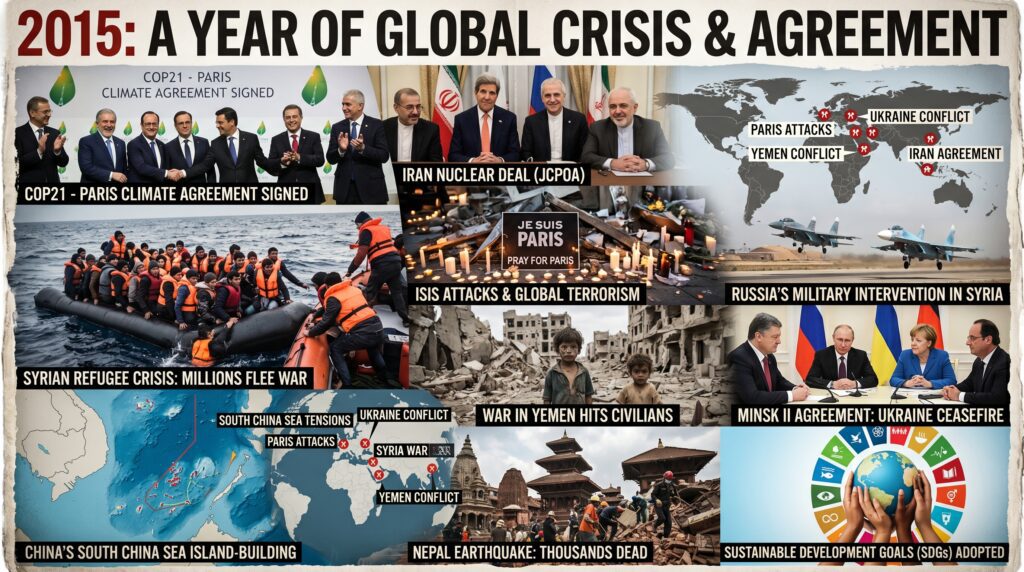
1. Why was 2015 important for global climate politics?
Discussion: The Paris Agreement was adopted in 2015, creating a major global framework for climate action. It marked a shift from divided climate politics toward wider international participation.
2. Did the Paris Agreement change climate diplomacy?
Discussion: Yes, it brought almost all countries into one climate framework. Each state had to submit its own climate targets instead of following one fixed model.
3. Why was the Paris Agreement different from the Kyoto Protocol?
Discussion: Kyoto mainly placed binding targets on developed countries. Paris included both developed and developing countries through nationally determined contributions.
4. Did Paris solve the climate crisis?
Discussion: No, it created a framework but not enough immediate emission cuts. Its success depended on national implementation and stronger future commitments.
5. Why was climate finance important in 2015?
Discussion: Developing countries needed support for adaptation and clean energy. Finance became central to climate justice and trust between rich and poor states.
6. Why was the Iran nuclear deal important?
Discussion: The Joint Comprehensive Plan of Action limited Iran’s nuclear program in exchange for sanctions relief. It reduced the immediate risk of war over Iran’s nuclear issue.
7. Did the Iran deal strengthen diplomacy?
Discussion: Yes, it showed that sanctions and negotiations could produce a major agreement. However, critics feared it did not permanently remove Iran’s nuclear capacity.
8. Why did Israel and Gulf states oppose the Iran nuclear deal?
Discussion: They feared the deal would strengthen Iran economically and regionally. They also doubted Iran’s long-term intentions.
9. Did the Iran deal affect Middle East power politics?
Discussion: Yes, it changed Iran’s relationship with the West and worried regional rivals. The deal became part of wider Saudi-Iranian and Israel-Iran tensions.
10. Why was verification important in the Iran nuclear deal?
Discussion: International inspections were needed to confirm Iranian compliance. Without verification, trust between Iran and world powers would remain weak.
11. Why was the Syrian refugee crisis globally significant in 2015?
Discussion: Large numbers of Syrians fled war and entered Europe and neighboring countries. The crisis became one of the biggest humanitarian and political issues of the year.
12. Did the refugee crisis challenge European unity?
Discussion: Yes, EU states disagreed over borders, quotas, and responsibility-sharing. The crisis exposed deep political divisions inside Europe.
13. Why did Angela Merkel’s refugee policy become important?
Discussion: Germany accepted many refugees and became central to Europe’s response. Merkel’s decision was praised by some and criticized by others.
14. Did the refugee crisis strengthen nationalist politics in Europe?
Discussion: Yes, fears over migration, identity, and security helped right-wing parties gain support. Immigration became a major political issue across Europe.
15. Why was the image of Alan Kurdi globally powerful?
Discussion: The image symbolized the human tragedy of the refugee crisis. It increased global attention to the suffering of displaced Syrians.
16. Why was ISIS still a major threat in 2015?
Discussion: ISIS controlled territory in Iraq and Syria and inspired attacks abroad. Its propaganda and foreign fighter networks made it a global security threat.
17. Did the Paris attacks change European security policy?
Discussion: Yes, the attacks led to stronger surveillance, policing, and counter-terrorism coordination. They also increased debate over migration and radicalization.
18. Why were the Paris attacks globally shocking?
Discussion: Coordinated attacks targeted civilians in a major European capital. They showed ISIS’s ability to inspire or direct violence beyond the Middle East.
19. Did ISIS use fear as a political weapon?
Discussion: Yes, ISIS used violence and media to spread fear and attract attention. Its strategy aimed to divide societies and provoke overreaction.
20. Why was foreign fighter recruitment a major concern?
Discussion: Thousands of people traveled to Syria and Iraq to join extremist groups. Their return created long-term security challenges for many states.
21. Why did Russia intervene militarily in Syria in 2015?
Discussion: Russia entered the war to support Bashar al-Assad and protect its strategic interests. The intervention changed the balance of the Syrian conflict.
22. Did Russia’s Syria intervention increase its global influence?
Discussion: Yes, it made Russia a central actor in Middle East diplomacy. It also showed Moscow’s willingness to use force beyond its neighborhood.
23. Why did Syria become a great-power battlefield?
Discussion: Russia, the US, Iran, Turkey, Gulf states, and others supported different goals. The war became a complex mix of civil war and international rivalry.
24. Did Russian intervention weaken Western influence in Syria?
Discussion: Yes, Russia protected Assad and limited Western options. It forced other powers to deal with Moscow in any future settlement.
25. Why was the Syrian war difficult to resolve in 2015?
Discussion: Too many local and foreign actors had conflicting interests. Military, sectarian, and geopolitical goals made peace negotiations extremely difficult.
26. Why was Yemen’s war important in 2015?
Discussion: A Saudi-led coalition intervened after Houthi advances. The conflict became a major humanitarian crisis and regional proxy war.
27. Did Yemen become part of Saudi-Iranian rivalry?
Discussion: Yes, Saudi Arabia viewed the Houthis as linked to Iran. Yemen became another arena of regional power competition.
28. Why did Yemen become a humanitarian disaster?
Discussion: Airstrikes, ground fighting, blockade, and state collapse damaged civilian life. Food, health, and water systems were badly affected.
29. Did the Yemen war expose limits of international response?
Discussion: Yes, global powers criticized the crisis but failed to stop it. Strategic alliances often mattered more than humanitarian pressure.
30. Why was the Saudi-led intervention controversial?
Discussion: It caused civilian casualties and worsened humanitarian conditions. Critics questioned its legality, effectiveness, and long-term goals.
31. Why was the Minsk II agreement important?
Discussion: It aimed to reduce fighting in eastern Ukraine. The agreement became the main diplomatic framework for the Donbas conflict.
32. Did Minsk II solve the Ukraine conflict?
Discussion: No, it reduced some violence but failed to create a lasting political settlement. Ukraine and Russia-backed separatists interpreted the deal differently.
33. Why did Ukraine remain central to Russia-West tensions?
Discussion: Ukraine’s alignment affected European security and Russia’s regional influence. Sanctions and military concerns continued.
34. Did sanctions change Russia’s behavior in 2015?
Discussion: Sanctions pressured Russia economically but did not reverse Crimea’s annexation. They became a long-term feature of Russia-West relations.
35. Why was NATO’s eastern security focus increasing?
Discussion: Russia’s actions in Ukraine worried Eastern European members. NATO increased reassurance measures and defense planning.
36. Why was China’s island-building in the South China Sea important?
Discussion: It increased tensions over sovereignty, sea routes, and military presence. Neighboring countries and the US saw it as a challenge to regional order.
37. Did the South China Sea become a global issue in 2015?
Discussion: Yes, it involved trade routes, international law, and US-China competition. The dispute moved beyond regional politics.
38. Why was China’s economic slowdown important?
Discussion: China’s slower growth affected global trade, commodities, and investor confidence. The world economy had become highly dependent on China.
39. Did China’s rise create both opportunity and fear?
Discussion: Yes, many states benefited from Chinese trade and investment. At the same time, they worried about strategic dependence and military assertiveness.
40. Why was the Belt and Road Initiative gaining importance?
Discussion: It expanded China’s infrastructure and economic influence across regions. It became a major tool of Chinese foreign policy.
41. Why was the Nepal earthquake globally important?
Discussion: The earthquake caused major destruction and humanitarian need. It exposed the vulnerability of poor and mountainous states to natural disasters.
42. Did the Nepal earthquake test regional cooperation?
Discussion: Yes, neighboring countries and global donors provided assistance. The disaster showed the importance of quick humanitarian coordination.
43. Why was the Sustainable Development Goals agenda important?
Discussion: The UN adopted the SDGs to replace the Millennium Development Goals. They created a broader global agenda for poverty, equality, environment, and development.
44. Did the SDGs change development thinking?
Discussion: Yes, they connected poverty, climate, health, education, gender, and inequality. Development was treated as a universal responsibility, not only a poor-country issue.
45. Why was migration a major world issue in 2015?
Discussion: War, poverty, and instability forced many people to move across borders. Migration became linked with security, identity, and humanitarian responsibility.
46. Why was Greece’s debt crisis still important?
Discussion: Greece faced bailout negotiations, austerity, and possible exit from the euro. The crisis tested European solidarity and economic governance.
47. Did the Greek crisis weaken trust in the EU?
Discussion: Yes, many citizens saw EU decisions as harsh and technocratic. It increased debate over democracy, sovereignty, and economic justice.
48. Why was terrorism connected with migration debates in 2015?
Discussion: Some political groups linked refugees with security fears after attacks. This connection increased public anxiety and nationalist politics.
49. Was 2015 a year of humanitarian and diplomatic turning points?
Discussion: Yes, Paris climate deal, Iran nuclear deal, refugee crisis, ISIS attacks, Syria, and Yemen all shaped global affairs. The year combined diplomacy with deep instability.
50. Why can 2015 be called a year of agreements and disorder?
Discussion: Major global agreements were reached on climate, development, and Iran. At the same time, wars, terrorism, refugees, and geopolitical rivalries showed a deeply unstable world.
World Affairs 2016
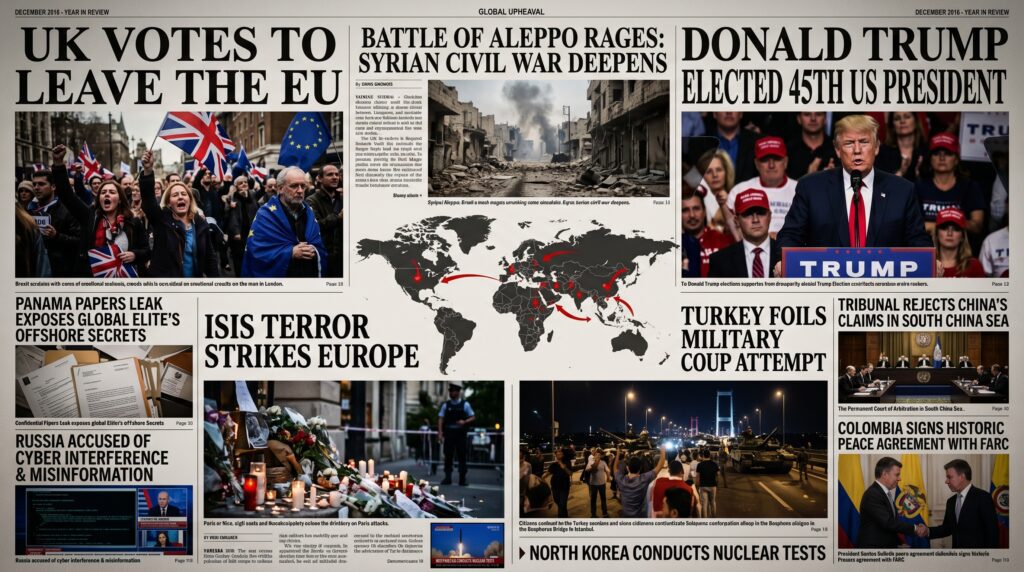
1. Why was Brexit one of the most important events of 2016?
Discussion: The United Kingdom voted to leave the European Union, challenging the idea of European integration. It showed rising nationalism, sovereignty concerns, and public distrust of elites.
2. Did Brexit weaken the European Union?
Discussion: Yes, Brexit created a major political and institutional shock for the EU. It also encouraged debates about nationalism, borders, and the future of European unity.
3. Why did many British voters support Brexit?
Discussion: Many voters were concerned about immigration, sovereignty, EU regulations, and economic inequality. The vote reflected both political frustration and identity concerns.
4. Did Brexit show a crisis of globalization?
Discussion: Yes, many people felt globalization had benefited elites more than ordinary citizens. Brexit became a symbol of backlash against open borders and supranational institutions.
5. Why was Brexit important for world politics beyond Europe?
Discussion: It showed that even stable democracies could reject long-standing international arrangements. It also encouraged populist and nationalist movements in other countries.
6. Why was Donald Trump’s election globally significant?
Discussion: Trump’s victory challenged traditional US politics and foreign policy expectations. His “America First” message signaled a shift toward nationalism and skepticism of global institutions.
7. Did Trump’s election represent a backlash against liberal internationalism?
Discussion: Yes, his campaign criticized trade deals, alliances, immigration, and globalism. It reflected wider public frustration with the existing political order.
8. Why did populism rise strongly in 2016?
Discussion: Economic inequality, cultural anxiety, migration fears, and distrust of elites helped populist movements grow. Social media also amplified political anger and polarization.
9. Did 2016 expose weaknesses in Western democracy?
Discussion: Yes, polarization, misinformation, and anti-establishment politics became more visible. Public trust in institutions declined in several democratic countries.
10. Why was misinformation important in 2016 politics?
Discussion: Online platforms spread false or misleading content quickly. This affected public debate and raised concerns about digital manipulation.
11. Why was Russian interference in the 2016 US election important?
Discussion: It raised fears that foreign actors could influence democratic processes through cyber tools and information campaigns. Election security became a major global concern.
12. Did cyber politics become central in 2016?
Discussion: Yes, hacking, leaks, and online influence operations became part of political competition. Cyber power moved from technical issue to strategic weapon.
13. Why did trust in social media decline after 2016?
Discussion: Social media was accused of spreading misinformation and political manipulation. Governments began debating regulation and platform responsibility.
14. Did 2016 change how democracies think about election security?
Discussion: Yes, election systems, political parties, and public opinion became targets of cyber influence. Democracies realized that security includes information integrity.
15. Why was the Panama Papers leak important?
Discussion: The leak exposed offshore wealth, tax avoidance, and hidden financial networks. It increased global debate on corruption, inequality, and financial transparency.
16. Did the Panama Papers damage political elites?
Discussion: Yes, many powerful figures faced public scrutiny. The leak showed how global finance could protect wealth from accountability.
17. Why was financial secrecy a world affairs issue?
Discussion: Offshore systems affect taxation, inequality, and governance across countries. They weaken public trust and reduce state revenue.
18. Did the Panama Papers strengthen demands for global transparency?
Discussion: Yes, they increased pressure for anti-corruption reforms and financial disclosure. However, offshore finance remained difficult to control.
19. Why was the Syrian war still central in 2016?
Discussion: The war continued with intense fighting, foreign intervention, and humanitarian suffering. Syria remained a major driver of regional instability and refugee flows.
20. Why was the Battle of Aleppo significant?
Discussion: Aleppo became a symbol of urban destruction and civilian suffering. The regime’s victory there shifted the military balance in Assad’s favor.
21. Did Aleppo show the limits of humanitarian intervention?
Discussion: Yes, global powers condemned suffering but failed to stop it. Great-power disagreement blocked effective international action.
22. Why did Russia’s role in Syria matter in 2016?
Discussion: Russia’s military support helped Assad regain territory. Moscow became a decisive actor in the Syrian conflict and Middle East diplomacy.
23. Did Syria strengthen Russia’s global position?
Discussion: Yes, Russia showed it could shape outcomes beyond its borders. It forced Western and regional powers to treat Moscow as essential.
24. Why was the Syrian refugee crisis still important in 2016?
Discussion: Millions of Syrians remained displaced, and Europe continued facing political pressure over migration. Refugees became central to debates on borders, identity, and humanitarian duty.
25. Did the refugee crisis strengthen European populism?
Discussion: Yes, fears over migration helped nationalist parties gain support. The crisis became linked with security, culture, and sovereignty debates.
26. Why was ISIS still a global threat in 2016?
Discussion: ISIS lost some territory but continued attacks and propaganda. Its ability to inspire violence abroad kept it central to global security.
27. Why were the Brussels attacks important?
Discussion: The attacks showed that ISIS-linked networks could strike major European cities. They increased pressure on European intelligence and border security.
28. Did ISIS begin losing its territorial power in 2016?
Discussion: Yes, coalition operations pushed ISIS back in Iraq and Syria. But the group remained dangerous as an insurgency and global network.
29. Why was the battle for Mosul important?
Discussion: Mosul was ISIS’s most important city in Iraq. The campaign to retake it was central to defeating the group’s territorial project.
30. Did the fight against ISIS create new political problems?
Discussion: Yes, questions remained about governance after liberation. Sectarian tension, Kurdish ambitions, and weak institutions complicated recovery.
31. Why was Turkey’s failed coup important in 2016?
Discussion: The coup attempt shocked Turkey and led to a major political crackdown. It changed Turkey’s domestic politics and relations with the West.
32. Did the failed coup strengthen Erdoğan’s power?
Discussion: Yes, the government used the coup attempt to expand control over institutions. Critics argued that democracy and rule of law weakened.
33. Why did Turkey-West relations become tense after the coup?
Discussion: Turkey accused Western states of weak support and demanded action against Gülen-linked networks. Human rights concerns also increased Western criticism.
34. Did Turkey become more assertive regionally in 2016?
Discussion: Yes, Turkey increased military involvement in Syria. It aimed to limit ISIS and Kurdish influence near its border.
35. Why was the South China Sea arbitration ruling important?
Discussion: The tribunal rejected many of China’s broad maritime claims. The ruling became a major test of international law and Chinese power.
36. Did China accept the South China Sea ruling?
Discussion: No, China rejected the ruling and continued its position. This raised questions about enforcement of international law.
37. Why did the South China Sea matter globally?
Discussion: It is a key trade route with strategic and resource value. The dispute involved China, Southeast Asian states, and the United States.
38. Did the ruling strengthen or weaken international law?
Discussion: Legally, it strengthened maritime law by clarifying claims. Politically, weak enforcement showed the limits of law against powerful states.
39. Why was North Korea’s nuclear program important in 2016?
Discussion: North Korea conducted nuclear and missile tests, increasing regional tension. It showed rapid progress in its weapons capability.
40. Did sanctions stop North Korea’s nuclear ambitions?
Discussion: No, sanctions increased pressure but did not change North Korea’s strategic goal. The regime saw nuclear weapons as essential for survival.
41. Why was the Paris Agreement’s entry into force important?
Discussion: The climate agreement became active faster than many expected. It showed strong international support for climate cooperation.
42. Did 2016 strengthen global climate action?
Discussion: Yes, Paris entered into force and climate diplomacy gained momentum. However, implementation and emission cuts remained difficult.
43. Why was the Zika virus outbreak important?
Discussion: Zika raised global health concerns, especially due to birth defects linked with infection. It showed that disease outbreaks could create international public health emergencies.
44. Did Zika expose weaknesses in health preparedness?
Discussion: Yes, many health systems struggled with surveillance, prevention, and public communication. It highlighted the need for stronger global health cooperation.
45. Why was Colombia’s peace agreement important?
Discussion: The government and FARC reached a historic peace deal after decades of conflict. It became a major example of negotiated conflict resolution.
46. Did Colombia’s peace deal face public resistance?
Discussion: Yes, an initial referendum rejected the agreement narrowly. This showed that peace processes require both elite negotiation and public legitimacy.
47. Why was the Rohingya crisis worsening in 2016?
Discussion: Violence and military operations in Myanmar’s Rakhine State increased displacement and fear. The crisis raised concerns about ethnic persecution and state responsibility.
48. Did Myanmar’s democratic opening hide deeper problems?
Discussion: Yes, political reforms did not solve ethnic conflict or military power. The Rohingya crisis exposed the limits of Myanmar’s transition.
49. Was 2016 a year of democratic shock and global uncertainty?
Discussion: Yes, Brexit, Trump, cyber interference, Syria, and populism all challenged old assumptions. The liberal international order looked increasingly fragile.
50. Why can 2016 be called a year of backlash politics?
Discussion: Voters and movements challenged globalization, elites, migration, and international institutions. The year showed a strong reaction against the post-Cold War liberal order.
World Affairs 2017
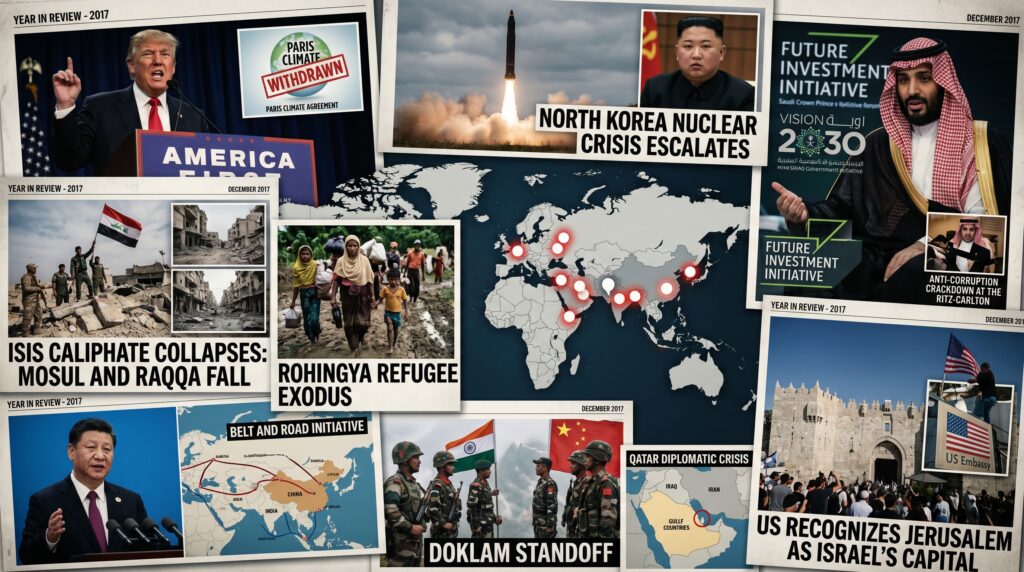
1. Why was 2017 important for the decline of liberal internationalism?
Discussion: Trump’s “America First” policy challenged free trade, multilateralism, and traditional alliances. It showed that the United States was becoming more skeptical of the global order it had helped build.
2. Did Trump’s foreign policy weaken US global leadership?
Discussion: Yes, many allies questioned America’s reliability. The shift toward nationalism and unilateral decisions reduced trust in US leadership.
3. Why was the US withdrawal from the Trans-Pacific Partnership important?
Discussion: It weakened America’s economic strategy in Asia-Pacific. China gained more space to expand its regional trade influence.
4. Did “America First” affect global alliances?
Discussion: Yes, allies worried that US security commitments were becoming more conditional. NATO and Asian partners faced new uncertainty.
5. Why was Trump’s travel ban globally controversial?
Discussion: It targeted several Muslim-majority countries and raised human rights concerns. Critics saw it as discriminatory and harmful to America’s global image.
6. Why did the US withdrawal from the Paris Agreement matter?
Discussion: It weakened global climate confidence and showed US retreat from climate leadership. However, many other countries continued supporting the agreement.
7. Did the Paris withdrawal damage climate diplomacy?
Discussion: Yes, it created political uncertainty and encouraged criticism of US responsibility. But it also pushed other actors, including Europe and China, to defend climate cooperation.
8. Why did climate change remain a major security issue in 2017?
Discussion: Extreme weather, rising temperatures, and disaster risks kept climate high on the global agenda. Climate was increasingly linked with food, migration, and conflict.
9. Why was China’s role in climate diplomacy increasing?
Discussion: As the US stepped back, China presented itself as a supporter of global climate action. This helped Beijing improve its diplomatic image.
10. Did 2017 show a shift from US-led climate leadership to multipolar climate diplomacy?
Discussion: Yes, Europe, China, cities, and non-state actors became more active. Climate governance became less dependent on Washington alone.
11. Why was North Korea’s nuclear crisis dangerous in 2017?
Discussion: North Korea tested missiles and claimed major nuclear progress. The crisis raised fears of war between North Korea and the United States.
12. Did North Korea’s ICBM tests change regional security?
Discussion: Yes, they suggested North Korea could threaten the US mainland. This increased pressure on Washington, Seoul, Tokyo, and Beijing.
13. Why did US-North Korea rhetoric become risky?
Discussion: Threatening language from both sides raised the danger of miscalculation. In nuclear crises, words can increase fear and escalation.
14. Did sanctions stop North Korea’s weapons program?
Discussion: No, sanctions increased pressure but did not stop testing. North Korea saw nuclear weapons as essential for regime survival.
15. Why was China central to the North Korea crisis?
Discussion: China had major economic influence over North Korea. Any serious pressure or diplomatic solution needed Beijing’s cooperation.
16. Why was ISIS’s territorial collapse important in 2017?
Discussion: ISIS lost Mosul and Raqqa, its most important urban centers. This marked the collapse of its so-called caliphate as a territorial project.
17. Did ISIS’s defeat end the global terrorist threat?
Discussion: No, ISIS shifted toward insurgency, online propaganda, and inspired attacks. Losing territory did not destroy its ideology or networks.
18. Why was the Battle of Mosul significant?
Discussion: Mosul was ISIS’s main stronghold in Iraq. Its liberation showed military progress but left major reconstruction and governance challenges.
19. Why was Raqqa important in the fight against ISIS?
Discussion: Raqqa served as ISIS’s symbolic capital in Syria. Its fall weakened ISIS’s image and operational control.
20. Did the anti-ISIS campaign create new political tensions?
Discussion: Yes, questions emerged over Kurdish forces, Syrian sovereignty, Iraqi unity, and foreign influence. Military victory did not automatically produce political stability.
21. Why was the Rohingya crisis globally significant in 2017?
Discussion: Myanmar’s military crackdown forced hundreds of thousands of Rohingya to flee to Bangladesh. The crisis became a major case of ethnic persecution and humanitarian failure.
22. Did the Rohingya crisis expose limits of international human rights protection?
Discussion: Yes, global condemnation did not stop the violence quickly. It showed the weakness of international action when state sovereignty and geopolitics intervene.
23. Why was Aung San Suu Kyi criticized internationally?
Discussion: She was accused of failing to defend the Rohingya and challenge military abuses. Her global image as a democracy icon was badly damaged.
24. Did Myanmar’s democratic transition fail in 2017?
Discussion: The crisis showed that the military still held major power. Political reform did not protect minorities or ensure accountability.
25. Why was Bangladesh important in the Rohingya crisis?
Discussion: Bangladesh hosted a massive number of refugees despite limited resources. The crisis placed heavy humanitarian and diplomatic pressure on Dhaka.
26. Why was the Qatar diplomatic crisis important?
Discussion: Saudi Arabia, the UAE, Bahrain, and Egypt cut ties with Qatar. The crisis exposed deep divisions inside the Gulf Cooperation Council.
27. Did the Qatar crisis weaken Gulf unity?
Discussion: Yes, it split key US partners in the Gulf. The crisis complicated regional cooperation against Iran and extremism.
28. Why was Al Jazeera central to the Qatar crisis?
Discussion: Qatar’s rivals accused Al Jazeera of supporting political opposition and unrest. Media influence became part of regional power politics.
29. Did the Qatar crisis reflect Saudi-Iran rivalry?
Discussion: Partly, because Qatar was accused of being too close to Iran. The crisis reflected wider struggles over influence in the Middle East.
30. Why was Saudi Arabia’s internal reform agenda important in 2017?
Discussion: Crown Prince Mohammed bin Salman pushed economic and social reforms under Vision 2030. At the same time, political centralization increased.
31. Why was the Saudi anti-corruption crackdown controversial?
Discussion: It targeted powerful princes and businessmen, strengthening MBS’s control. Critics saw it as both reform and political consolidation.
32. Did Saudi Arabia’s regional policy become more assertive?
Discussion: Yes, Saudi Arabia took strong positions on Yemen, Qatar, Iran, and domestic reform. This increased both its influence and risks.
33. Why was the Jerusalem recognition decision important?
Discussion: The United States recognized Jerusalem as Israel’s capital. This broke with long-standing diplomatic practice and angered Palestinians and many Muslim-majority countries.
34. Did the Jerusalem decision weaken the peace process?
Discussion: Yes, Palestinians saw it as biased toward Israel. It reduced trust in the US as a neutral mediator.
35. Why was Jerusalem such a sensitive diplomatic issue?
Discussion: Jerusalem has religious, national, and historical importance for Jews, Muslims, and Christians. Its final status is central to any peace agreement.
36. Why was China’s Belt and Road Initiative more important in 2017?
Discussion: China hosted a major Belt and Road Forum, promoting global infrastructure and connectivity. The project became central to China’s foreign policy identity.
37. Did BRI increase China’s global influence?
Discussion: Yes, it expanded Chinese investment, trade links, and diplomatic reach. It also raised concerns about debt, dependency, and strategic influence.
38. Why was the 19th Communist Party Congress important?
Discussion: Xi Jinping strengthened his authority and placed his ideology into the party constitution. This signaled stronger central control and long-term leadership ambition.
39. Did China become more assertive under Xi in 2017?
Discussion: Yes, China projected greater confidence in global governance, trade, and regional security. Its rise became more politically visible.
40. Why was the Doklam standoff important?
Discussion: India and China faced a military standoff near Bhutan. It showed that Himalayan border disputes could still create serious strategic tension.
41. Did Doklam affect India-China relations?
Discussion: Yes, it increased mistrust between the two Asian powers. The crisis showed competition over territory, influence, and regional security.
42. Why was Afghanistan still unstable in 2017?
Discussion: The Taliban remained active and Afghan institutions stayed weak. The US announced a new strategy but the war remained unresolved.
43. Did Trump’s Afghanistan strategy change the conflict?
Discussion: It increased pressure on the Taliban and Pakistan, but did not produce quick peace. The war continued to resist military solution.
44. Why was Pakistan criticized in US Afghanistan policy?
Discussion: The US accused Pakistan of allowing militant safe havens. Pakistan rejected the criticism and argued it had suffered heavily from terrorism.
45. Why was the Iran nuclear deal under pressure in 2017?
Discussion: Trump strongly criticized the JCPOA and questioned Iran’s compliance and regional behavior. This created uncertainty over the deal’s future.
46. Did pressure on the Iran deal increase Middle East tensions?
Discussion: Yes, Iran’s rivals welcomed pressure, while supporters feared collapse of diplomacy. The deal became linked to wider regional competition.
47. Why was Venezuela’s crisis important in 2017?
Discussion: Economic collapse, political repression, and protests created a major humanitarian and governance crisis. Millions later fled the country.
48. Did Venezuela expose the limits of regional diplomacy?
Discussion: Yes, neighboring states and international bodies struggled to force democratic change. The crisis showed how domestic collapse can become regional instability.
49. Was 2017 a year of nationalist realignment?
Discussion: Yes, America First, Brexit negotiations, Gulf rivalry, and China’s rise all reflected changing global alignments. The world became less cooperative and more competitive.
50. Why can 2017 be called a year of fractured global leadership?
Discussion: US retreat from some global commitments, China’s growing ambition, Middle East rivalry, and humanitarian crises showed a divided world. Global leadership became more uncertain and contested.
World Affairs 2018
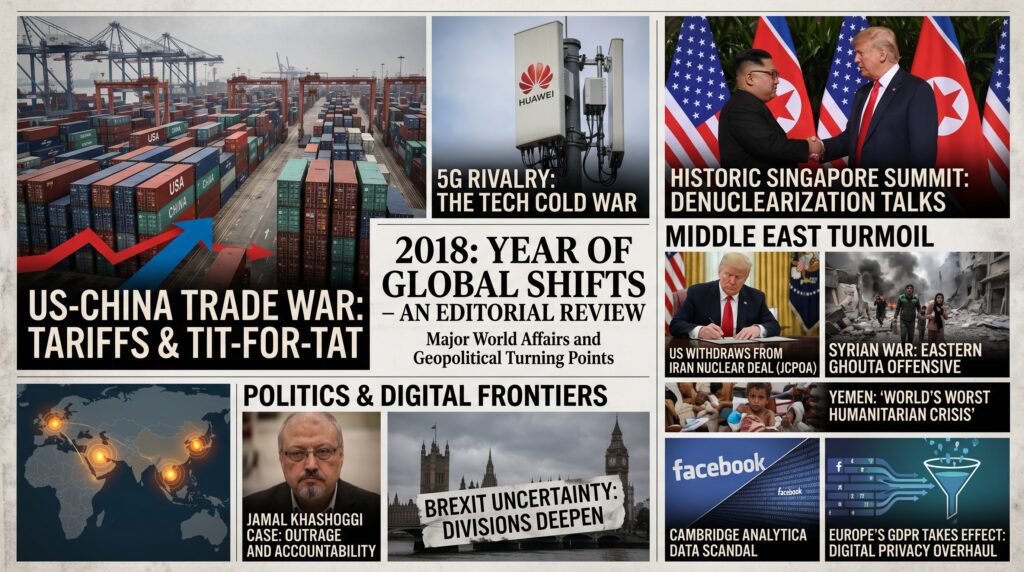
1. Why was the US-China trade war important in 2018?
Discussion: The trade war showed growing economic rivalry between the world’s two largest economies. It turned trade, tariffs, technology, and supply chains into major geopolitical tools.
2. Did the trade war mark the end of smooth globalization?
Discussion: Yes, it showed that major powers were no longer fully committed to open trade. Economic interdependence became a source of conflict, not only cooperation.
3. Why did tariffs become a strategic weapon in 2018?
Discussion: The United States used tariffs to pressure China over trade practices and industrial policy. China responded with its own tariffs, creating a cycle of economic confrontation.
4. Did the US-China trade war affect global markets?
Discussion: Yes, businesses and investors faced uncertainty over supply chains and costs. Many countries feared that a long trade conflict could slow global growth.
5. Why was technology central to US-China rivalry?
Discussion: Both countries competed over 5G, artificial intelligence, chips, and digital infrastructure. Technology became linked with national security and global influence.
6. Why was Huawei a major issue in 2018?
Discussion: Western governments raised concerns about Huawei’s role in 5G networks. The debate connected technology, espionage fears, and China’s global rise.
7. Did 2018 begin a wider tech cold war?
Discussion: Yes, the year showed that digital systems could divide global politics. Countries began choosing between competing technological ecosystems.
8. Why was Xi Jinping’s removal of presidential term limits important?
Discussion: It allowed Xi to remain in power beyond previous limits. This showed deeper centralization of authority in China.
9. Did China become more authoritarian in 2018?
Discussion: Yes, stronger party control, surveillance, and political centralization became more visible. China’s governance model became a major global debate.
10. Why was Xinjiang a major human rights issue in 2018?
Discussion: Reports of mass detention and surveillance of Uyghurs drew international criticism. The issue became central to debates about human rights and China’s global image.
11. Why was the Trump-Kim Singapore summit important?
Discussion: It was the first meeting between a sitting US president and a North Korean leader. It created diplomatic hope after the 2017 nuclear crisis.
12. Did the Singapore summit solve the North Korea nuclear issue?
Discussion: No, the summit produced symbolic progress but few concrete details. Denuclearization remained unclear and difficult to verify.
13. Why was summit diplomacy risky with North Korea?
Discussion: High-level meetings can create headlines without solving technical problems. North Korea could gain legitimacy while keeping nuclear leverage.
14. Did North Korea gain international recognition in 2018?
Discussion: Yes, Kim Jong-un appeared as a major diplomatic actor. This improved North Korea’s image without requiring immediate disarmament.
15. Why was South Korea important in 2018 diplomacy?
Discussion: South Korea helped open dialogue between Washington and Pyongyang. Inter-Korean diplomacy reduced immediate war fears.
16. Why was the US withdrawal from the Iran nuclear deal important?
Discussion: It seriously weakened the JCPOA and increased tension with Iran. The withdrawal showed a major shift from diplomacy to pressure.
17. Did leaving the Iran deal damage US credibility?
Discussion: Yes, allies questioned whether the US would honor international agreements. Iran also lost trust in future negotiations with Washington.
18. Why did Europe oppose the US withdrawal from the Iran deal?
Discussion: European states believed the agreement was working and reduced nuclear risk. They feared withdrawal would increase Middle East instability.
19. Did pressure on Iran increase regional tensions?
Discussion: Yes, sanctions and political pressure strengthened confrontation. Iran’s rivals welcomed the pressure, while others feared escalation.
20. Why was the Iran deal debate important for international law?
Discussion: It showed how domestic political change in one powerful state can affect global agreements. It also raised questions about reliability in diplomacy.
21. Why was the killing of Jamal Khashoggi globally significant?
Discussion: His killing inside the Saudi consulate in Istanbul caused international outrage. It raised major questions about human rights, accountability, and Saudi foreign relations.
22. Did the Khashoggi case damage Saudi Arabia’s image?
Discussion: Yes, it weakened the reformist image promoted by Crown Prince Mohammed bin Salman. Many governments and companies faced pressure over ties with Saudi Arabia.
23. Why was Turkey important in the Khashoggi case?
Discussion: Turkey controlled the investigation location and released information gradually. This gave Ankara diplomatic leverage over Saudi Arabia.
24. Did the Khashoggi case expose limits of human rights pressure?
Discussion: Yes, many states criticized the killing but maintained strategic ties with Saudi Arabia. Arms sales, oil, and regional politics limited stronger action.
25. Why was Yemen’s war still a major issue in 2018?
Discussion: Yemen faced famine, disease, airstrikes, and state collapse. The war became one of the world’s worst humanitarian crises.
26. Did the Yemen crisis increase pressure on Saudi Arabia?
Discussion: Yes, civilian suffering and the Khashoggi case increased criticism of Saudi policy. Western support for the Saudi-led coalition became more controversial.
27. Why was the Stockholm Agreement important for Yemen?
Discussion: It aimed to reduce fighting around Hodeidah, a key port for humanitarian aid. The agreement created hope but remained fragile.
28. Did diplomacy solve Yemen’s conflict in 2018?
Discussion: No, talks reduced some immediate risks but did not end the war. Deep political, regional, and humanitarian problems continued.
29. Why was Syria still central to world affairs in 2018?
Discussion: The Assad regime regained more territory with Russian and Iranian support. The conflict remained a major humanitarian and geopolitical crisis.
30. Why was Eastern Ghouta important in 2018?
Discussion: Heavy fighting and civilian suffering drew global criticism. It showed the regime’s strategy of retaking opposition areas through siege and force.
31. Did US-led strikes on Syria change the war?
Discussion: No, the strikes responded to chemical weapons concerns but did not alter the military balance. Assad’s forces continued gaining ground.
32. Why did Russia remain powerful in Syria?
Discussion: Russia’s military support protected Assad and gave Moscow diplomatic leverage. Syria strengthened Russia’s role in Middle East politics.
33. Why was Turkey’s role in Syria important?
Discussion: Turkey focused on Kurdish forces near its border and controlled parts of northern Syria. Its goals sometimes conflicted with both the US and Russia.
34. Did ISIS remain a threat in 2018?
Discussion: ISIS lost most of its territory but remained active as an insurgent and terrorist network. Its ideology and cells continued to threaten stability.
35. Why was Afghanistan still unstable in 2018?
Discussion: Taliban attacks continued and Afghan institutions remained weak. Peace talks became more important because military victory looked unlikely.
36. Did the Taliban gain diplomatic importance in 2018?
Discussion: Yes, direct talks involving the Taliban became more serious. This showed recognition that the Taliban had to be part of any settlement.
37. Why was the US-Taliban dialogue important?
Discussion: It opened a path toward possible withdrawal and peace negotiations. However, it also raised fears that the Afghan government could be sidelined.
38. Did Pakistan remain central to Afghan peace efforts?
Discussion: Yes, Pakistan’s influence over Taliban networks made it important for talks. The US continued to pressure Pakistan on militant sanctuaries.
39. Why was the Rohingya crisis still important in 2018?
Discussion: Hundreds of thousands of refugees remained in Bangladesh. Myanmar faced growing international criticism over accountability and safe return.
40. Did international action protect the Rohingya effectively?
Discussion: No, humanitarian aid helped refugees but political accountability remained weak. Myanmar’s military faced criticism but limited consequences.
41. Why was migration still a major global issue in 2018?
Discussion: Conflicts, poverty, and instability continued forcing people to move. Migration shaped politics in Europe, the US, and many border regions.
42. Did migration politics strengthen nationalism?
Discussion: Yes, anti-immigration parties and leaders used migration fears to gain support. Borders and identity became major political themes.
43. Why was Brexit still uncertain in 2018?
Discussion: The UK and EU struggled over withdrawal terms, trade, and the Irish border. Brexit showed how difficult leaving an integrated system can be.
44. Did Brexit weaken British politics?
Discussion: Yes, it created deep divisions inside parties, parliament, and society. The Irish border issue became especially difficult.
45. Why was the Cambridge Analytica scandal important?
Discussion: It exposed how personal data could be used for political targeting. The scandal increased concern over privacy, elections, and platform power.
46. Did data privacy become a global political issue in 2018?
Discussion: Yes, digital platforms held huge influence over public opinion and personal information. Governments began demanding stronger regulation.
47. Why was GDPR important?
Discussion: The EU’s data protection law strengthened privacy rights and corporate responsibility. It became a major global model for digital regulation.
48. Did 2018 show the rise of digital sovereignty?
Discussion: Yes, states began treating data, platforms, and networks as strategic assets. Control over digital space became part of national power.
49. Was 2018 a year of economic and technological rivalry?
Discussion: Yes, US-China trade tensions, 5G disputes, data scandals, and sanctions all showed rising competition. Economics and technology became central to geopolitics.
50. Why can 2018 be called a year of fragmented globalization?
Discussion: Trade wars, digital regulation, Iran deal tensions, Yemen, Syria, and migration all showed a divided world. Globalization continued, but trust between major powers weakened.
World Affairs 2019
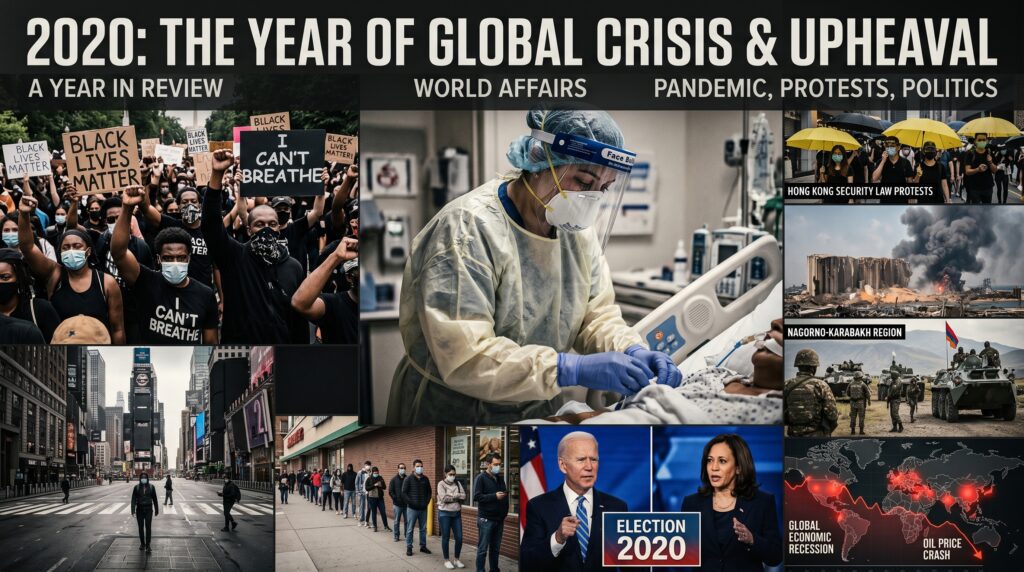
1. Why was 2019 important for global protest movements?
Discussion: Protests spread across Hong Kong, Chile, Lebanon, Iraq, Sudan, Algeria, and other countries. They showed public anger over corruption, inequality, authoritarianism, and weak governance.
2. Did 2019 prove that street politics was returning globally?
Discussion: Yes, mass protests became a powerful tool against governments. Citizens used streets, social media, and civil resistance to challenge political systems.
3. Why were the Hong Kong protests globally significant?
Discussion: They began over an extradition bill but grew into a wider movement for autonomy and democratic rights. The protests became a major challenge to Beijing’s authority.
4. Did Hong Kong expose the limits of “one country, two systems”?
Discussion: Yes, protesters feared that Beijing was reducing Hong Kong’s freedoms. The crisis raised global concerns about autonomy, rights, and Chinese control.
5. Why did China view the Hong Kong protests as a security threat?
Discussion: Beijing saw the protests as a challenge to sovereignty and political control. It feared that unrest could weaken national unity and inspire other movements.
6. Why were Sudan’s protests important in 2019?
Discussion: Sudanese protesters forced long-time ruler Omar al-Bashir from power. The movement became a major example of civilian resistance against authoritarian rule.
7. Did Sudan’s revolution create stable democracy?
Discussion: Not immediately, because military and civilian groups struggled over power. The transition remained fragile despite the fall of Bashir.
8. Why was Algeria’s Hirak movement important?
Discussion: It forced President Abdelaziz Bouteflika to resign after decades of rule. The movement demanded deeper political change, not just leadership replacement.
9. Did protests in Algeria and Sudan revive Arab Spring ideas?
Discussion: Yes, they showed that popular mobilization still had power in the Arab world. However, both cases also showed the difficulty of building lasting democratic systems.
10. Why did protests erupt in Lebanon and Iraq?
Discussion: People were angry over corruption, poor services, unemployment, and sectarian politics. The protests rejected ruling elites and demanded accountability.
11. Why was the US-China trade war still important in 2019?
Discussion: Tariffs and technology restrictions continued to damage trust between the two powers. The conflict expanded from trade into technology, security, and global influence.
12. Did 2019 deepen US-China strategic competition?
Discussion: Yes, the rivalry became broader and more permanent. Both countries increasingly viewed each other as long-term competitors.
13. Why was Huawei central to US-China tensions?
Discussion: Huawei became a symbol of technology rivalry and 5G security concerns. The US pressured allies to limit Huawei’s role in critical networks.
14. Did the Huawei issue create a technology split?
Discussion: Yes, countries faced pressure to choose trusted digital infrastructure partners. Technology became part of alliance politics and national security.
15. Why was 5G geopolitically important?
Discussion: 5G networks would support future economies, defense systems, and data flows. Control over this technology meant influence over the digital future.
16. Why was Brexit still unresolved in 2019?
Discussion: The UK struggled over the withdrawal agreement, parliament, and the Irish border. Brexit exposed deep divisions in British politics.
17. Did Boris Johnson’s victory change Brexit’s direction?
Discussion: Yes, his election victory gave him the political power to complete Brexit. It ended years of parliamentary deadlock.
18. Why was the Irish border issue so difficult?
Discussion: Brexit risked creating a hard border between Northern Ireland and the Republic of Ireland. This threatened trade, identity, and the peace settlement.
19. Did Brexit weaken the idea of European unity?
Discussion: Yes, it showed that integration could be reversed. But it also pushed many EU states to protect the union more strongly.
20. Why did populism remain strong in 2019?
Discussion: Inequality, migration fears, distrust of elites, and cultural anxiety continued. Populist leaders used these issues to challenge traditional politics.
21. Why was the Trump impeachment important in 2019?
Discussion: It reflected deep political polarization in the United States. The case centered on presidential power, foreign policy, and democratic accountability.
22. Did impeachment affect America’s global image?
Discussion: Yes, it showed political division inside the world’s most powerful democracy. Allies and rivals watched signs of institutional stress.
23. Why was Ukraine central to Trump’s impeachment?
Discussion: The case involved pressure on Ukraine and questions about military aid. It connected domestic US politics with foreign policy.
24. Did the impeachment show the link between domestic politics and geopolitics?
Discussion: Yes, foreign policy became part of internal political conflict. Ukraine’s security needs were pulled into US partisan struggle.
25. Why was Ukraine still important in 2019?
Discussion: Ukraine remained at the center of Russia-West tensions after Crimea and Donbas. Its new president, Volodymyr Zelenskyy, sought peace and reform.
26. Why was Zelenskyy’s election significant?
Discussion: His victory showed public frustration with corruption and old political elites. It also created new hope for reform and negotiations with Russia.
27. Did the Ukraine conflict improve in 2019?
Discussion: There were diplomatic efforts and prisoner exchanges. But Crimea, Donbas, and Russia-West mistrust remained unresolved.
28. Why was NATO still focused on Russia?
Discussion: Russia’s actions in Ukraine and military modernization worried NATO members. Eastern European states demanded stronger deterrence.
29. Why was the INF Treaty collapse important?
Discussion: The end of the treaty weakened a major arms control agreement. It raised fears of a new missile competition between Russia and the United States.
30. Did arms control enter a crisis in 2019?
Discussion: Yes, the collapse of the INF Treaty showed declining trust between major powers. Nuclear and missile stability became more uncertain.
31. Why was the India-Pakistan crisis important in 2019?
Discussion: The Pulwama attack and Balakot airstrikes created serious military tension. Two nuclear-armed states came close to dangerous escalation.
32. Did nuclear deterrence prevent war in South Asia?
Discussion: It helped prevent full-scale war, but it did not stop limited military action. The crisis showed that nuclear deterrence can still be risky.
33. Why was Balakot significant?
Discussion: India carried out airstrikes inside Pakistan, claiming action against militants. Pakistan responded militarily, making escalation fears very serious.
34. Did the crisis change South Asian security thinking?
Discussion: Yes, it raised questions about limited war under nuclear conditions. Both sides tested red lines and crisis management.
35. Why was Kashmir’s status change important in 2019?
Discussion: India revoked Jammu and Kashmir’s special constitutional status. The move increased tension with Pakistan and raised human rights concerns.
36. Did Kashmir become more internationalized after 2019?
Discussion: Pakistan tried to raise the issue globally, while India called it an internal matter. The dispute remained a major source of regional tension.
37. Why was the Christchurch mosque attack globally significant?
Discussion: It exposed the threat of far-right extremism and Islamophobia. The attack showed that terrorism was not limited to jihadist groups.
38. Did the Christchurch attack change terrorism debates?
Discussion: Yes, governments paid more attention to white supremacist and online radicalization threats. Extremism was increasingly seen as a multi-ideological problem.
39. Why was the Sri Lanka Easter attack important?
Discussion: Coordinated bombings killed many civilians and shocked the region. The attacks raised concerns about ISIS-inspired networks after ISIS lost territory.
40. Did ISIS remain dangerous after losing territory?
Discussion: Yes, ISIS continued inspiring attacks through networks and propaganda. Its territorial defeat did not end its global threat.
41. Why was ISIS’s territorial defeat important in 2019?
Discussion: The fall of Baghouz ended ISIS’s physical caliphate in Syria and Iraq. However, the group shifted toward insurgency and global attacks.
42. Did the death of Abu Bakr al-Baghdadi end ISIS?
Discussion: No, it was symbolic but not decisive. ISIS remained a decentralized movement with local branches.
43. Why was the US-Taliban negotiation important in 2019?
Discussion: The talks aimed to end America’s longest war. They showed that the Taliban had become central to Afghanistan’s political future.
44. Did Afghan peace talks weaken the Afghan government?
Discussion: Many feared that direct US-Taliban talks sidelined Kabul. This raised concerns about the legitimacy of any settlement.
45. Why was climate activism important in 2019?
Discussion: Youth-led movements pushed climate change higher on the global agenda. Climate strikes showed growing public pressure on governments.
46. Did Greta Thunberg influence global climate politics?
Discussion: Yes, she became a symbol of youth climate activism. Her message pressured leaders to treat climate change as an emergency.
47. Why were Amazon fires globally controversial?
Discussion: The fires raised concern about deforestation, biodiversity, and climate impact. They also created tension between Brazil and international critics.
48. Did climate politics become more emotional in 2019?
Discussion: Yes, extreme weather, youth activism, and environmental destruction made climate debates more urgent. Public pressure increased on governments and corporations.
49. Was 2019 a year of protest, polarization, and strategic rivalry?
Discussion: Yes, global protests, US-China rivalry, Brexit, Kashmir, arms control collapse, and climate activism shaped the year. The world looked increasingly divided and restless.
50. Why can 2019 be called the final warning year before the pandemic era?
Discussion: It showed fragile governance, angry societies, strategic rivalry, and weak global cooperation. These weaknesses became even more visible when COVID-19 arrived in 2020.
World Affairs 2020
1. Why was 2020 a turning point in modern world affairs?
Discussion: COVID-19 disrupted health systems, economies, travel, education, and global politics. It showed how one crisis could affect every part of the international system.
2. Did COVID-19 expose weaknesses in global governance?
Discussion: Yes, many countries acted nationally instead of collectively. The crisis showed weak coordination, vaccine inequality, and limited trust between major powers.
3. Why did the pandemic become a human security crisis?
Discussion: It threatened health, jobs, food security, education, and mental well-being. Security was no longer only about armies and borders.
4. Did COVID-19 weaken globalization?
Discussion: Yes, border closures, supply chain failures, and travel bans exposed the risks of deep interdependence. Many states began focusing more on self-reliance.
5. Why were supply chains important in 2020?
Discussion: Shortages of masks, medicines, and medical equipment showed dependence on global production networks. Supply chain security became a national policy issue.
6. Did the pandemic increase state power?
Discussion: Yes, governments imposed lockdowns, emergency laws, and surveillance measures. Public health gave states stronger control over daily life.
7. Why was vaccine nationalism a major concern?
Discussion: Rich countries tried to secure vaccine access first. This created fear that poorer countries would be left behind.
8. Did COVID-19 increase inequality?
Discussion: Yes, poorer workers, informal economies, and weaker health systems suffered more. The crisis exposed social and economic gaps inside and between countries.
9. Why was the World Health Organization criticized in 2020?
Discussion: Some governments accused the WHO of slow response and political weakness. The criticism reflected broader distrust in international institutions.
10. Did the pandemic worsen US-China tensions?
Discussion: Yes, both sides blamed each other over the virus, transparency, and global leadership. COVID-19 turned health into a geopolitical issue.
11. Why was China’s early pandemic response controversial?
Discussion: China was criticized for early information control and lack of transparency. Later, it promoted strict lockdown success and medical diplomacy.
12. Did China use pandemic diplomacy to expand influence?
Discussion: Yes, China sent masks, medical supplies, and later vaccines to many countries. This strengthened its soft power in some regions but also faced criticism.
13. Why did the United States face global criticism during COVID-19?
Discussion: High infection and death numbers damaged the image of US competence. Political division weakened its global leadership during the crisis.
14. Did COVID-19 accelerate multipolarity?
Discussion: Yes, the crisis weakened confidence in Western leadership and increased attention on China and other powers. Global power appeared more contested.
15. Why was economic recession a major issue in 2020?
Discussion: Lockdowns and reduced activity caused a severe global downturn. Governments used massive stimulus to prevent deeper collapse.
16. Did the pandemic prove the importance of government intervention?
Discussion: Yes, states funded health systems, supported workers, and rescued businesses. The crisis showed that markets alone could not manage such shocks.
17. Why did debt levels rise globally in 2020?
Discussion: Governments borrowed heavily to fund emergency relief and stimulus. This created future concerns about debt sustainability.
18. Did developing countries face deeper pandemic challenges?
Discussion: Yes, many had weaker health systems, less fiscal space, and large informal economies. Lockdowns were harder to sustain in poorer societies.
19. Why was digital transformation accelerated in 2020?
Discussion: Work, education, shopping, and communication moved online. The pandemic increased dependence on digital platforms and technology companies.
20. Did the pandemic increase digital inequality?
Discussion: Yes, people without internet, devices, or digital skills were left behind. Education and work opportunities became more unequal.
21. Why was the US presidential election globally important?
Discussion: The election decided whether America would continue Trump’s nationalist approach or return to more traditional diplomacy. The result affected alliances, climate policy, and global institutions.
22. Did Joe Biden’s victory signal a change in US foreign policy?
Discussion: Yes, Biden promised to restore alliances, rejoin climate cooperation, and support multilateralism. However, US domestic polarization remained a major challenge.
23. Why did the 2020 US election raise concerns about democracy?
Discussion: Disputes over election integrity and peaceful transfer of power worried many observers. It showed deep institutional and political division inside the United States.
24. Did misinformation affect politics in 2020?
Discussion: Yes, false claims about elections, COVID-19, and vaccines spread widely online. Information disorder became a major democratic and public health threat.
25. Why was Black Lives Matter globally significant in 2020?
Discussion: Protests after George Floyd’s killing spread beyond the United States. They turned racial justice and police violence into global debates.
26. Did BLM show the global power of social movements?
Discussion: Yes, protests in many countries showed shared anger against racism and inequality. Digital activism helped local issues become global causes.
27. Why was Hong Kong’s National Security Law important?
Discussion: China imposed the law to control dissent and protests. Critics argued it weakened Hong Kong’s autonomy and civil liberties.
28. Did the Hong Kong law damage China-West relations?
Discussion: Yes, Western states criticized Beijing and imposed measures. The issue became part of wider China-West confrontation.
29. Why was the India-China border clash important?
Discussion: The Galwan Valley clash killed soldiers and sharply worsened relations. It showed that two major Asian powers could still face dangerous border conflict.
30. Did the Galwan clash change India-China relations?
Discussion: Yes, trust collapsed and India took stronger measures against China. The border became a long-term strategic flashpoint.
31. Why was the Armenia-Azerbaijan war important in 2020?
Discussion: Azerbaijan regained territory in Nagorno-Karabakh with strong military and drone use. The war changed the balance of power in the South Caucasus.
32. Did drones change modern warfare in Nagorno-Karabakh?
Discussion: Yes, drones played a major role in targeting armor and defenses. The war showed how technology can reshape battlefield strategy.
33. Why was Turkey’s role important in the conflict?
Discussion: Turkey supported Azerbaijan diplomatically and militarily. This increased Ankara’s influence in the South Caucasus.
34. Did Russia remain influential in the South Caucasus?
Discussion: Yes, Russia brokered the ceasefire and deployed peacekeepers. Even with Azerbaijan’s victory, Moscow remained central to regional security.
35. Why was Brexit still important in 2020?
Discussion: The UK formally left the European Union and negotiated future relations. Brexit continued reshaping trade, law, and European politics.
36. Did Brexit create long-term uncertainty?
Discussion: Yes, trade rules, Northern Ireland, and regulatory differences remained complex. Leaving the EU proved easier politically than practically.
37. Why was the Abraham Accords important?
Discussion: The UAE, Bahrain, and later others normalized relations with Israel. This changed Middle East diplomacy and reduced the centrality of the Palestinian issue for some Arab states.
38. Did the Abraham Accords reshape Arab-Israeli politics?
Discussion: Yes, they created open cooperation between Israel and Gulf states. However, Palestinians viewed the agreements as a diplomatic setback.
39. Why was Iran under pressure in 2020?
Discussion: US sanctions, regional tensions, and the killing of Qasem Soleimani increased pressure. Iran faced economic hardship and strategic confrontation.
40. Did Soleimani’s killing increase war risk?
Discussion: Yes, the US strike on a senior Iranian commander brought both countries close to direct conflict. Iran responded with missile attacks on US bases in Iraq.
41. Why was the US-Taliban agreement important?
Discussion: It created a path for US withdrawal from Afghanistan. But it raised concerns about Taliban power and the weakness of the Afghan government.
42. Did the US-Taliban deal bring real peace?
Discussion: No, violence continued and trust remained weak. The deal focused more on withdrawal than on a stable political settlement.
43. Why was Afghanistan still fragile in 2020?
Discussion: The Afghan state faced Taliban pressure, political division, and weak institutions. The withdrawal process increased uncertainty.
44. Why was climate change still important despite COVID-19?
Discussion: Extreme weather and scientific warnings continued. The pandemic temporarily reduced emissions but did not solve long-term climate risks.
45. Did COVID-19 delay climate diplomacy?
Discussion: Yes, major climate meetings were postponed and governments focused on health and economic survival. Still, green recovery debates gained attention.
46. Why was the oil price crash important in 2020?
Discussion: Pandemic lockdowns reduced demand, causing major price shocks. Oil-dependent economies faced serious financial pressure.
47. Did 2020 expose the vulnerability of oil economies?
Discussion: Yes, countries relying heavily on oil revenues suffered from price collapse. It strengthened debate on economic diversification.
48. Why was the Beirut explosion globally significant?
Discussion: The explosion caused huge destruction and exposed governance failure in Lebanon. It intensified public anger against corruption and mismanagement.
49. Was 2020 a year of global shock and institutional stress?
Discussion: Yes, COVID-19, economic collapse, US political tension, China-West rivalry, and regional conflicts all tested institutions. Many governments struggled to respond effectively.
50. Why can 2020 be called the beginning of the pandemic era?
Discussion: The pandemic reshaped health, economy, technology, politics, and international relations. Its effects continued to influence the world long after the year ended.
World Affairs 2021
1. Why was 2021 important for Afghanistan?
Discussion: The Taliban returned to power after the US withdrawal. It marked the collapse of two decades of Western-backed state-building.
2. Did the US withdrawal damage American credibility?
Discussion: Yes, the chaotic withdrawal raised doubts about US planning and commitment. Allies questioned Washington’s reliability.
3. Why did the Afghan government collapse so quickly?
Discussion: Weak institutions, corruption, low morale, and Taliban momentum caused rapid collapse. Foreign support had kept the system alive.
4. Did the Taliban victory change regional politics?
Discussion: Yes, Pakistan, China, Russia, Iran, and Central Asian states had to adjust. Afghanistan again became a regional security concern.
5. Why was the Kabul airport crisis globally shocking?
Discussion: It showed desperation, fear, and disorder during evacuation. The scenes damaged the image of Western control and planning.
6. Did the Taliban face a legitimacy problem?
Discussion: Yes, many states hesitated to recognize Taliban rule. Human rights, women’s rights, and terrorism concerns remained central.
7. Why were Afghan women’s rights a global issue?
Discussion: The Taliban’s return raised fears of severe restrictions on women. Education, employment, and public life became major concerns.
8. Did Afghanistan become a humanitarian crisis in 2021?
Discussion: Yes, economic collapse, sanctions, drought, and aid cuts worsened poverty. Millions faced food insecurity and displacement.
9. Why was the Doha agreement criticized after 2021?
Discussion: Critics argued it weakened the Afghan government and empowered the Taliban. It focused more on withdrawal than durable peace.
10. Did 2021 end the War on Terror?
Discussion: No, it ended one major military phase. Terrorism, regional militancy, and security risks continued.
11. Why was COVID-19 still central in 2021?
Discussion: The pandemic continued through new variants and uneven vaccination. Health, economy, travel, and politics remained deeply affected.
12. Did vaccine inequality become a major global issue?
Discussion: Yes, rich countries accessed vaccines faster than poorer states. This exposed inequality in global health governance.
13. Why was the Delta variant important?
Discussion: Delta spread faster and caused major new waves. It showed that the pandemic could continue despite vaccination progress.
14. Did vaccines change the pandemic response?
Discussion: Yes, vaccines reduced severe illness and reopened economies. But hesitancy and unequal access limited their global impact.
15. Why was COVAX important?
Discussion: COVAX aimed to provide vaccines to poorer countries. However, supply shortages and rich-country hoarding weakened its effectiveness.
16. Did COVID-19 strengthen state control?
Discussion: Yes, governments used restrictions, vaccine rules, and emergency powers. This created debates over liberty and public health.
17. Why was economic recovery uneven in 2021?
Discussion: Rich countries recovered faster due to stimulus and vaccines. Poorer countries faced debt, weak health systems, and limited resources.
18. Did the pandemic increase global debt?
Discussion: Yes, governments borrowed heavily for relief and recovery. Debt pressure became serious for developing economies.
19. Why were supply chain disruptions important?
Discussion: Shortages affected shipping, electronics, food, and prices. States and companies began rethinking dependence on global supply chains.
20. Did inflation become a global concern in 2021?
Discussion: Yes, supply shortages and recovery demand pushed prices up. Inflation became a major economic and political issue.
21. Why was COP26 important?
Discussion: COP26 in Glasgow aimed to strengthen climate commitments. It kept the Paris Agreement process alive but left many gaps.
22. Did COP26 solve the climate crisis?
Discussion: No, it produced pledges but not enough action. Climate finance and emissions cuts remained major disputes.
23. Why was climate finance controversial?
Discussion: Developing countries demanded support from richer states. They argued rich countries caused most historical emissions.
24. Did 2021 show climate change as a security issue?
Discussion: Yes, floods, fires, heatwaves, and storms increased concern. Climate risks affected food, migration, and state stability.
25. Why was the US return to the Paris Agreement important?
Discussion: Biden reversed Trump’s withdrawal and restored US participation. It improved climate diplomacy but did not remove implementation challenges.
26. Why was US-China rivalry still important?
Discussion: Competition continued over technology, trade, Taiwan, security, and global influence. The rivalry became a defining feature of world politics.
27. Did Biden change US policy toward China?
Discussion: The tone changed, but competition remained strong. Washington continued viewing China as a strategic rival.
28. Why was AUKUS important?
Discussion: The US, UK, and Australia formed a security pact focused on the Indo-Pacific. It showed growing concern about China’s rise.
29. Did AUKUS anger France?
Discussion: Yes, Australia cancelled a submarine deal with France. The dispute created tension among Western allies.
30. Why was Taiwan a major flashpoint in 2021?
Discussion: Chinese military pressure increased around Taiwan. The issue became central to US-China strategic competition.
31. Did the Quad gain importance in 2021?
Discussion: Yes, the US, India, Japan, and Australia strengthened cooperation. It reflected balancing efforts in the Indo-Pacific.
32. Why was Myanmar’s military coup important?
Discussion: The military removed Aung San Suu Kyi’s elected government. It ended Myanmar’s fragile democratic opening.
33. Did Myanmar become a humanitarian crisis?
Discussion: Yes, repression, protests, armed resistance, and displacement increased. The country moved toward deeper instability.
34. Did ASEAN handle Myanmar effectively?
Discussion: ASEAN tried diplomacy but had limited success. Its non-interference principle weakened strong action.
35. Why was Russia’s military buildup near Ukraine important?
Discussion: It raised fears of a larger conflict in Europe. The buildup showed growing Russian pressure on Ukraine and NATO.
36. Did Russia-West tensions worsen in 2021?
Discussion: Yes, Ukraine, sanctions, cyber issues, and NATO disputes increased mistrust. Europe’s security order looked increasingly fragile.
37. Why was Nord Stream 2 controversial?
Discussion: Critics said it increased Europe’s energy dependence on Russia. Supporters viewed it as an economic energy project.
38. Did energy politics become more important in 2021?
Discussion: Yes, rising gas prices and supply concerns affected Europe. Energy became linked with geopolitics and economic security.
39. Why was the Israel-Gaza conflict important in 2021?
Discussion: Fighting caused civilian suffering and renewed global attention to Palestine. Jerusalem tensions and Gaza violence showed the conflict remained unresolved.
40. Did the conflict affect global public opinion?
Discussion: Yes, social media increased international activism and criticism. The issue became more visible among younger global audiences.
41. Why was Iran nuclear diplomacy important in 2021?
Discussion: Talks continued to revive the JCPOA after US withdrawal. Mistrust and Iranian nuclear advances made diplomacy difficult.
42. Did Iran’s new leadership affect negotiations?
Discussion: Yes, Ebrahim Raisi’s election brought a harder political tone. Nuclear talks became slower and more complicated.
43. Why was Ethiopia’s Tigray conflict important?
Discussion: The conflict caused mass displacement, hunger, and human rights concerns. It threatened stability in the Horn of Africa.
44. Did the Tigray war expose limits of international response?
Discussion: Yes, global pressure could not quickly stop fighting. Humanitarian access and accountability remained difficult.
45. Why was the Sudan coup important?
Discussion: The military coup disrupted Sudan’s democratic transition. It showed the fragility of post-authoritarian politics.
46. Did 2021 weaken democracy globally?
Discussion: Yes, coups, polarization, authoritarian pressure, and misinformation challenged democracy. Democratic systems faced stress in many regions.
47. Why was the January 6 attack important?
Discussion: The attack on the US Capitol shocked the world. It raised concerns about political extremism and democratic stability in America.
48. Did January 6 affect US global image?
Discussion: Yes, it weakened America’s ability to present itself as a model democracy. Rivals used it to criticize US political credibility.
49. Was 2021 a year of withdrawal and rivalry?
Discussion: Yes, Afghanistan withdrawal, US-China rivalry, Russia-Ukraine tension, and pandemic inequality shaped the year. Global cooperation remained weak.
50. Why can 2021 be called a year of fragile recovery?
Discussion: The world tried to recover from COVID-19, but crises continued. Afghanistan, climate, democracy, supply chains, and great-power rivalry showed deep instability.
World Affairs 2022
1. Why was Russia’s invasion of Ukraine the most important world affair of 2022?
Discussion: It created the largest war in Europe in decades and challenged Ukraine’s sovereignty. The invasion reshaped global security, energy markets, food supplies, and Russia-West relations.
2. Did the Ukraine war end the post-Cold War European order?
Discussion: Yes, it destroyed the idea that large-scale war in Europe was unlikely. NATO, EU security policy, and Western defense planning changed sharply after the invasion.
3. Why did Russia justify its invasion of Ukraine?
Discussion: Russia claimed security concerns, NATO expansion fears, and protection of Russian speakers. Most Western states rejected these claims and called the invasion illegal aggression.
4. Did the invasion strengthen Ukrainian national identity?
Discussion: Yes, the war united much of Ukrainian society around resistance and sovereignty. President Zelenskyy became a global symbol of wartime leadership.
5. Why did Western sanctions against Russia matter?
Discussion: Sanctions targeted banks, energy, technology, and elites to weaken Russia’s war capacity. They became one of the strongest economic pressure campaigns in modern history.
6. Did sanctions stop Russia’s war?
Discussion: No, sanctions hurt Russia economically but did not end the invasion. They worked more as long-term pressure than immediate war-stopping tools.
7. Why was NATO strengthened in 2022?
Discussion: Russia’s invasion pushed NATO members to increase defense spending and unity. Finland and Sweden also moved toward NATO membership.
8. Did the Ukraine war revive NATO’s purpose?
Discussion: Yes, NATO returned to its core mission of deterring Russian aggression. The war made collective defense more urgent for Europe.
9. Why was Finland and Sweden’s NATO decision historic?
Discussion: Both countries had long traditions of military non-alignment. Russia’s invasion changed their security calculations dramatically.
10. Did the Ukraine war create a global energy crisis?
Discussion: Yes, Europe’s dependence on Russian gas became a major vulnerability. Energy prices rose and states rushed to find alternative supplies.
11. Why did Europe reduce dependence on Russian energy?
Discussion: Russian gas became a strategic risk after the invasion. Europe sought LNG, renewables, storage, and new suppliers to improve energy security.
12. Did energy become a geopolitical weapon in 2022?
Discussion: Yes, Russia used energy supply pressure while Europe used sanctions and price caps. Energy became part of the wider war strategy.
13. Why was the food crisis linked to the Ukraine war?
Discussion: Ukraine and Russia are major grain and fertilizer suppliers. War disrupted exports and increased food insecurity in many developing countries.
14. Did the Black Sea Grain Initiative matter?
Discussion: Yes, it allowed some Ukrainian grain exports to resume through the Black Sea. It helped reduce pressure on global food markets.
15. Why were developing countries affected by the Ukraine war?
Discussion: Many depended on imported food, fuel, and fertilizers. Rising prices increased inflation, debt pressure, and social instability.
16. Why was inflation a major global issue in 2022?
Discussion: Energy prices, food costs, supply chain disruptions, and post-pandemic demand pushed inflation higher. Central banks raised interest rates to control it.
17. Did higher interest rates hurt developing economies?
Discussion: Yes, borrowing costs increased and currencies weakened in many countries. Debt repayment became more difficult for vulnerable states.
18. Why was the global economy fragile in 2022?
Discussion: The world faced war, inflation, pandemic aftershocks, energy shocks, and supply chain pressure. Growth slowed while living costs rose.
19. Why did COVID-19 still matter in 2022?
Discussion: The pandemic continued through variants and uneven recovery. China’s zero-COVID policy also affected supply chains and global markets.
20. Did China’s zero-COVID policy create global economic effects?
Discussion: Yes, lockdowns disrupted factories, ports, and supply chains. They also slowed China’s growth and affected global trade.
21. Why were protests against zero-COVID important in China?
Discussion: Public anger over strict lockdowns became unusually visible. The protests showed social pressure inside China’s tightly controlled political system.
22. Did China’s 20th Party Congress matter globally?
Discussion: Yes, Xi Jinping secured a third term and strengthened personal authority. It signaled continued centralization and a more assertive Chinese direction.
23. Why did US-China tensions remain high in 2022?
Discussion: Competition continued over Taiwan, technology, trade, human rights, and military influence. The rivalry became a central feature of world politics.
24. Why was Taiwan a dangerous flashpoint in 2022?
Discussion: Tensions rose after high-level US political visits and Chinese military exercises. Taiwan became a major symbol of US-China strategic competition.
25. Did the Taiwan crisis increase military risk in Asia?
Discussion: Yes, China’s exercises showed its ability to pressure Taiwan. The crisis raised fears of miscalculation in the Taiwan Strait.
26. Why was technology competition important in 2022?
Discussion: The US restricted advanced semiconductor exports to China. Chips became a strategic resource linked to military power, AI, and economic leadership.
27. Did semiconductors become a geopolitical weapon?
Discussion: Yes, control over chips and manufacturing tools became part of national security policy. Technology supply chains became deeply political.
28. Why was the Indo-Pacific strategically important in 2022?
Discussion: The US, China, India, Japan, Australia, and ASEAN all focused more on the region. Trade routes, Taiwan, and maritime disputes made it central to global strategy.
29. Why was Pakistan’s political crisis important in 2022?
Discussion: Imran Khan was removed through a no-confidence vote, creating political instability. Economic pressure, polarization, and governance challenges increased.
30. Did Pakistan’s floods become a global climate issue?
Discussion: Yes, massive floods affected millions and highlighted climate vulnerability. Pakistan argued that countries with low emissions suffer heavily from climate disasters.
31. Why was climate justice important after Pakistan’s floods?
Discussion: The floods strengthened demands for loss and damage finance. Poorer countries argued that rich emitters should help pay for climate harm.
32. Why was COP27 important in 2022?
Discussion: COP27 created a loss and damage fund for vulnerable countries. It was a major step in climate justice debates.
33. Did COP27 solve climate finance problems?
Discussion: No, it made progress on loss and damage but left many funding details unclear. Emission reduction commitments also remained insufficient.
34. Why was climate adaptation more urgent in 2022?
Discussion: Floods, heatwaves, droughts, and storms showed that climate damage was already happening. Countries needed protection, not only future emission cuts.
35. Why was Sri Lanka’s economic crisis important?
Discussion: Sri Lanka faced debt default, fuel shortages, protests, and political collapse. It became a warning about debt, governance failure, and external shocks.
36. Did Sri Lanka’s crisis expose global debt risks?
Discussion: Yes, many developing countries faced similar pressure from debt, inflation, and import costs. The crisis raised concern about a wider debt wave.
37. Why did protests remove Sri Lanka’s president?
Discussion: Public anger grew over shortages, corruption, and economic mismanagement. Mass protests forced Gotabaya Rajapaksa to flee and resign.
38. Why was Afghanistan’s humanitarian crisis still serious in 2022?
Discussion: Taliban rule, sanctions, aid limits, and economic collapse worsened suffering. Women’s rights and education restrictions increased global concern.
39. Did the Taliban gain international recognition in 2022?
Discussion: No, most states avoided formal recognition because of terrorism and human rights concerns. Afghanistan remained diplomatically isolated.
40. Why was Iran’s protest movement important in 2022?
Discussion: Protests erupted after Mahsa Amini’s death in custody. They became a major challenge to Iran’s political and social control.
41. Did Iran’s protests become a women’s rights movement?
Discussion: Yes, women’s freedom and state repression became central themes. The slogan “Woman, Life, Freedom” gained global attention.
42. Why did Iran’s unrest affect international politics?
Discussion: The protests increased pressure on Iran over human rights. They also complicated nuclear diplomacy and relations with the West.
43. Why was the Iran nuclear deal still unresolved in 2022?
Discussion: Negotiations to restore the JCPOA stalled because of mistrust and political conditions. Iran’s nuclear advances made the issue more urgent.
44. Why was the Israel-Palestine issue still tense in 2022?
Discussion: Violence, settlement expansion, and political mistrust continued. The peace process remained weak and largely frozen.
45. Why was Ethiopia’s Tigray peace deal important?
Discussion: The agreement aimed to end a brutal conflict that caused massive suffering. It created hope for humanitarian access and political stabilization.
46. Did the Tigray agreement fully solve Ethiopia’s problems?
Discussion: No, it reduced major fighting but left deep political and ethnic tensions. Accountability and reconstruction remained difficult.
47. Why was global democracy under pressure in 2022?
Discussion: War, authoritarianism, misinformation, coups, and polarization weakened democratic norms. Many countries faced institutional stress.
48. Why was information warfare important in 2022?
Discussion: The Ukraine war showed how social media, propaganda, and digital narratives shape global opinion. Information became part of battlefield and diplomatic strategy.
49. Was 2022 a year of war, inflation, and climate crisis?
Discussion: Yes, Ukraine, energy shocks, food insecurity, floods, inflation, and great-power rivalry defined the year. Multiple crises overlapped and reinforced one another.
50. Why can 2022 be called the year the world entered a harder geopolitical era?
Discussion: Russia’s invasion, US-China rivalry, energy insecurity, climate disasters, and economic stress made cooperation harder. The global order became more divided, militarized, and uncertain.
World Affairs 2023
1. Why was the Israel-Hamas war the most important world affair of 2023?
Discussion: The October 7 attacks and Israel’s military response in Gaza reshaped Middle East politics. The conflict created a major humanitarian crisis and intensified global diplomatic divisions.
2. Did the Gaza war weaken the idea of regional normalization?
Discussion: Yes, it slowed momentum toward wider Arab-Israeli normalization, especially Saudi-Israel talks. The Palestinian issue returned to the center of Middle East diplomacy.
3. Why was October 7 a strategic shock for Israel?
Discussion: The attacks exposed serious intelligence and security failures. They also changed Israeli public opinion and pushed the state toward a major military response.
4. Did the Gaza war create a global humanitarian debate?
Discussion: Yes, civilian casualties, displacement, aid access, and siege conditions became central issues. The war raised major questions about humanitarian law.
5. Why did the conflict divide global opinion?
Discussion: Some states focused on Israel’s right to security, while others emphasized Palestinian suffering and occupation. The divide reflected deeper political, historical, and moral disagreements.
6. Did the war increase regional escalation risks?
Discussion: Yes, Hezbollah, Iran-backed groups, and Red Sea attacks raised fears of a wider conflict. Gaza became linked with broader Middle East security tensions.
7. Why was Egypt important in Gaza diplomacy?
Discussion: Egypt controlled the Rafah crossing and played a role in ceasefire and hostage negotiations. Its border position made it central to humanitarian access.
8. Did Qatar become more important diplomatically?
Discussion: Yes, Qatar helped mediate hostage talks due to its contacts with Hamas and Western states. This increased its role as a regional mediator.
9. Why was the hostage issue central to the conflict?
Discussion: Hostages became a major political and humanitarian concern for Israel and mediators. Their release shaped ceasefire negotiations and public pressure.
10. Did the Gaza war affect US foreign policy?
Discussion: Yes, the US strongly backed Israel while also facing pressure over civilian protection. The conflict became a difficult test of American diplomacy.
11. Why did the Ukraine war remain central in 2023?
Discussion: Ukraine continued resisting Russia while seeking Western military and financial support. The war remained a defining issue for European and global security.
12. Did Ukraine’s counteroffensive change the war?
Discussion: It achieved limited gains but did not produce a decisive breakthrough. The war moved toward a longer and more difficult phase.
13. Why was Western support for Ukraine under pressure?
Discussion: Military costs, political fatigue, and domestic debates increased in Western countries. Long wars often test alliance unity and public patience.
14. Did Russia adapt to sanctions and war pressure?
Discussion: Russia adjusted through alternative trade routes, defense production, and closer ties with non-Western partners. Sanctions hurt but did not collapse its war effort.
15. Why was the Wagner mutiny important?
Discussion: The mutiny exposed tensions inside Russia’s war system and challenged Putin’s image of control. Even though it failed quickly, it revealed internal stress.
16. Did the Wagner crisis weaken Putin?
Discussion: It damaged the appearance of absolute authority but did not immediately remove his power. The state later reasserted control over Wagner-linked structures.
17. Why was NATO enlargement important in 2023?
Discussion: Finland joined NATO, ending decades of military non-alignment. This expanded NATO’s border with Russia and strengthened northern European security.
18. Did Finland’s NATO membership change European security?
Discussion: Yes, it made NATO stronger in the Baltic and Arctic regions. It also showed that Russia’s invasion pushed neutral states closer to NATO.
19. Why was Sweden’s NATO path still delayed?
Discussion: Turkey and Hungary delayed approval due to political and security concerns. This showed that alliance decisions depend on internal bargaining.
20. Did the Ukraine war strengthen Europe’s defense mindset?
Discussion: Yes, European states increased defense spending and military planning. Security became a higher priority after years of dependence on peace assumptions.
21. Why was US-China rivalry important in 2023?
Discussion: Competition continued over technology, Taiwan, trade, military influence, and global leadership. Both sides tried to manage tensions while preparing for long-term rivalry.
22. Did the Biden-Xi meeting reduce tensions?
Discussion: It helped reopen communication channels, especially military dialogue. However, deeper strategic competition remained unresolved.
23. Why was Taiwan still a major flashpoint?
Discussion: China increased military pressure while the US continued supporting Taiwan’s defense. The Taiwan Strait remained one of the world’s most dangerous security points.
24. Did technology controls become stronger in 2023?
Discussion: Yes, the US expanded restrictions on advanced chips and AI-related technology. Technology became central to national security competition.
25. Why were semiconductors geopolitically important?
Discussion: Advanced chips power AI, defense systems, and modern economies. Control over chip supply chains became a major source of strategic advantage.
26. Why was artificial intelligence a major world affairs issue in 2023?
Discussion: AI tools expanded rapidly and raised questions about jobs, security, misinformation, and regulation. Governments began treating AI as a strategic technology.
27. Did AI create new governance challenges?
Discussion: Yes, states struggled to regulate AI without slowing innovation. Risks included deepfakes, cyber threats, bias, and military use.
28. Why was AI competition linked to great-power rivalry?
Discussion: AI can improve military systems, surveillance, economic productivity, and intelligence. The US, China, and others saw it as a key technology race.
29. Why was climate change still urgent in 2023?
Discussion: Extreme heat, floods, fires, and storms increased global concern. Climate risks affected food security, migration, health, and economic stability.
30. Why was COP28 important?
Discussion: COP28 produced a global call to transition away from fossil fuels. It was significant because fossil fuels were directly named in the climate outcome.
31. Did COP28 solve the fossil fuel problem?
Discussion: No, the language was important but implementation remained uncertain. Many countries still depended heavily on oil, gas, and coal.
32. Why was loss and damage finance still important?
Discussion: Vulnerable countries needed support for climate harm they could not prevent. The issue remained central to climate justice.
33. Did climate disasters affect global politics in 2023?
Discussion: Yes, disasters increased pressure on governments and international institutions. Climate became more connected to security and development policy.
34. Why was Sudan’s civil war important in 2023?
Discussion: Fighting between the Sudanese army and RSF created a major humanitarian crisis. It threatened regional stability in the Horn of Africa and Red Sea area.
35. Did Sudan expose the failure of political transition?
Discussion: Yes, hopes after Bashir’s fall collapsed into armed power struggle. The case showed the danger of incomplete civilian-military transitions.
36. Why was the Niger coup important?
Discussion: The coup challenged democratic rule and Western influence in the Sahel. It also reflected growing anti-French sentiment and regional instability.
37. Did coups weaken security in West Africa?
Discussion: Yes, coups in the Sahel complicated counter-terrorism and regional cooperation. Military governments often struggled to restore stability.
38. Why was France’s influence declining in the Sahel?
Discussion: Anti-French sentiment, security failures, and new partnerships with Russia-linked actors reduced French influence. Sahel politics became more multipolar.
39. Why was migration still a major global issue in 2023?
Discussion: Conflict, poverty, climate stress, and political instability pushed people across borders. Migration shaped politics in Europe, the US, and regional border zones.
40. Did migration increase political polarization?
Discussion: Yes, migration debates strengthened nationalist politics and border-security demands. Humanitarian responsibility and sovereignty clashed sharply.
41. Why was Turkey’s 2023 election important?
Discussion: Erdoğan’s re-election confirmed his long-term political dominance. Turkey remained a key actor in NATO, Syria, migration, and Black Sea diplomacy.
42. Did Turkey balance between Russia and the West?
Discussion: Yes, Turkey supported Ukraine in some ways while keeping ties with Russia. This balancing gave Ankara diplomatic leverage.
43. Why was the Black Sea region important in 2023?
Discussion: War, grain exports, energy, and NATO security made the region strategically central. The Black Sea became a frontline of Russia-West competition.
44. Why was India’s G20 presidency important?
Discussion: India used the G20 to present itself as a voice of the Global South. It also showed India’s growing diplomatic confidence.
45. Did the G20 show a more multipolar world?
Discussion: Yes, emerging powers played a larger role in shaping global discussions. The Global South demanded more attention to debt, climate, and development.
46. Why was BRICS expansion important in 2023?
Discussion: BRICS invited new members, showing interest in non-Western cooperation. It reflected dissatisfaction with Western-dominated institutions.
47. Did BRICS challenge the Western-led order?
Discussion: It challenged Western dominance symbolically and diplomatically. However, internal differences limited BRICS as a unified bloc.
48. Why was global debt stress important in 2023?
Discussion: Many developing countries faced high debt, inflation, and expensive borrowing. Debt became linked with development, climate finance, and political stability.
49. Was 2023 a year of overlapping crises?
Discussion: Yes, Gaza, Ukraine, Sudan, coups, climate disasters, AI, and great-power rivalry all overlapped. The world faced multiple crises at the same time.
50. Why can 2023 be called a year of fractured geopolitics?
Discussion: Wars, technology rivalry, climate stress, and institutional weakness divided global politics. Cooperation remained necessary, but trust between major actors was low.
World Affairs 2024
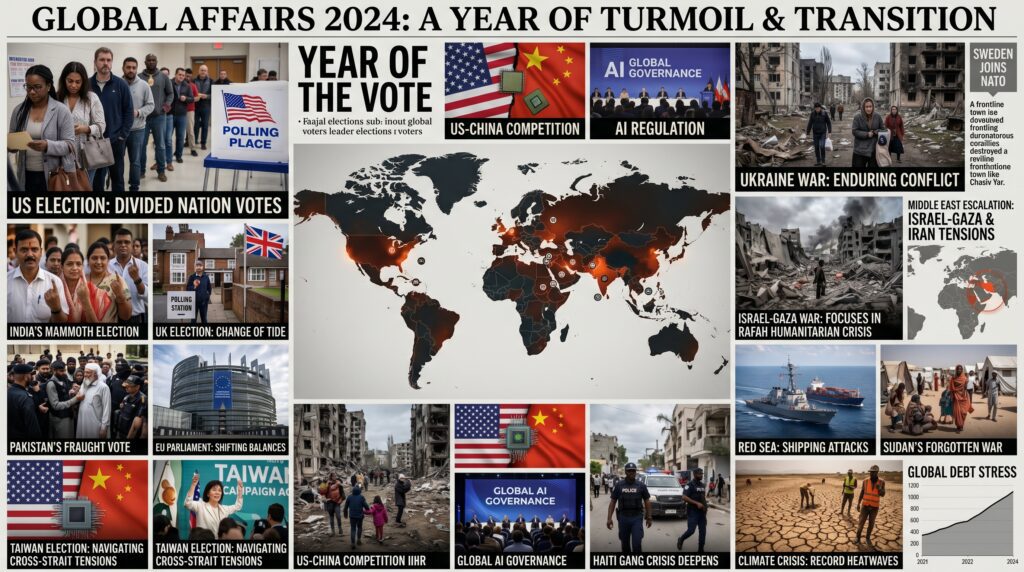
1. Why was 2024 important for global elections?
Discussion: Many countries held major elections, including the United States, India, Russia, Pakistan, the UK, and the European Parliament. These elections shaped debates on democracy, populism, nationalism, and global power.
2. Did 2024 show democracy under pressure?
Discussion: Yes, many elections took place amid polarization, misinformation, legal disputes, and distrust in institutions. Democracy remained active but increasingly contested.
3. Why was the US presidential election globally important?
Discussion: The election affected American foreign policy, NATO, Ukraine, China, climate policy, and global trade. The world watched because US leadership influences almost every region.
4. Did Donald Trump’s return change global expectations?
Discussion: Yes, many allies expected a more nationalist and transactional US foreign policy. Rivals and partners both prepared for changes in American diplomacy.
5. Why was the India election important?
Discussion: India’s election confirmed the country’s central role in global politics. It also showed the importance of democracy, nationalism, economic growth, and regional power in South Asia.
6. Did India remain important for the Global South?
Discussion: Yes, India continued presenting itself as a voice of developing countries. Its role in trade, technology, climate, and diplomacy kept growing.
7. Why was Pakistan’s 2024 election important?
Discussion: Pakistan’s election took place amid political polarization, economic stress, and institutional tension. It showed the country’s continuing struggle with democratic stability.
8. Did Pakistan’s political crisis affect regional stability?
Discussion: Yes, political uncertainty weakened governance and economic confidence. Pakistan’s internal stability remains important for South Asia, Afghanistan, and security policy.
9. Why was the UK election important?
Discussion: The UK election ended a long Conservative period and brought Labour back to power. It changed domestic policy direction and affected Britain’s global posture.
10. Did European Parliament elections show a right-wing shift?
Discussion: Yes, nationalist and right-wing parties gained strength in several countries. Migration, economy, identity, and dissatisfaction with elites shaped the vote.
11. Why was the Ukraine war still central in 2024?
Discussion: Ukraine continued resisting Russia while depending heavily on Western aid. The war remained a major test of NATO unity and European security.
12. Did the Ukraine war become more difficult in 2024?
Discussion: Yes, battlefield pressure, ammunition shortages, and political delays in aid created challenges. Russia tried to exploit Western fatigue.
13. Why did Western aid to Ukraine matter?
Discussion: Ukraine needed weapons, funding, and air defense to continue resistance. Aid decisions directly affected the balance of the war.
14. Did Russia remain under sanctions in 2024?
Discussion: Yes, Western sanctions continued, but Russia adapted through alternative markets and partners. Sanctions created pressure but did not stop the war.
15. Why was NATO still important in 2024?
Discussion: NATO remained central to European defense after Russia’s invasion of Ukraine. Sweden’s NATO membership also strengthened the alliance in northern Europe.
16. Why was Sweden joining NATO historic?
Discussion: Sweden ended its long tradition of military non-alignment. Russia’s invasion of Ukraine changed Nordic security thinking.
17. Did 2024 strengthen Europe’s defense mindset?
Discussion: Yes, European states increased defense spending and military planning. Security became a top priority across the continent.
18. Why was the Israel-Gaza war still important in 2024?
Discussion: The war continued causing massive humanitarian suffering and diplomatic division. Gaza remained central to Middle East instability.
19. Did the Gaza war damage global trust in international law?
Discussion: Yes, debates over civilian casualties, occupation, hostages, and proportionality created deep disagreement. Many states accused global institutions of double standards.
20. Why was Rafah important in the Gaza conflict?
Discussion: Rafah became a major humanitarian and military flashpoint. It was also linked to aid access, displaced civilians, and Egypt’s border concerns.
21. Did the Gaza war increase regional escalation?
Discussion: Yes, Hezbollah, Iran-backed groups, Red Sea attacks, and direct Iran-Israel tensions increased risk. The conflict spread pressure across the Middle East.
22. Why were Iran-Israel tensions important in 2024?
Discussion: Direct attacks and retaliation raised fears of wider regional war. The long shadow conflict became more open and dangerous.
23. Why were Red Sea attacks globally important?
Discussion: Houthi attacks disrupted shipping through a key trade route. This affected global supply chains, insurance costs, and naval security.
24. Did the Red Sea crisis show the vulnerability of global trade?
Discussion: Yes, one regional conflict affected international shipping and prices. It proved that maritime security is central to the world economy.
25. Why was Sudan’s war still important in 2024?
Discussion: Sudan faced mass displacement, hunger, and state collapse. The conflict became one of the world’s worst humanitarian crises.
26. Did Sudan expose weak international crisis response?
Discussion: Yes, the world struggled to stop fighting or deliver enough aid. Sudan showed how some crises receive limited attention despite huge suffering.
27. Why was Haiti’s crisis important in 2024?
Discussion: Gang violence and weak governance pushed Haiti into deeper collapse. The crisis raised questions about intervention, state failure, and regional security.
28. Did Haiti show the danger of state breakdown?
Discussion: Yes, armed groups challenged state authority and public safety. It showed how weak institutions can create humanitarian and security emergencies.
29. Why was US-China rivalry important in 2024?
Discussion: Competition continued over Taiwan, chips, AI, trade, security, and global influence. Both powers tried to manage tension while preparing for long-term rivalry.
30. Why was Taiwan’s 2024 election important?
Discussion: Taiwan’s election affected cross-strait relations and US-China tensions. Beijing watched closely because Taiwan remains a core security issue for China.
31. Did Taiwan remain a global flashpoint?
Discussion: Yes, Chinese military pressure and US support kept tensions high. The Taiwan Strait remained one of the world’s most dangerous areas.
32. Why was technology competition important in 2024?
Discussion: AI, semiconductors, quantum technology, and cyber tools became strategic assets. Technology competition shaped economic power and national security.
33. Did AI become a major global governance issue?
Discussion: Yes, governments debated AI safety, regulation, jobs, misinformation, and military use. AI became both an economic opportunity and a security risk.
34. Why was misinformation important in 2024?
Discussion: Elections and wars made false information more dangerous. AI-generated content increased fears about manipulation and public trust.
35. Did cyber security become more serious in 2024?
Discussion: Yes, states, companies, and elections faced growing cyber threats. Digital infrastructure became a core part of national security.
36. Why was climate change still urgent in 2024?
Discussion: Extreme heat, floods, storms, and wildfires continued to affect many regions. Climate change remained linked with food security, migration, and economic loss.
37. Did 2024 increase climate justice debates?
Discussion: Yes, vulnerable countries demanded more finance for loss, damage, and adaptation. Poorer states argued they suffer most from a crisis they contributed least to.
38. Why were heatwaves important in 2024?
Discussion: Heatwaves affected health, agriculture, energy demand, and labor productivity. They showed that climate change is already affecting daily life.
39. Why was global debt stress important in 2024?
Discussion: Many developing countries faced high debt, inflation, and expensive borrowing. Debt limited spending on health, education, climate, and development.
40. Did the global economy remain fragile in 2024?
Discussion: Yes, inflation, interest rates, wars, supply chain risks, and debt pressures continued. Economic recovery remained uneven across countries.
41. Why was migration still a major issue?
Discussion: Conflict, poverty, climate stress, and political instability pushed people across borders. Migration shaped politics in Europe, the US, and many regions.
42. Did migration strengthen nationalist politics?
Discussion: Yes, border control and identity politics became stronger campaign issues. Humanitarian responsibility and sovereignty remained in conflict.
43. Why was BRICS expansion important in 2024?
Discussion: New members increased the group’s global visibility. It reflected growing interest in alternatives to Western-dominated institutions.
44. Did BRICS become a real challenge to the West?
Discussion: It challenged Western influence symbolically and diplomatically. But internal differences limited its ability to act as one unified bloc.
45. Why was the Global South more vocal in 2024?
Discussion: Developing countries demanded fairer treatment on debt, climate, trade, and conflict diplomacy. They resisted being forced into one side of great-power rivalry.
46. Did 2024 show a more multipolar world?
Discussion: Yes, the US, China, Russia, India, EU, Gulf states, and middle powers all shaped events. Power was more dispersed than before.
47. Why was the Sahel still unstable in 2024?
Discussion: Coups, militant violence, weak states, and foreign influence continued. The region remained a major security challenge in Africa.
48. Did French influence continue declining in parts of Africa?
Discussion: Yes, anti-French sentiment and military governments reduced France’s role in the Sahel. New actors gained influence in the region.
49. Was 2024 a year of elections, wars, and technological anxiety?
Discussion: Yes, major elections, Gaza, Ukraine, Sudan, AI, climate stress, and US-China rivalry shaped the year. The world remained unstable and deeply connected.
50. Why can 2024 be called a year of contested global order?
Discussion: Wars challenged international law, elections tested democracy, and technology reshaped power. Cooperation remained necessary, but mistrust between major actors stayed high.
World Affairs 2025
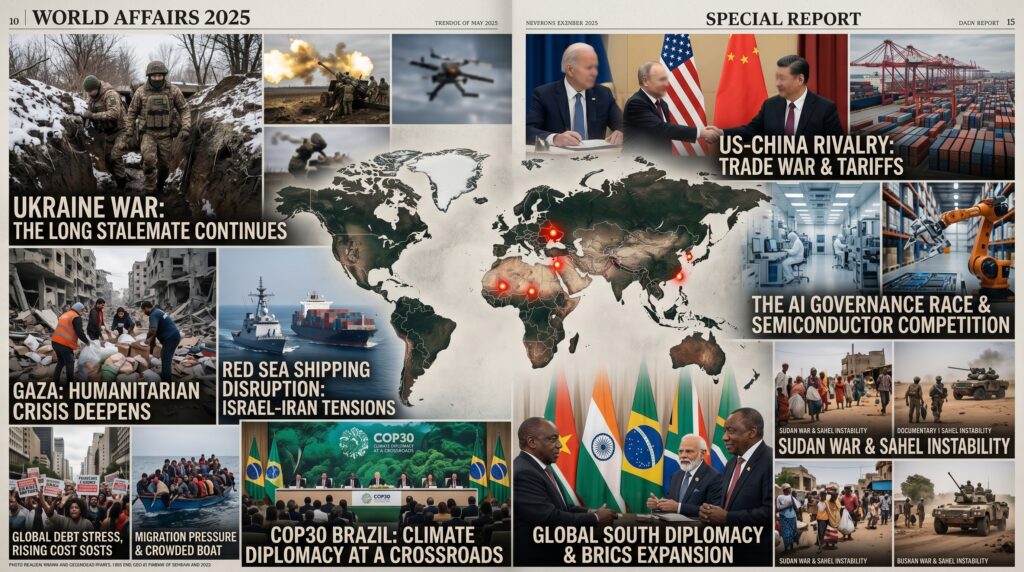
1. Why was 2025 important for the Ukraine war?
Discussion: The war entered another difficult phase with continued Russian attacks and limited battlefield movement. It remained a major test of Western unity and European security.
2. Did the Ukraine war become a war of endurance in 2025?
Discussion: Yes, both sides relied on drones, missiles, manpower, and long-term supply capacity. The conflict showed that modern wars are fought through industry as much as battlefield tactics.
3. Why was Western support for Ukraine still crucial?
Discussion: Ukraine depended on weapons, air defense, intelligence, and financial aid. Any delay in support affected its ability to resist Russian pressure.
4. Did Russia fully overcome Western sanctions?
Discussion: No, sanctions created pressure, but Russia adapted through alternative trade, defense production, and non-Western partners. Sanctions became a long-term pressure tool rather than a quick solution.
5. Why was NATO defense spending important in 2025?
Discussion: The Hague NATO summit focused heavily on higher defense spending and deterrence. This showed that European security had entered a more militarized phase.
6. Did 2025 strengthen NATO’s role?
Discussion: Yes, the Ukraine war kept NATO central to European security. Member states treated Russia as a long-term strategic threat.
7. Why was the Israel-Gaza war still central in 2025?
Discussion: Gaza remained a major humanitarian and diplomatic crisis. The war continued to divide global opinion over security, occupation, civilian harm, and international law.
8. Did Gaza damage global trust in international institutions?
Discussion: Yes, many states and publics accused global institutions of weakness or double standards. The crisis exposed deep moral and political divisions.
9. Why was humanitarian access in Gaza a major issue?
Discussion: Civilians faced severe shortages of food, medicine, shelter, and safety. Aid access became central to ceasefire and diplomatic pressure.
10. Did the Gaza war affect Middle East normalization?
Discussion: Yes, the Palestinian issue returned to the center of regional diplomacy. Normalization efforts became harder while the humanitarian crisis continued.
11. Why was Israel-Iran escalation important in 2025?
Discussion: Military escalation between Israel and Iran raised fears of a wider regional war. It also increased concern over Iran’s nuclear program and US involvement.
12. Did the Israel-Iran crisis change Middle East security?
Discussion: Yes, direct confrontation made the region more dangerous. It showed that proxy conflict could turn into open state-to-state escalation.
13. Why was Iran’s nuclear issue still serious in 2025?
Discussion: The nuclear dispute remained tied to sanctions, regional rivalry, and war risks. Diplomacy struggled because trust between Iran, Israel, and the US was extremely low.
14. Did US involvement increase regional tension?
Discussion: Yes, US policy toward Iran and Israel affected the entire regional balance. Washington’s actions shaped both deterrence and escalation risks.
15. Why were Red Sea and shipping routes still important?
Discussion: Attacks and threats around key sea lanes kept global trade vulnerable. Maritime security became directly linked with Middle East conflict.
16. Why was Donald Trump’s second presidency globally important?
Discussion: His return reshaped expectations on trade, alliances, immigration, climate, Ukraine, and China. Many allies prepared for a more transactional US foreign policy.
17. Did America First return as a global force?
Discussion: Yes, US policy again emphasized tariffs, borders, and national advantage. This challenged multilateral cooperation and traditional alliance habits.
18. Why were 2025 tariffs important for the global economy?
Discussion: New US tariff policies increased trade uncertainty and affected partners including China, Canada, and Mexico. Trade policy became a major geopolitical weapon again.
19. Did 2025 show the return of trade wars?
Discussion: Yes, tariffs and retaliation increased pressure on supply chains and markets. Globalization became more conditional and politically contested.
20. Why was US-China rivalry still central?
Discussion: The rivalry continued across trade, semiconductors, AI, rare earths, Taiwan, and military influence. It remained the main structural competition in world politics.
21. Why were rare earth minerals important in 2025?
Discussion: China’s leverage over rare earths showed that supply chains can become strategic weapons. These minerals are vital for defense, energy, and advanced technology.
22. Did technology become more geopolitical in 2025?
Discussion: Yes, chips, AI, data, cyber tools, and rare earths became instruments of power. States treated technology as national security infrastructure.
23. Why was AI governance important in 2025?
Discussion: The Paris AI Action Summit showed rising concern over AI safety, regulation, innovation, and global access. AI became a major diplomatic issue.
24. Did AI increase global competition?
Discussion: Yes, countries competed over computing power, models, data, and talent. AI became connected with military, economic, and political influence.
25. Why was AI misinformation dangerous in 2025?
Discussion: AI tools made fake images, videos, and political content easier to produce. This increased risks for elections, public trust, and social stability.
26. Why was global conflict intensity alarming in 2025?
Discussion: Reports described 2025 as one of the deadliest post-Cold War years, driven by Ukraine, Sudan, and Gaza. Civilian harm became a major global concern.
27. Why was Sudan’s war still important in 2025?
Discussion: Sudan remained one of the world’s worst humanitarian crises. Fighting, hunger, displacement, and weak diplomacy exposed the limits of international response.
28. Did Sudan show global attention inequality?
Discussion: Yes, despite massive suffering, Sudan received less attention than some other conflicts. This showed how geopolitics often shapes humanitarian visibility.
29. Why was the Sahel still unstable in 2025?
Discussion: Coups, militant violence, anti-Western sentiment, and weak governance continued. The region remained a major security challenge for Africa and Europe.
30. Did African coups reshape global influence?
Discussion: Yes, military governments looked for new partners beyond traditional Western allies. This opened space for Russia, China, Turkey, and regional actors.
31. Why was the G20 Johannesburg summit important?
Discussion: It was the first G20 summit held on the African continent. The summit highlighted Global South priorities such as debt, inequality, climate, and development.
32. Did the Global South become more vocal in 2025?
Discussion: Yes, developing countries demanded fairer treatment on trade, finance, climate, and conflict diplomacy. They resisted being forced into one great-power camp.
33. Why was BRICS important in 2025?
Discussion: BRICS tried to present itself as an alternative voice in global governance. Its agenda reflected frustration with Western-dominated institutions.
34. Did BRICS become a united anti-Western bloc?
Discussion: No, BRICS had growing visibility but also internal divisions. Its members had different interests on trade, war, finance, and security.
35. Why was COP30 important in 2025?
Discussion: COP30 in Brazil kept climate diplomacy focused on the 1.5°C target, finance, forests, and climate justice. Small island states pushed strongly for survival-focused action.
36. Did COP30 solve climate problems?
Discussion: No, it kept negotiations alive but did not remove the gap between promises and action. Climate finance and fossil fuel dependence remained major obstacles.
37. Why was the Amazon important in climate politics?
Discussion: Brazil’s COP30 role made the Amazon central to climate diplomacy. Forest protection became linked with biodiversity, Indigenous rights, and global emissions.
38. Did climate change remain a security issue in 2025?
Discussion: Yes, heat, floods, fires, food stress, and migration risks kept climate tied to security. Climate damage increasingly affected political stability.
39. Why was global debt stress important in 2025?
Discussion: Many developing countries faced high borrowing costs, weak currencies, and limited fiscal space. Debt reduced their ability to invest in climate, health, and development.
40. Did inflation and tariffs pressure the global economy?
Discussion: Yes, trade tensions, policy uncertainty, and high costs created economic stress. The IMF warned that policy shifts and complex forces shaped the 2025 outlook.
41. Why was migration still a major issue in 2025?
Discussion: Conflict, poverty, climate stress, and political instability continued pushing people across borders. Migration remained tied to security, identity, and humanitarian responsibility.
42. Did migration politics strengthen nationalism?
Discussion: Yes, border control and anti-immigration politics remained powerful in many countries. Migration became a key issue in domestic and international politics.
43. Why was Syria’s transition important in 2025?
Discussion: Syria’s political uncertainty after years of war remained a major regional concern. Any transition carried risks of instability, foreign influence, and institutional collapse.
44. Did the Middle East move toward peace in 2025?
Discussion: There were talks and ceasefire efforts, but not real peace. Gaza, Iran, Lebanon, Yemen, and Syria kept the region unstable.
45. Why was digital news trust important in 2025?
Discussion: The Reuters Institute reported a media environment shaped by political uncertainty, conflict, climate breakdown, and changing alliances. Trust in information became part of democratic resilience.
46. Did information warfare become more serious?
Discussion: Yes, wars, elections, AI, and social media made narratives harder to control. Public opinion became a strategic battlefield.
47. Why was democracy under pressure in 2025?
Discussion: Polarization, misinformation, populism, war, and economic stress weakened trust in institutions. Democratic systems had to manage both internal division and external interference.
48. Did 2025 show a more multipolar world?
Discussion: Yes, the US, China, Russia, India, EU, Gulf states, BRICS, and middle powers all shaped events. Power was more dispersed and harder to coordinate.
49. Was 2025 a year of wars, tariffs, AI, and climate pressure?
Discussion: Yes, Ukraine, Gaza, Iran, trade wars, AI governance, debt, migration, and COP30 all shaped world affairs. The year showed overlapping crises across security, economy, and technology.
50. Why can 2025 be called a year of hard power and fragmented globalization?
Discussion: Military conflict, sanctions, tariffs, technology controls, and climate bargaining defined global politics. Cooperation continued, but mistrust between major actors remained very high.
World Affairs 2026
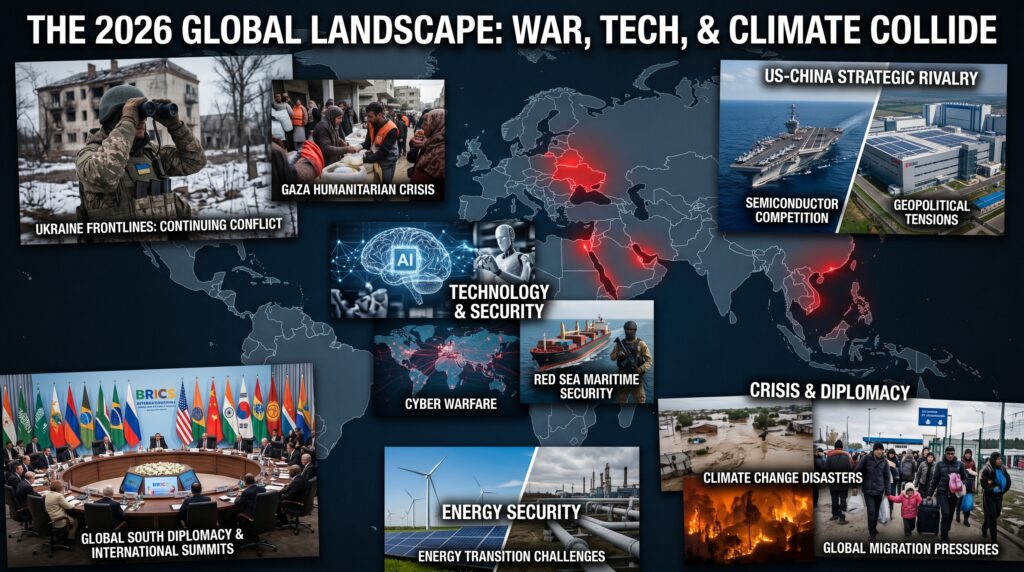
1. Why is 2026 important for world affairs so far?
Discussion: 2026 is being shaped by war, AI, trade tensions, climate stress, and weak global cooperation. Global risk reports highlight geoeconomic confrontation, AI anxiety, and geopolitical shocks as major concerns.
2. Why is the Ukraine war still central in 2026?
Discussion: The war remains a major test of European security and Western support. Reports in June 2026 show continued fighting and shifting battlefield pressure.
3. Has Ukraine become a long war of endurance?
Discussion: Yes, both sides depend on drones, missiles, manpower, and defense production. The conflict is now as much about supply capacity as battlefield strategy.
4. Why is NATO still important in 2026?
Discussion: NATO remains central because Russia is treated as a long-term threat. European states are focusing more on deterrence, defense spending, and military readiness.
5. Why is Gaza still a major world issue in 2026?
Discussion: Gaza remains in a severe humanitarian crisis, with displacement, poor sanitation, limited water, and daily insecurity. OCHA reported overcrowding, waste buildup, and disease risks in June 2026.
6. Did Gaza damage trust in international law?
Discussion: Yes, the war created deep arguments over civilian protection, proportionality, occupation, hostages, and accountability. Many people see global institutions as weak or selective.
7. Why is humanitarian access in Gaza important?
Discussion: Aid, clean water, medicine, shelter, and sanitation are essential for civilian survival. Restrictions and insecurity make relief work extremely difficult.
8. Why is Israel-Iran tension dangerous in 2026?
Discussion: Any direct escalation can spread across Lebanon, Syria, Iraq, Yemen, and the Gulf. The issue is also linked with Iran’s nuclear program and US policy.
9. Why are Red Sea shipping routes important?
Discussion: Red Sea instability threatens one of the world’s most important trade corridors. Attacks or disruption can raise shipping costs and affect global supply chains.
10. Why is the Middle East still unstable in 2026?
Discussion: Gaza, Iran, Lebanon, Yemen, Syria, and maritime security remain connected. One crisis can quickly affect the whole region.
11. Why is geoeconomic confrontation a major risk in 2026?
Discussion: Trade, tariffs, sanctions, supply chains, and technology controls are now used as power tools. The World Economic Forum ranked geoeconomic confrontation as a top short-term risk.
12. Is globalization becoming more fragmented in 2026?
Discussion: Yes, countries are reducing dependence on rivals and protecting strategic industries. Global trade continues, but trust is weaker.
13. Why is US-China rivalry central in 2026?
Discussion: The rivalry affects technology, Taiwan, trade, AI, chips, rare earths, and military strategy. It remains the main structural competition in global politics.
14. Why are semiconductors important in 2026?
Discussion: Chips power AI, weapons, vehicles, phones, and data centers. Control over chip supply chains gives states economic and military advantage.
15. Why are rare earth minerals strategic?
Discussion: Rare earths are essential for defense, clean energy, electronics, and advanced manufacturing. Control over them can become political leverage.
16. Why is AI governance important in 2026?
Discussion: AI affects jobs, misinformation, cyber security, education, military planning, and economic power. Governments are trying to regulate AI without losing innovation.
17. Does AI increase misinformation risks?
Discussion: Yes, AI can create fake videos, images, voices, and political content. This makes elections, news, and public trust more vulnerable.
18. Why is cyber security a major issue in 2026?
Discussion: States, banks, hospitals, elections, and infrastructure depend on digital systems. Cyberattacks can now create real political and economic damage.
19. Why is climate change still urgent in 2026?
Discussion: Heatwaves, floods, storms, droughts, and food insecurity continue to affect many regions. Climate is now a security, economic, and humanitarian issue.
20. Why is climate adaptation more important now?
Discussion: Many countries are already facing climate damage. Adaptation means preparing for floods, heat, water stress, and disaster risks.
21. Why is climate finance still controversial?
Discussion: Developing countries demand support for damage they did not mainly create. Rich countries face pressure to fund adaptation and loss-and-damage support.
22. Why is global debt stress important in 2026?
Discussion: Many developing states face high borrowing costs and weak currencies. Debt limits spending on health, education, climate protection, and development.
23. Why is inflation still politically sensitive?
Discussion: Food, energy, housing, and borrowing costs affect ordinary people directly. Inflation can weaken governments and increase protest politics.
24. Why is migration still a major world issue?
Discussion: War, poverty, climate stress, and weak governance push people across borders. Migration creates humanitarian duties and political tensions.
25. Does migration strengthen nationalist politics?
Discussion: Yes, many parties use border control, identity, and security concerns to gain support. Migration remains one of the most emotional issues in politics.
26. Why is Sudan still important in 2026?
Discussion: Sudan remains a major humanitarian crisis with war, hunger, displacement, and weak state control. It shows how ignored conflicts can become regional disasters.
27. Why is the Sahel unstable in 2026?
Discussion: Military coups, militant violence, weak governance, and foreign competition continue. The region is a major test for African security.
28. Why is Haiti important in global affairs?
Discussion: Haiti shows the danger of state collapse, gang power, and weak institutions. Its crisis affects migration, humanitarian aid, and regional security.
29. Why is Afghanistan still a global concern?
Discussion: Taliban rule, women’s rights restrictions, economic hardship, and security risks remain major issues. Afghanistan is still diplomatically isolated.
30. Why are women’s rights in Afghanistan important?
Discussion: Restrictions on education, work, and public life are central human rights concerns. They also affect Afghanistan’s development and international recognition.
31. Why is Iran’s nuclear issue still unresolved?
Discussion: Trust between Iran, the US, Israel, and European powers remains weak. Nuclear progress, sanctions, and regional conflict keep the issue dangerous.
32. Why is Taiwan still a flashpoint?
Discussion: Taiwan sits at the center of US-China rivalry. Military pressure, political identity, and chip supply chains make it globally important.
33. Why is the Indo-Pacific important in 2026?
Discussion: The region contains major trade routes, powerful economies, and strategic rivalries. China, the US, India, Japan, Australia, and ASEAN all shape its future.
34. Why is India important in world affairs?
Discussion: India is a major economy, democracy, military power, and Global South voice. Its choices affect trade, climate, technology, and Indo-Pacific security.
35. Why is Pakistan’s stability important?
Discussion: Pakistan’s politics, economy, nuclear status, and Afghanistan border make it regionally important. Internal instability can affect South Asian security.
36. Why is the Global South more vocal in 2026?
Discussion: Developing countries demand fairer rules on debt, climate, trade, technology, and conflict diplomacy. They do not want to be forced into one power bloc.
37. Why is BRICS important in 2026?
Discussion: BRICS reflects dissatisfaction with Western-dominated institutions. However, its members have different interests, so unity remains limited.
38. Does multipolarity make cooperation harder?
Discussion: Yes, more power centers mean more bargaining and disagreement. Cooperation is still necessary, but global consensus is harder to build.
39. Why is information warfare important in 2026?
Discussion: Wars, elections, AI, and social media make narratives powerful. Public opinion has become part of strategic competition.
Read More : 𝐏𝐚𝐤𝐢𝐬𝐭𝐚𝐧 𝐇𝐢𝐬𝐭𝐨𝐫𝐲
40. Why is democracy under pressure in 2026?
Discussion: Polarization, misinformation, corruption, inequality, and authoritarian influence weaken trust. Elections continue, but democratic confidence is fragile.
41. Why are elections vulnerable in the AI age?
Discussion: Deepfakes, bots, data manipulation, and targeted propaganda can influence voters. Election security now includes digital information security.
42. Why is energy security still important?
Discussion: Wars and sanctions can disrupt oil, gas, and shipping routes. Energy dependence can become a national security weakness.
43. Why are food prices a global concern?
Discussion: War, climate shocks, fertilizer costs, and trade disruption affect food supply. Poor countries are hit hardest when prices rise.
44. Why is maritime security important in 2026?
Discussion: Global trade depends on safe sea routes. Disruption in the Red Sea, Black Sea, or South China Sea can affect the world economy.
45. Why is international law under stress?
Discussion: Wars in Gaza, Ukraine, and other regions create accusations of double standards. Powerful states and allies often disagree over enforcement.
46. Why are humanitarian crises becoming more political?
Discussion: Aid access, sanctions, borders, and recognition are often tied to political goals. Human suffering becomes harder to separate from geopolitics.
47. Why is global health still important after COVID-19?
Discussion: The pandemic showed that disease can disrupt economies and security. Weak health systems remain a global vulnerability.
48. Why is trust in media important in 2026?
Discussion: People need reliable information during wars, elections, disasters, and health crises. Low trust makes societies easier to manipulate.
49. Is 2026 a year of fragmented global order?
Discussion: Yes, wars, AI, trade rivalry, climate stress, debt, and weak institutions show fragmentation. Power is spread across more actors, but cooperation is weaker.
50. Why can 2026 be called a year of uncertainty so far?
Discussion: The year is still unfolding, but major trends are already clear: hard-power politics, AI competition, climate pressure, humanitarian crises, and economic insecurity. The global order remains unstable and contested.